What the Dunning-Kruger Effect Test measures
This quiz does not measure general intelligence, assign an IQ number, or diagnose cognitive disorders. It measures how much you agree with introductory metacognition literacy grouped four ways: effect concept statements about domain-specific gaps between self-ratings and performance; calibration literacy about comparing confidence to answer keys, practice tests, and explain-it-back checks; overconfidence myths about memes, IQ shortcuts, and what this screener is not; and learning humility about retesting, expert doubt on hard tasks, and updating beliefs after feedback. You answer 22 statements from strongly disagree to strongly agree, with reverse-worded traps so agreeing with every shortcut cannot inflate every bar. Your answers also feed a second chart on closeness and trust habits, because classrooms and online debates sometimes reward loud confidence instead of accurate self-assessment. The total becomes an index from 0 to 100 where higher means more reported metacognition literacy on this screener, not proof you are smarter than other people.
Effect concept
Domain-specific overconfidence, metacognition, and what Dunning-Kruger research actually studied.
Calibration literacy
Rubrics, practice scores, explain-it-back checks, and feedback that align confidence with evidence.
Overconfidence myths
IQ memes, permanent traps, and why this quiz is literacy, not intelligence testing.
Learning humility
Retests, expert doubt, mistakes as data, and recalibrating after new results.
How it works
Answer 22 agreement items
Rate each statement from Strongly disagree to Strongly agree. Tap Next after each answer.
Answers sort into four domains
Each answer feeds one of four metacognition groups, and every item also feeds a closeness and trust layer.
See your index and charts
You get a 0 to 100 index, a band, and two bar charts you can use before a study session.
Take the Dunning-Kruger Effect Test
Answer 22 short statements to see your metacognition literacy index, four domain bars, and a closeness and trust chart.
What your result means
Your index is the average of all 22 answers, scaled from 0 to 100, with reverse-worded items flipped first. Higher means more reported metacognition literacy on this screener. Read overconfidence myth and calibration bars together before you treat the total as proof you never overestimate in every subject.
| Band | Index range | Typical reading |
|---|---|---|
| Building metacognition literacy | 0 to 35 | Fewer agreed facts about the effect, calibration, myths, or humility habits on this screener. |
| Mixed metacognition literacy | 36 to 65 | Solid habits in some domains with traps on IQ myths, online rank games, or confidence-only proof. |
| Strong metacognition literacy | 66 to 100 | Frequent agreement with effect framing, calibration, myth correction, and humility habits on this screener. |
Tips at a glance
A quick takeaway graphic with topic tips (not your personal quiz scores). Start the quiz for your index, bands, and charts.
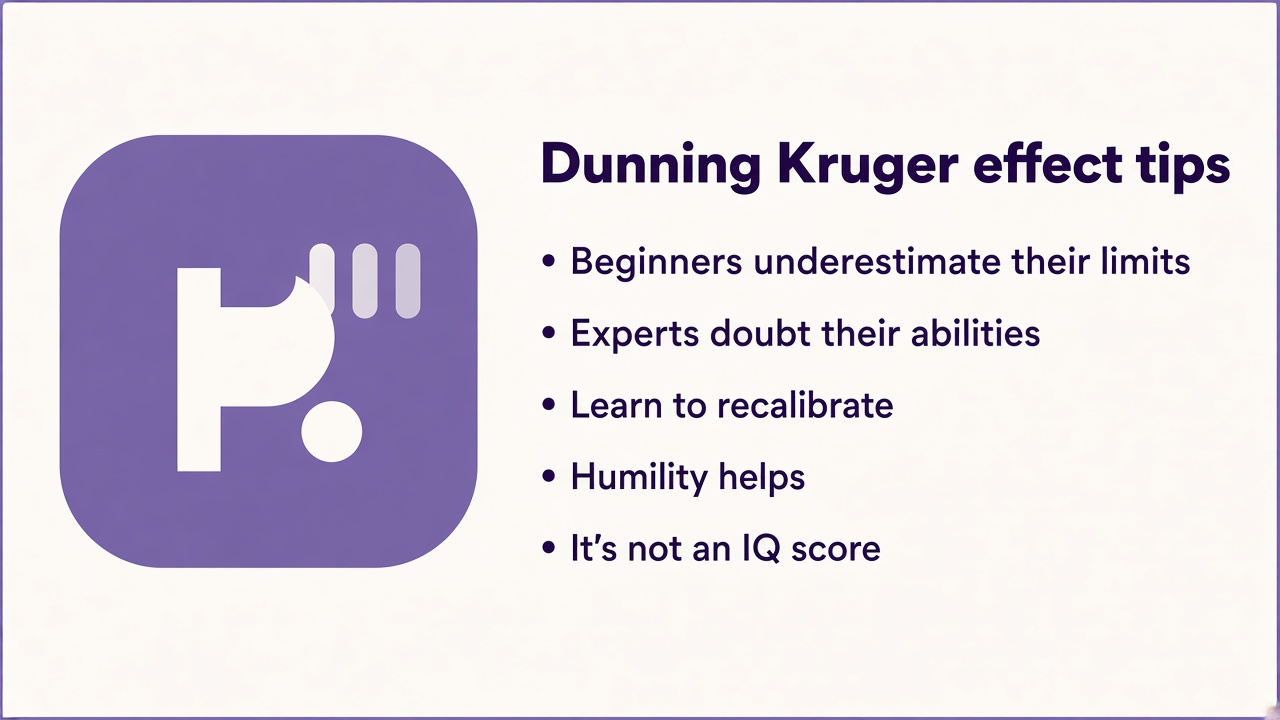
What this quiz can and cannot tell you
Can tell you
- Clarify domain-specific Dunning-Kruger findings in plain language
- Highlight calibration habits worth trying before you claim mastery
- Separate literacy practice from IQ testing and meme shortcuts
- Give you a retake baseline during a psychology or study-skills unit
Cannot tell you
- Measure general intelligence, IQ, or giftedness from one online screener
- Replace tutoring, graded exams, or licensed psychological assessment
- Cover every bias catalog, such as full cognitive bias batteries or clinical metacognition scales
- Prove you will never overestimate yourself under stress on every topic
Metacognition literacy beyond the confidence meme
Students search Dunning-Kruger when a classmate sounds sure while missing obvious errors, or when they feel like the only person who still does not get it despite hours of study. The original findings describe a metacognitive gap inside a particular task: people who lack skill in that task also lack cues to spot their mistakes, so self-ratings can run ahead of performance until practice and feedback catch up. That is not a license to call strangers stupid, and it is not a global scoreboard of who is smartest in the room.
Calibration is the everyday skill this screener emphasizes. Before you tell yourself you crushed a unit, compare confidence to something concrete: a practice quiz, a rubric, an explain-it-back conversation, or a teacher comment on one worked problem. Confidence that never meets evidence is a warning sign in any subject, including topics where you usually excel. Reverse items catch the habit of treating online rank games or trivia streaks as permanent proof of rank.
Experts doubt for a different reason than beginners overestimate. Skilled people often see nuance, edge cases, and how much they still have not read, so self-ratings on hard tasks can look modest even when performance is strong. That pattern is related to impostor feelings but not identical to the beginner overconfidence meme. Humility that invites correction usually teaches faster than defending a wrong answer to protect ego, especially in math, writing, labs, and languages where errors are visible once someone shows your step.
Myth busting matters because bad summaries hurt study habits. High IQ does not vaccinate anyone against overconfidence in a new domain. One low score on a fun quiz does not trap you forever at the bottom of a cartoon curve. This Dunning-Kruger effect test is agree-or-disagree literacy about those ideas, not an intelligence exam. If you need formal cognitive testing, seek qualified professionals with standardized tools, not a 22-item screener.
Use this tool as a warm-up, not a verdict. Pair it with one retest after studying and our drama terms quiz when you want another low-stakes literacy break on the same hub. Browse the IQ and cognitive test hub for more study games that label themselves honestly. Retake after you compare confidence to a practice score in one class; literacy grows when recalibration becomes habit, not when you memorize that Dunning starts with D and hope humility follows on exam day.
| Test | Focus |
|---|---|
| Drama terms quiz | Theater vocabulary and rehearsal literacy, not metacognition or IQ |
| On topic metacognition | Broader metacognition habits, not Dunning-Kruger framing alone |
Dunning-Kruger Effect Test FAQ
What does this quiz measure?
It measures how much you agree with introductory metacognition literacy about the Dunning-Kruger effect, calibration habits, common myths, and learning humility. You get an index from 0 to 100 and four bars. It reflects self-reported agreement on this screener, not an IQ score or clinical diagnosis.
Is this an IQ test?
No. It builds literacy about overconfidence, calibration, and recalibration for study practice. Formal intelligence testing uses standardized batteries administered by qualified professionals, not this screener.
Why do some statements sound like common mistakes?
Reverse-worded traps catch shortcuts. Agreeing that low IQ always causes global overconfidence, that confidence replaces explain-it-back checks, or that this quiz measures IQ should not inflate your literacy index.
Does a high score mean I never overestimate myself?
No. A higher literacy index means you agreed with accurate framing and habits on this tool today. People still misjudge specific topics under stress, fatigue, or social pressure. Use practice scores and feedback to recalibrate in real tasks.
Who reviewed this quiz?
Dr. James Whitfield, PhD reviewed the educational framing, metacognition literacy limits, and result explanations. See our editorial policy for review standards.
Reviewed by