
What Ephesians Quiz measures
This quiz does not ordain ministers, certify seminary graduates, or speak for any denomination. It measures how much you agree with literacy statements grouped four ways: context not proof-text about letter genre, chapter flow, historical household language, and resisting single-line weapons; grace and unity themes about reconciliation, one body imagery, and armor as encouragement not harassment; Paul and audience humility about authorship study, Roman-era setting, respectful disagreement, and kindness to kids in faith spaces; and Ephesians quiz limits about unofficial screeners, refusing pulpit fantasies, and captioning shares as trivia not divine instruction. You rate 22 statements from strongly disagree to strongly agree, with reverse-worded traps so one hot take cannot inflate every bar. Your answers also feed a second chart on closeness and trust habits, because performative scripture drops sometimes chase belonging over honest study. The total becomes an index from 0 to 100 where higher means more reported literacy habits on this screener, not proof clergy approved your feed.
Context not proof-text
Letter flow, setting, and chapter reading before verse dunking.
Grace and unity themes
Reconciliation and one body language without harassment passes.
Paul and audience humility
Roman setting, study questions, and respectful disagreement.
Ephesians quiz limits
Unofficial trivia only; seminary and pastoral care stay separate.
How it works
Answer 22 agreement items
Rate each statement from Strongly disagree to Strongly agree. Tap Next after each answer.
Answers sort into four domains
Each answer feeds one of four Ephesians literacy groups, and every item also feeds a closeness and trust layer.
See your index and charts
You get a 0 to 100 index, a band, four domain bars, and a second chart for intimacy habits.
Take the Ephesians Quiz
Answer 22 short statements to see your Ephesians literacy index, four domain bars, and a closeness and trust chart.
What your result means
Your index is the average of all 22 answers, scaled from 0 to 100, with reverse-worded items flipped first. Read unofficial limits with context bars before you treat a high grace score as permission to proof-text strangers. Literacy supports kinder study talk; pastors and teachers still matter for hard questions.
| Band | Index range | Typical reading |
|---|---|---|
| Building Ephesians literacy | 0 to 35 | Fewer agreed facts on context, grace themes, audience humility, or unofficial limits on this screener. |
| Mixed Ephesians literacy | 36 to 65 | Solid recall in some domains with proof-text traps, grace myths, or seminary fantasy slips in others. |
| Strong Ephesians literacy | 66 to 100 | Frequent agreement with context, grace, audience humility, and unofficial limits; still not licensing. |
Tips at a glance
A quick takeaway graphic with topic tips (not your personal quiz scores). Start the quiz for your index, bands, and charts.
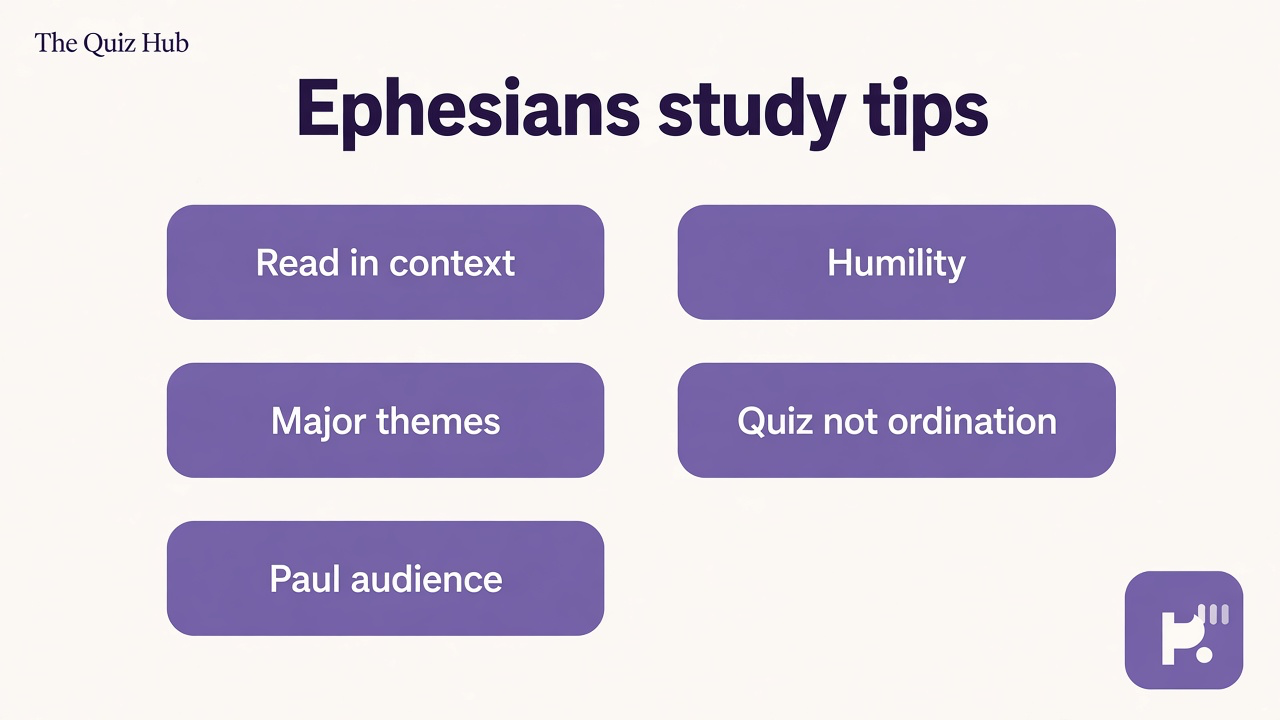
What this quiz can and cannot tell you
Can tell you
- Highlight context, grace, and humility habits worth revisiting before study group
- Separate unofficial literacy from ordination or publisher fantasies
- Encourage full-chapter reading before verse drops in chat
- Spark honest talk with friends about unofficial captions on shares
Cannot tell you
- Ordain ministers or certify seminary degrees from one online screener
- Speak for any church body, publisher, or translation committee
- Replace pastoral care, counseling, or instructor feedback on sacred text
- Turn literacy scores into harassment, proof-text pile-ons, or purity tests
Ephesians literacy before proof-text cosplay
Ephesians search intent often blends two needs: prove you remember major themes for study group, and claim a share lane that feels faithful in mixed chats. Those goals help when they spark context reading and humility questions. They hurt when meme scores become licenses to bait prayer groups, or when threads blur parody into proof that someone is holier than believers who opt out.
Dr. James Whitfield reviews fun novelty screeners with a simple split: reward honest context habits and honest limits on seminary pretense at the same time. Context not proof-text tracks letter flow and setting without single-line weapons. Grace and unity themes tracks reconciliation language without holy harassment passes. Paul and audience humility keeps Roman setting and respectful disagreement visible. Ephesians quiz limits keeps screeners, publishers, and pastoral offices separate from bar height.
Real readers mix bars. You may score high grace while keeping context moderate, which often describes strong theme memory before setting notes land. You may score high context with softer limit items, which can mean good reading habits plus occasional unofficial caption slips. Reverse items catch sloppy answers: verse weapons without chapters, grace as argument license, bishop citation fantasies, or pile-ons tied to high bars should not inflate charts meant to track humble literacy.
Pair results with siblings on this hub instead of forcing one faith story. Our bible verse quiz leans straight scripture recall when you want citation trivia without letter-context framing. Our emoji bible quiz stays on pictograph meme lanes when you want Gen Z humor separate from book study. Browse the fun and novelty hub for more light screeners. Caption shares unofficial, read the room, and skip bait threads on friends who never opted in.
Study seasons shift faster than one sermon series. When you share results, say context and kindness beat scoreboard. When you borrow tips, credit partners who read whole chapters and pastors who welcome questions. Retake after a lent or small-group block and watch whether context bars rise even if grace trivia felt easy, which often means you separated performative verse drops from actual listening.
| Test | Focus |
|---|---|
| Bible verse quiz | Straight scripture recall and citation trivia rather than Ephesians letter-context literacy bars |
| Emoji bible quiz | Pictograph meme format lanes rather than book themes and Paul audience humility |
Ephesians Quiz FAQ
What does Ephesians Quiz measure?
It measures how much you agree with statements about reading Ephesians in context, grace and unity themes, Paul and audience humility, and unofficial quiz limits. You get an index from 0 to 100 plus four bars. It describes self-reported literacy habits on this screener, not ordination readiness or church endorsement.
Is this affiliated with my church or publisher?
No. The Quiz Hub wrote this page without partnership from any church body, publisher, or translation committee. Licensed study tools and pastoral offices exist separately.
Does a high score mean I should proof-text in every debate?
No. High bars mean you related to literacy statements here. Context items explicitly reward chapter reading and respectful disagreement; verse drops without listening still harm mixed groups.
Why include Paul and audience items?
Ephesians study blends theology with history. Audience humility keeps Roman setting and kindness norms visible without turning trivia into harassment licenses.
Who reviewed this quiz?
Dr. James Whitfield, PhD reviewed the unofficial framing, faith respect limits, and result explanations. See our editorial policy for review standards.
Reviewed by
