
What Environmental Science Quiz measures
This quiz does not grade AP exams, publish research, or certify activism. It measures how much you agree with study-habit statements grouped four ways: systems thinking and cycles about energy flow, water and nutrient connections, human inputs, feedback, and context beyond single-villain stories; data units and field notes about labeled numbers, observation logs, correlation versus causation, and magnitude checks; skeptical sources about funding, methods, peer review as a starting point, updating beliefs, and rejecting viral-method-free certainty; and environmental science limits about study screeners, refusing AP-key fantasies, separating learning from dunk culture, and academic integrity. You rate 22 statements from strongly disagree to strongly agree, with reverse-worded myths so one passionate thread cannot inflate every bar. Your answers also feed a second chart on closeness and trust habits, because debate performance sometimes chases belonging over honest study. The total becomes an index from 0 to 100 where higher means more reported study literacy on this screener, not proof you aced the AP or won a policy fight.
Systems thinking and cycles
Energy flow, water and nutrients, human inputs, feedback, and context.
Data, units, and field notes
Labeled numbers, observation logs, and correlation humility.
Skeptical sources
Methods, funding, peer review starts, and belief updates without harassment.
Environmental science limits
Study screener only; exams, labs, and kindness stay primary.
How it works
Answer 22 agreement items
Rate each statement from Strongly disagree to Strongly agree. Tap Next after each answer.
Answers sort into four domains
Each answer feeds one of four environmental science literacy groups, and every item also feeds a closeness and trust layer.
See your index and charts
You get a 0 to 100 index, a band, and two bar charts you can compare after a unit or midterm week.
Take the Environmental Science Quiz
Answer 22 short statements to see your environmental science literacy index, four domain bars, and a closeness and trust chart.
What your result means
Your index is the average of all 22 answers, scaled from 0 to 100, with reverse-worded items flipped first. Read ES limits with data bars before you treat a high systems score as permission to skip units or dunk peers. Literacy supports better study talk; exams still need your instructor rubric.
| Band | Index range | Typical reading |
|---|---|---|
| Building environmental science literacy | 0 to 35 | Fewer agreed facts on systems, data, sources, or ES limit items on this screener. |
| Mixed environmental science literacy | 36 to 65 | Solid habits in some domains with cycle myths, unlabeled charts, or activism dunk traps in others. |
| Strong environmental science literacy | 66 to 100 | Frequent agreement with systems, data, source, and limit habits; still not licensing. |
Tips at a glance
A quick takeaway graphic with topic tips (not your personal quiz scores). Start the quiz for your index, bands, and charts.
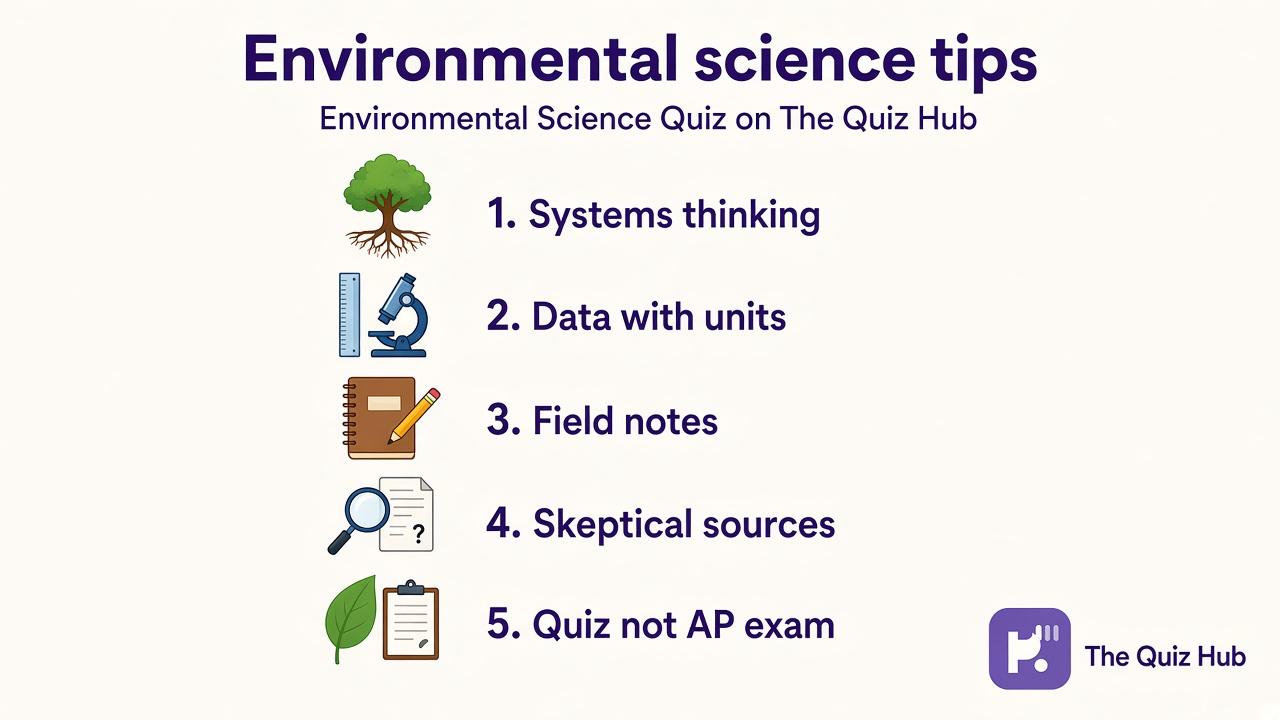
What this quiz can and cannot tell you
Can tell you
- Highlight cycles, data, and source habits worth revisiting before labs and tests
- Separate class study literacy from activism dunk culture
- Encourage field-note and unit-label habits before graph debates
- Spark better study group talk about evidence and feedback loops
Cannot tell you
- Issue AP Environmental Science scores or college credit from one online screener
- Replace lab notebooks, instructor rubrics, or academic integrity policies
- Prove policy positions or authorize harassment of classmates
- Turn literacy scores into fabricated data or fake research credentials
Environmental science study habits before debate cosplay
Environmental science search intent often blends two needs: sound prepared before unit tests without rereading every slide deck, and check whether cycles and units still line up after a week of headlines. Those goals help when readers treat bars as a study map, not a debate trophy. They hurt when people treat scores like AP keys, skip unit labels because systems trivia felt easy, or dunk classmates whose policy views differ.
Dr. James Whitfield reviews iq cognitive study screeners with a simple split: reward honest agreement with widely taught systems and data facts and honest limits on exam and dunk hype at the same time. Systems thinking and cycles tracks energy flow, water and nutrients, and feedback without habitat-never-compensates myths. Data units and field notes keeps labeled numbers and observation logs separate from unlabeled chart vibes. Skeptical sources keeps methods and funding visible without harassment dressed as skepticism. Environmental science limits keeps screeners, AP pathways, and lab integrity visible beside thread-war stress.
Real readers mix bars. You might score high on cycles while keeping data moderate, which often describes strong diagram memory before unit discipline lands. You might score high on skeptical sources with softer field-note items, which can mean good headline habits yet rushed lab logs. Reverse items catch sloppy answers: insisting extinction ends all cycles, approving axis-free charts, trusting viral posts as final science, or inventing data from quiz scores should not inflate bars meant to track layered study habits.
Pair results with siblings on this hub instead of forcing one class story. Our climate change quiz leans policy and mechanism recall when your syllabus overlaps atmosphere units. The ecology quiz stays on species and food-web relationships at intro depth. Browse the IQ and cognitive test hub for more study screeners. Caption shares as study practice and keep kindness in policy disagreements.
Syllabi shift faster than one midterm. When you share results, say units and field notes beat scoreboard. When you borrow study tips, credit teachers who enforce integrity and classmates who ask good methods questions. Retake after labs week and watch whether data bars rise even if cycles trivia lags, which often means you separated performative debating from actual notebook habits.
| Test | Focus |
|---|---|
| Climate change quiz | Climate mechanism and policy recall rather than full ES study-habit literacy across cycles and labs |
| Ecology quiz | Species and food-web relationships rather than data units and skeptical source habits |
Environmental Science Quiz FAQ
What does Environmental Science Quiz measure?
It measures how much you agree with statements about systems thinking and cycles, data with units and field notes, skeptical sources, and ES quiz limits. You get an index from 0 to 100 plus four bars. It describes self-rated study literacy on this screener, not AP exam scores or research credentials.
Is this an AP Environmental Science practice exam?
No. This page builds study-habit reflection aligned with common class themes. Official AP materials and your instructor govern exam preparation.
Does a high score mean I should win every climate debate?
No. High bars mean you related to study-habit statements here. Policy disagreements still deserve evidence, respect, and classroom rules beyond any screener.
Why include skeptical source items?
Environmental science classes ask you to read graphs and studies, not only memorize cycles. Source habits stay separate from harassment; skepticism means asking methods questions, not attacking people.
Who reviewed this quiz?
Dr. James Whitfield, PhD reviewed the educational framing, cycles-not-dunk limits, and result explanations. See our editorial policy for review standards.
Reviewed by
