What Ecology Quiz measures
This quiz does not certify you as a professional ecologist, grade your moral worth as a hiker, or replace instructor led field labs. It measures how much you agree with statements in four groups: food webs about producers, consumers, decomposers, trophic level language, linked feeding relationships, and common energy myths; habitats about where organisms live, abiotic and biotic factors, and habitat types on maps; populations and communities about population versus community definitions, mutualism and other interaction language, carrying capacity basics, and invasive species risks; and field notes and study about dated observations, sketching chains from visits, treating results as class supplement, and rejecting fake credential claims. You rate 22 statements from strongly disagree to strongly agree, with reverse worded items so autopilot responding cannot inflate every bar. Your answers also feed a second chart on closeness and trust habits, because people who love solo nature time sometimes overlap with how much they share what they notice with friends. The total becomes an index from 0 to 100 where higher means more endorsed ecology literacy statements on this screener, not proof you must memorize every biome list overnight.
Food webs
Producers, consumers, decomposers, trophic levels, and linked chains in plain language.
Habitats
Places organisms live, abiotic and biotic factors, and common habitat types on maps.
Populations and communities
Population versus community terms, symbiosis basics, carrying capacity, and invasive risks.
Field notes and study
Simple journals, sketch habits, class supplement framing, and no fake licensing claims.
How it works
Answer 22 agreement items
Rate each statement from Strongly disagree to Strongly agree. Tap Next after each answer.
Answers sort into four domains
Each answer feeds one of four ecology literacy groups, and every item also feeds a closeness and trust layer.
See your index and charts
You get a 0 to 100 index, a band, and two bar charts you can compare with a friend who loves park walks or biology units.
Take the Ecology Quiz
Answer 22 short statements to see your ecology literacy index, four domain bars, and a closeness and trust chart.
What your result means
Your index is the average of all 22 answers, scaled from 0 to 100, with reverse worded items flipped first. Read field notes and study limits before celebrating a high food web or habitat bar. Ecology vocabulary is for curious learners; gentle observation beats lecturing strangers on trails.
| Band | Index range | Typical reading |
|---|---|---|
| Building ecology literacy | 0 to 35 | Fewer agreed facts on food webs, habitats, communities, or field study habits on this screener. |
| Mixed ecology literacy | 36 to 65 | Some ecology domains click; others stay fuzzy or secondhand. |
| Stronger ecology literacy | 66 to 100 | Frequent agreement across food webs, habitats, communities, and field study habits; still fun only. |
Tips at a glance
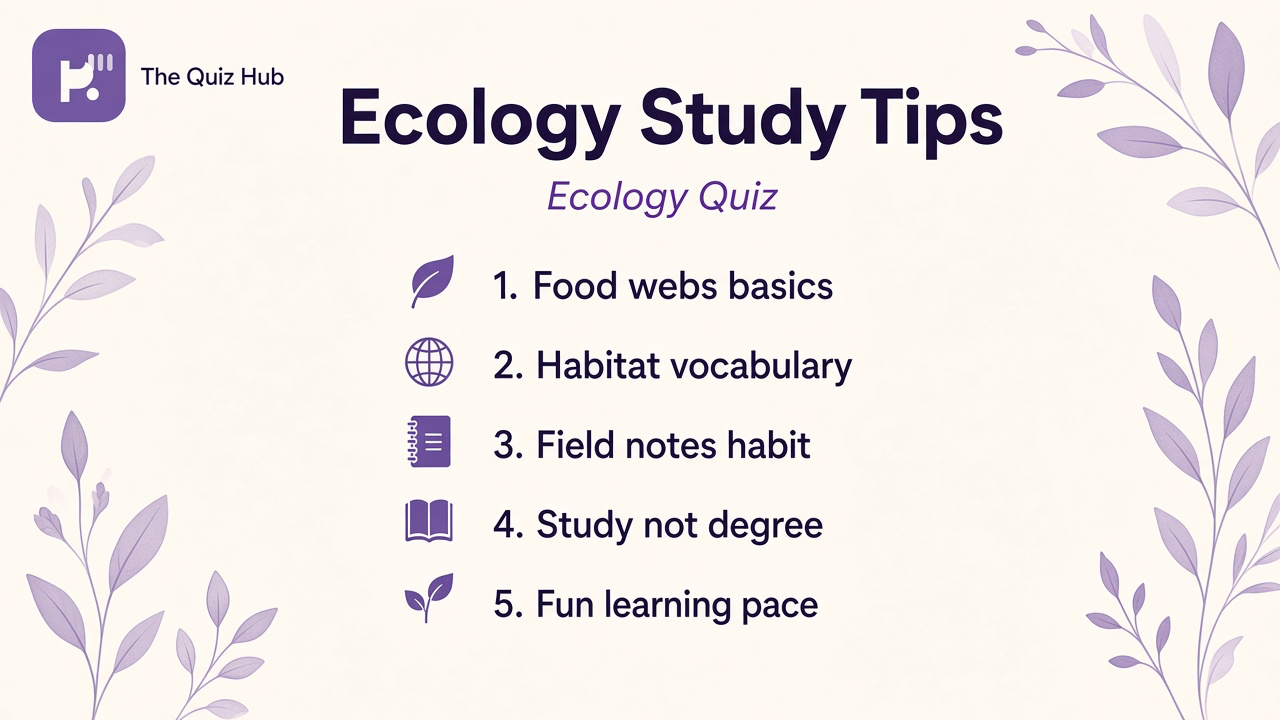
A quick takeaway graphic with topic tips (not your personal quiz scores). Start the quiz for your index, bands, and charts.
What this quiz can and cannot tell you
Can tell you
- Clarify food web roles, habitat factors, and population vocabulary in plain language
- Highlight common trophic level and predator myths worth unlearning before exams
- Encourage field notes and retake habits without shame
- Spark better questions during intro environmental science units
Cannot tell you
- Replace accredited field ecology courses, permits, or professional environmental licensing
- Prove you should handle wildlife closer than park rules allow
- Grade formal lab practicums or district science fair rubrics
- Turn scores into harassment of classmates still learning glossary terms
Ecology literacy beyond a thin glossary
Students search ecology quizzes when a unit jumps from definitions to food webs and every trophic label blurs together. Producers capture energy, consumers transfer it, and decomposers return nutrients in stories teachers draw on whiteboards. Mixing up food chains with food webs is a trap quizzes flag on purpose because real communities rarely look like one straight line from sun to hawk.
Habitat language separates where an organism lives from how populations interact inside that place. Abiotic factors like light, temperature, and moisture sit beside biotic factors like predators and competition in the same paragraph instructors expect on tests. Calling every cute trail camera clip proof that any species belongs anywhere is another myth worth rejecting before you share results.
Population and community vocabulary helps you read textbook graphs without panic. Carrying capacity and invasive species stories show why local parks care about nonnative plants even when memes treat nature like a static backdrop. Symbiosis terms reward careful reading: mutualism is not the same label as every interaction you notice on one afternoon walk.
Field notes turn observation into study without pretending you finished graduate field work. Date, location, weather, and a rough sketch of who eats whom are habits accredited courses still teach because memory fades faster than photo rolls. Dr. Rachel Kim reviews fun novelty science screeners with a simple split: reward curiosity and honest limits at the same time.
Pair results with siblings on this hub instead of forcing one ecology story. Our biodiversity quiz leans species risk and hotspot language rather than trophic homework on this page. The botany quiz focuses plant anatomy recall rather than full community webs. Browse the fun and novelty hub for more light study games. Retake after you can name one producer, one consumer, and one decomposer from a local habitat without peeking; literacy grows when layers stay linked, not when you memorize that ecology starts with e and hope the exam never asks what decomposers return to soil.
| Test | Focus |
|---|---|
| Biodiversity quiz | Species risk and hotspot curiosity rather than trophic level and food web stems on this page |
| Botany quiz | Plant anatomy recall rather than population, community, and field note checklists here |
Ecology Quiz FAQ
What does Ecology Quiz measure?
It measures how much you agree with statements about food webs, habitats, populations and communities, and field note study habits. You get an index from 0 to 100 plus four bars. It reflects self reported vocabulary on this screener, not a university degree, professional licensing, or IQ score.
Is this the same as the Eco Quiz?
No. This page focuses on ecology science vocabulary like trophic roles, habitats, and communities. The Eco Quiz sibling focuses on everyday green shopping, plate, and trail habit reflection with different stems. You can take both; they are written to stay distinct.
Does a high score mean I can skip my class field trip rules?
No. High bars mean you related to study statements here. Teachers and rangers set safety, permits, and wildlife distance rules. Field note items treat this as supplement, not replacement for supervised labs.
Why include field note statements with science facts?
Ecology search intent blends glossary recall with how students actually study outdoors. Split bars keep vocabulary separate from journal habits so results stay honest about which parts you endorse.
Who reviewed this quiz?
Dr. Rachel Kim reviewed the fun study framing, ecology literacy limits, and result explanations. See our editorial policy for review standards.
Reviewed by