What this quiz measures
This quiz does not contact Martin Seligman or your employer, is not the validated PERMA-4 research form, and does not belong in a performance review file. It measures how often you noticed workplace habit patterns grouped four ways: positive emotion pockets when small satisfaction, humor, or calm appeared without demanding ecstatic hours every shift; engagement not hustle when focus felt worthwhile without glorifying midnight email or influencer grind comparison; relationships at work when respect, help-seeking, psychological safety, or boundary setting showed up without gossip sport or quiet-shaming; and meaning and limits when tasks linked to values while you refused to treat web totals as Seligman scores, HR verdicts, or public manager shaming tools. You answer 22 how-often statements about the past two weeks from never to very often, with reverse-worded martyrdom and misuse items so hustle myths cannot inflate every bar. Your answers also feed a second chart on closeness and trust habits, because work stress sometimes chases certainty and loyalty performance over kind boundaries. The total becomes an index from 0 to 100 where higher means more reported PERMA-themed habit frequency on this screener, not proof your job is perfect or that you should ignore toxic policy.
Positive emotion pockets
Micro-wins, calm breaths, interest without promotion hype, and anti-permanent-broken myths.
Engagement not hustle
Focused flow, break permission, anti-midnight-email grind, and learning without instant mastery.
Relationships at work
Respect, mutual help, anti-gossip, quiet-style respect, and after-hours boundaries.
Meaning and limits
Values links, job-change honesty, unofficial-not-Seligman framing, and EAP when patterns persist.
How it works
Answer 22 frequency items
Rate each statement from Never to Very often. Tap Next after each answer.
Answers sort into four domains
Each answer feeds one of four workplace PERMA habit groups, and every item also feeds a closeness and trust layer.
See your index and charts
You get a 0 to 100 index, a band, and two bar charts you can compare before a job-fit conversation.
Take the Employee Subjective Well-Being Questionnaire (PERMA-4)
Answer 22 short statements to see your workplace PERMA habit index, four domain bars, and a closeness and trust chart.
What your result means
Your index is the average of all 22 answers, scaled from 0 to 100, with reverse-worded items flipped first. Higher means more reported PERMA-themed habit frequency on this screener. Read meaning-and-limits bars together with engagement before you treat the total as proof you must stay or leave without support.
| Band | Index range | Typical reading |
|---|---|---|
| Lower reported workplace PERMA habit patterns | 0 to 35 | Fewer frequent positive emotion, engagement, relationship, or meaning items in the past two weeks. |
| Mixed reported workplace PERMA habit patterns | 36 to 65 | Some manageable weeks alongside hustle spikes, lonely days, or unofficial-PERMA misuse on others. |
| Higher reported workplace PERMA habit patterns | 66 to 100 | Frequent positive pockets, focused engagement, relationship respect, or values links; still not Seligman certification. |
Tips at a glance
A quick takeaway graphic with topic tips (not your personal quiz scores). Start the quiz for your index, bands, and charts.
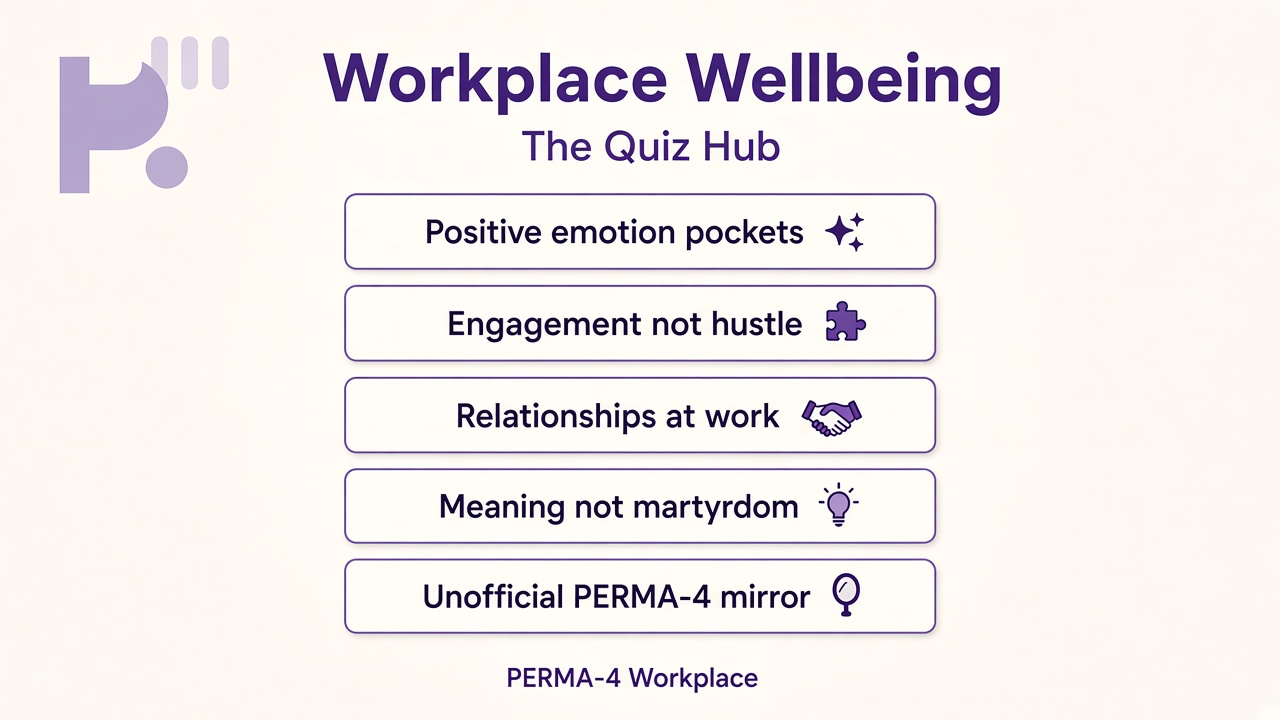
What this quiz can and cannot tell you
Can tell you
- Name PERMA-themed habits in plain workplace language
- Separate engagement from hustle-post martyrdom in self-talk
- Encourage EAP or HR conversations when patterns persist
- Spark job-fit reflection without public score shaming
Cannot tell you
- Replace Seligman validated PERMA-4 research administration or licensing
- Prove hireability, promotion worth, or manager guilt from one web bar
- Diagnose burnout, depression, or anxiety disorders from frequency items alone
- Substitute for union, HR policy, legal review, or clinician assessment
Why PERMA-4 workplace mirrors need unofficial framing
Employees search PERMA-4 when positive psychology language shows up in engagement decks but the lived week still feels hollow. Positive emotion, engagement, relationships, and meaning are useful conversation frames. They hurt when influencer hustle culture treats engagement as never logging off, or when a four-letter acronym becomes proof a manager is evil without policy context. Habit language works best when it names micro-bright moments and martyrdom limits together.
Dr. James Whitfield reviews personality hub workplace screeners with a simple split: reward honest frequency recall about pockets of okay and honest limits on unofficial framing at the same time. Positive emotion pockets tracks small wins and calm without demanding ecstatic hours. Engagement not hustle tracks absorption without grind worship or midnight email lore. Relationships at work tracks respect and help without gossip sport or quiet-shaming. Meaning and limits tracks values links while refusing Seligman certification fantasies and public HR shaming from web totals.
Real workers mix bars. You might score high on engagement while low on relationships during a remote sprint, which often describes focus without trust repair. You might score high on positive emotion while questioning meaning during a pay-the-rent season, which is valid. Reverse items catch overconfidence: believing broken PERMA means permanent failure, glorifying endless email, or using unofficial bars to flame managers in threads they never joined should not inflate domains meant to track habits.
Pair results with siblings on this hub instead of forcing one career story. Our employment fit quiz explores broader role values and interview humility with a different item bank when you want generic job-fit language beyond PERMA framing here. The Emotional Intelligence Level (EIL) sibling angles toward everyday EQ literacy and context-beats-rank limits at work. Browse the personality and psychology hub for more low-stakes screeners. Share scores with a trusted coworker or EAP, not as public verdicts on your team.
Seasons change which stressor dominates. A relationships bar might dip during reorg week while positive emotion recovers after one kind project. Retake after a boundary experiment on after-hours pings and notice whether meaning-and-limits bars stay high even when engagement rises, which often marks sustainable focus. PERMA language is a mirror for conversation, not a license from Seligman or HR.
| Test | Focus |
|---|---|
| Employment fit quiz | Broader employment values and interview humility, not PERMA-themed frequency habits on this page |
| Emotional Intelligence Level (EIL) | Everyday EQ literacy at work, not dedicated PERMA-4 habit frequency framing |
Employee Subjective Well-Being Questionnaire (PERMA-4) FAQ
What does this quiz measure?
It measures how often you noticed PERMA-themed workplace habits (positive emotion pockets, engagement without hustle worship, relationships, and meaning with limits) in the past two weeks. You get an index from 0 to 100 and four bars. It describes self-reported habits on this screener, not validated PERMA-4 research scores.
Is this the official Seligman PERMA-4 questionnaire?
No. This is an unofficial habit mirror inspired by PERMA themes with original frequency items. Martin Seligman and PERMA researchers did not write or endorse this page. Use licensed materials and trained administrators for research-grade PERMA work.
Can I send my score to HR as proof I need a new role?
This screener is for self-reflection, not performance files. Bring concrete examples and policy questions to HR, EAP, or union reps. Web bars alone are not documentation of misconduct or fit.
Why include hustle and martyrdom reverse items?
Engagement language is often hijacked by grind culture. Reverse items catch agreeing that midnight email equals virtue or that low bars license public manager shaming, so totals track healthier habit patterns.
Who reviewed this quiz?
Dr. James Whitfield reviewed the unofficial PERMA framing, workplace well-being limits, and result explanations. See our editorial policy for review standards.
Reviewed by