What Emotional Creativity Questionnaire (ECQ-1126) measures
This quiz does not administer the published Emotional Creativity Questionnaire from peer-reviewed research, and it cannot measure IQ, hiring readiness, or clinical creative talent. It measures how much you agree with statements in four groups: playful ideation about metaphors, what-if reframes, and brainstorming alternate stories when moods feel stuck; expressive play about music, art, movement, rituals, and safe sharing when words lag; mood-mix curiosity about holding contradictory feelings, perspective swaps, and asking what else a mood might signal before reactive replies; and creativity study limits about treating ECQ-1126 as an unofficial playful mirror, refusing bar charts as IQ proof, retaking after life seasons change, and keeping respect when others process feelings more quietly. You rate 22 statements from strongly disagree to strongly agree, with reverse-worded myths so autopilot responding cannot inflate every bar. Your answers also feed a second chart on closeness and trust habits, because playful sharing sometimes overlaps with how much you fear judgment when vulnerability meets imagination. The total becomes an index from 0 to 100 where higher means more reported endorsement of these playful emotional creativity habits on this screener, not proof you out-create calmer friends.
Playful ideation
Weather metaphors, what-if angles, alternate stories, and rejecting logic-only traps.
Expressive play
Playlists, doodles, improv energy, movement, and art without professional-artist gatekeeping.
Mood-mix curiosity
Mixed moods, perspective swaps, envy-as-values clues, and patience before the first reply.
Creativity study limits
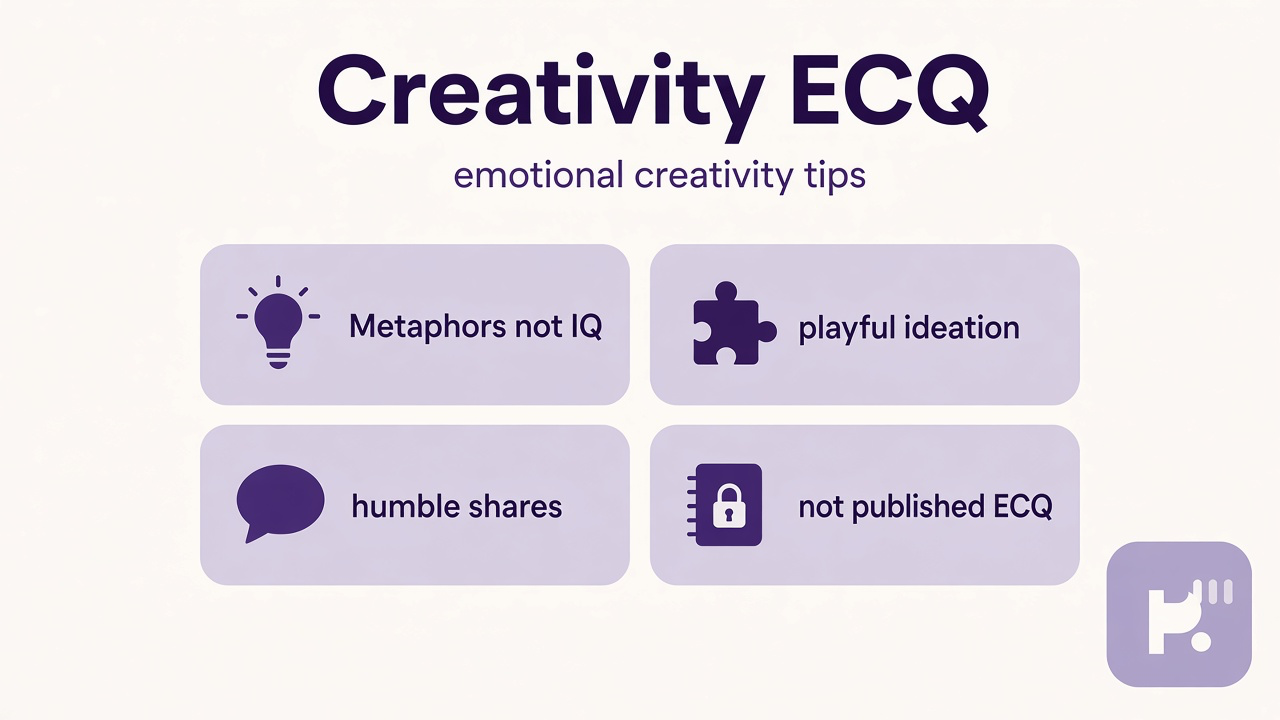
Not published ECQ, not IQ proof, not ranking others, retakes for fun with humble shares.
How it works
Answer 22 agreement items
Rate each statement from Strongly disagree to Strongly agree. Tap Next after each answer.
Answers sort into four domains
Each answer feeds one of four playful creativity groups, and every item also feeds a closeness and trust layer.
See your index and charts
You get a 0 to 100 index, a band, and two bar charts you can compare with a friend who explores feelings differently.
Take the Emotional Creativity Questionnaire (ECQ-1126)
Answer 22 short statements to see your emotional creativity habit index, four domain bars, and a closeness and trust chart.
What your result means
Your index is the average of all 22 answers, scaled from 0 to 100, with reverse-worded items flipped first. Read creativity study limits together with ideation and expressive play before you treat the total as IQ proof, destiny, or a reason to rank people in group chats.
| Band | Index range | Typical reading |
|---|---|---|
| Quieter playful creativity endorsement | 0 to 35 | Less agreement with ideation play, expressive experiments, mood curiosity, and limit items on this screener. |
| Mixed playful creativity endorsement | 36 to 65 | Some domains show vivid ideation or art play; others show reserve, plain-language preference, or strong limit awareness. |
| Stronger playful creativity endorsement | 66 to 100 | Frequent agreement with ideation, expressive play, and mood curiosity items; pair with limit bars. |
Tips at a glance
A quick takeaway graphic with topic tips (not your personal quiz scores). Start the quiz for your index, bands, and charts.
What this quiz can and cannot tell you
Can tell you
- Name whether you tend toward metaphor and art play versus plain-language processing in the current season
- Separate vivid ideation from habits around humble sharing and respectful boundaries
- Spark honest friend or coach conversations about how you explore feelings creatively
- Highlight limit myths you might unlearn before you type yourself or others from one score
Cannot tell you
- Replace the published Emotional Creativity Questionnaire or validated creativity batteries used in research
- Prove IQ, genius status, or hiring creativity from self-report agreement alone
- Show you are more talented than friends whose bars look quieter on one afternoon
- Override respect for someone who shares less because your ideation bar looks higher
Playful feelings, metaphors, and limits that are not IQ proof
Search traffic around emotional creativity questionnaires usually wants a verdict: am I imaginative enough, or behind some research scale I saw on social media. Those questions help when they spark honest play with metaphors and mixed moods. They hurt when clever reframes become excuses to dodge accountability, or when plain processors get read as uncreative in every room. Reflection language works best when playful ideation and humility stay in the same sentence.
Dr. James Whitfield reviews personality reflection tools with a respect-first lens. Playful ideation tracks sideways stories and what-if angles without shaming people who prefer direct words. Expressive play tracks art, music, and movement experiments without gatekeeping non-professionals. Mood-mix curiosity tracks contradictory feelings and perspective swaps without treating every mixed mood as confusion. Creativity study limits keeps fun framing visible so creativity talk does not slide into IQ flexing or cloning published ECQ items from journals.
Real emotional creativity mixes bars. You might score high on mood curiosity while strong on limits, which often describes people who reframe feelings without diagnosing strangers. You might score high on ideation while low on expressive play, which is a cue to try one private art ritual, not shame. Reverse items catch myths: imagination is wasted without instant logic, only professionals may use art to feel, mixed moods forbid reframes, web scores prove IQ, or bars decide who deserves respect should not inflate habits meant to track playful patterns.
Pair results with siblings on this hub instead of forcing one creativity story. Our emotional characteristics quiz explores expressiveness and sensitivity when you want trait-style language beside playful ideation. The emotion recognition sibling angles toward reading others with cultural humility rather than internal metaphor play. Browse the personality and psychology hub for more low-stakes screeners. Share scores as conversation starters, not as orders to perform cleverness forever.
Playful habits change with sleep, grief, apps, and workload. An ideation bar might spike after one art class while expressive play bars hold steady from old journal rituals. Retake after an honest friend chat and notice whether creativity study limits stay high even when ideation rises; that often marks healthier sharing hygiene. Patterns are data, not destiny boxes or IQ certificates.
| Test | Focus |
|---|---|
| Emotional characteristics quiz | Expressiveness and sensitivity trait mirror when playful ideation needs broader emotional style context |
| Emotion recognition | Reading others with humility rather than internal metaphor and art-play habits |
Emotional Creativity Questionnaire (ECQ-1126) FAQ
What does Emotional Creativity Questionnaire (ECQ-1126) measure?
It measures how much you agree with statements about playful ideation, expressive play, mood-mix curiosity, and creativity study limits. You get an index from 0 to 100 plus four bars. It describes self-reported playful emotional creativity habits on this unofficial screener, not IQ, not the published research ECQ, and not a fixed talent label.
Is this the same as the published Emotional Creativity Questionnaire?
No. ECQ-1126 uses original agree stems for everyday reflection on this site. It is not the validated item bank researchers cite in journals and cannot replace those instruments in studies or hiring.
Does a high score mean I am highly creative or smart?
No. High scores mean you agreed with many playful ideation and expressive play statements here. That is habit reflection, not proof of IQ, genius status, or workplace creativity. Pair bars with study limits and seek professional support only if mood patterns disrupt safety or daily life for weeks.
Why include creativity limit items beside playful items?
Creativity searches often skip ethics and humility. Limit bars keep playful metaphors separate from ranking others, IQ flexing, and treating unofficial screeners like published research forms.
Who reviewed this quiz?
Dr. James Whitfield reviewed the respectful framing, original-stem limits, study-not-IQ-proof wording, and reflection-only humility. See our editorial policy for review standards.
Reviewed by