What the Emotional Awareness Test measures
This quiz does not diagnose alexithymia, autism, mood disorders, or any other condition. Only a licensed clinician using interview methods, history, and observation can do that. It measures how often you noticed awareness-linked habits grouped four ways: mood tracking humility when journals, streaks, or colors steered shame or arguments before context or support; social cues when tone, pace, inclusion, humor shifts, or your own stress steered verdicts about others; ask, don't assume when hunches, empathy pride, or viral quizzes outran questions, updates when corrected, and respect for how someone names their experience; and study limits when you treat screeners as reflection, consider therapy when practice stalls, and reject myths that web bars replace evaluation or justify shaming others. You answer 22 how-often statements about the past two weeks, with reverse-worded items so one humble day cannot hide frequent strain across other days. Your responses also feed a second chart on closeness and trust habits, because some people chase certainty about partners or peers when vulnerability feels unsafe. The total becomes an index from 0 to 100 where higher means more frequent reported awareness-strain patterns on this screener. Your responses suggest intensity and habits to discuss with support; they do not mean you failed an emotional intelligence exam.
Mood tracking humility
How often apps and logs steered verdicts before context, identity, or care.
Social cues
How often tone, timing, and inclusion were read with, or without, curiosity.
Ask, don't assume
How often stories and quizzes outran questions and updates when corrected.
Study limits
How often you keep screeners separate from diagnosis, therapy, and public ranking.
How it works
Answer 22 frequency items
Rate each statement from Never to Very often for the past two weeks. Tap Next after each answer.
Answers sort into four domains
Each answer feeds one of four awareness habit groups, and every item also feeds a closeness and trust layer.
See your index and charts
You get a 0 to 100 index, a band, and two bar charts you can bring to a clinician.
Take the Emotional Awareness Test
Answer 22 short statements to see your emotional awareness habit index, four domain bars, and a closeness and trust chart.
What your result means
Your index is the average of all 22 answers, scaled from 0 to 100, with reverse-worded items flipped first. Higher means more frequent reported awareness-strain patterns on this screener. Read mood-tracking and ask-don't-assume bars together before the total, because app shame and guess-first loops often rise as a pair.
| Band | Index range | Typical reading |
|---|---|---|
| Lower reported awareness strain | 0 to 35 | Fewer frequent mood-log verdicts, cue misreads, guess-first loops, or quiz-as-rank habits in the past two weeks. |
| Mixed reported awareness strain | 36 to 65 | Some humble tracking days alongside app shame, gossip guesses, or quiz-rank spikes on others. |
| Higher reported awareness strain | 66 to 100 | Frequent log-as-verdict habits, cue gossip, or quiz ranking; clinician-informed care may help. |
Tips at a glance
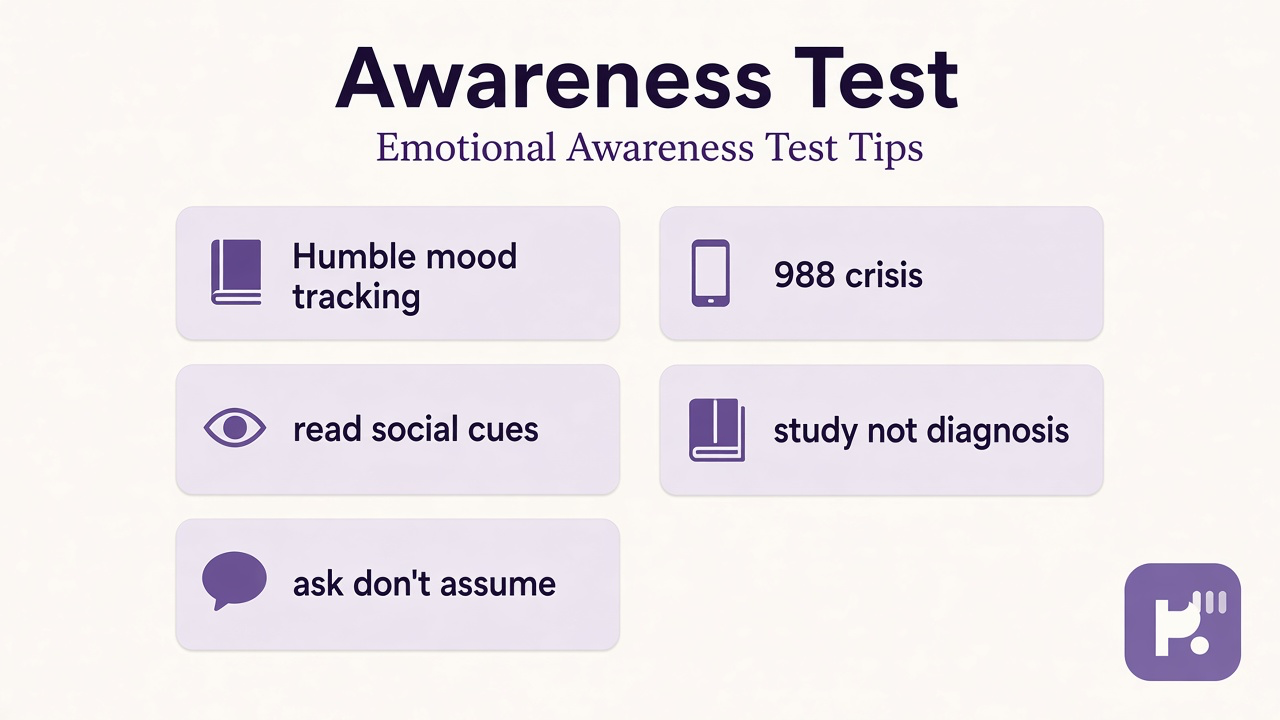
A quick takeaway graphic with topic tips (not your personal quiz scores). Start the quiz for your index, bands, and charts.
What this quiz can and cannot tell you
Can tell you
- Name tracking-as-verdict, cue gossip, and quiz-ranking patterns in plain language for intake
- Highlight when awareness bars run high enough to deserve compassion or care
- Support early conversations with therapists about mood apps, conflict, and social reads
- Offer a baseline if you retake after one ask-first or limit-sharing experiment
Cannot tell you
- Diagnose alexithymia, autism, mood disorders, or EQ deficits without evaluation
- Prove you are more emotionally aware than friends from one frequency total
- Replace trauma therapy, couples work, or crisis care with wellness-app trivia
- Tell you to confront or rank children, coworkers, or partners from quiz scores alone
Awareness without hype: tracking, cues, asking, and care limits
People search emotional awareness tests when mood apps, therapy speak, or group chats tempt them to treat charts as destiny. Real awareness grows with context, curiosity, and words someone chooses to share, not with dunking relatives on viral quizzes. This page scores frequency so your responses suggest where habits cluster, not whether you earn a personality label from a bar chart.
Mood tracking humility is the first domain because wellness culture loves visible data. A single orange day, a broken streak, or a friend's glossy graph can trigger shame that ignores sleep, grief, hormones, or pain. Screenshots in arguments teach partners that feelings must match pixels. Humility means patterns can inform care without one entry rewriting your identity or someone else's.
Social cues are the second domain because rooms send thin signals: pace, humor deflection, who gets invited, who goes quiet. Noticing shifts is skill; gossiping a verdict before asking is strain. Stress can make your own buzzing nerves feel like proof about everyone else's mood. Curiosity about overload, illness, or cultural restraint beats ranking coworkers as cold from one brief exchange.
Ask, don't assume is the third domain because empathy pride spreads fast. Hunches about why someone snapped, insisting you know a friend better than their words, or ranking family on awareness memes outrun basic ethics. Open questions and updating when someone says you guessed wrong are practice, not weakness when misreads return during hard seasons.
Study limits are the fourth domain because web totals cannot replace clinicians. Months of stuck loops deserve therapy pacing, not only retakes. High bars do not cancel professional support; low bars do not license shaming kids or coworkers in public threads. Agreeing that online quizzes diagnose or rank people should not inflate a humility screener meant to track real habits. Our Emotional Awareness Questionnaire sibling emphasizes label literacy, body-cue variety, and therapist-for-stuck-loops framing with a separate question bank. Our emotion recognition sibling stresses face-and-mood-as-proof humility when still images drive fights. The emotion regulation quiz adds broader daily regulation frequency when heated scenes are not the whole story. Browse the mental health and clinical test hub for more non-diagnostic screeners.
Retake after two weeks of one concrete experiment, one ask-first check before sharing a mood graph, one pause when group-chat gossip starts, or one update when corrected, and compare domain bars. Your responses suggest whether habits are easing, not whether you deserve care. Licensed clinicians turn examples into treatment plans this page cannot deliver. If distress feels unbearable tonight, call or text 988 in the US or your local crisis line before debating awareness alone.
| Test | Focus |
|---|---|
| Emotional Awareness Questionnaire | Separate bank on labels-not-destiny, body-cue variety, and stuck-loop care rather than mood-app verdict habits |
| Emotion recognition | Face-and-still-image mood-as-proof humility rather than tracker and group-chat strain items |
| Emotion regulation quiz | Broader daily regulation frequency when awareness habits need heat-of-moment skills too |
Emotional Awareness Test FAQ
What does this quiz measure?
It measures how often you noticed awareness-linked habits in four areas during the past two weeks: mood tracking humility, social cues, ask don't assume, and study limits. You get an index from 0 to 100 plus four domain bars. Your responses suggest self-reported frequency for reflection, not a clinical diagnosis.
How is this different from the Emotional Awareness Questionnaire?
Both are YMYL frequency screeners with separate 22-item banks. This test emphasizes mood-app humility, conversational cues, and ask-first ethics. The questionnaire sibling emphasizes label-not-destiny literacy, body-cue variety, and therapist-for-stuck-loops themes without reusing these stems.
Does a high score mean I lack emotional awareness?
No. Your responses suggest how often strain patterns, log-as-verdict habits, gossip guesses, or quiz ranking, showed up on this screener. Skills grow with practice, context, and support. Use bars to describe habits, not to shame yourself or others.
Why are some statements worded as humble tracking or asking first?
Reverse-worded items catch over-reporting strain. Reporting that you used tracking without identity collapse, noticed cues with curiosity, asked before acting, updated when corrected, kept screeners separate from diagnosis, or considered therapy should not inflate an index meant to track hype and guess-first loops.
What should I do if my score is high or I feel in crisis?
Contact a mental health clinician with domain examples from your results, especially if mood apps or conflict loops distress you for months. Call or text 988 (US) if you feel hopeless, unsafe, or in emotional crisis. Pause public ranking posts until you can ask how someone feels in their own words.
Who reviewed this quiz?
Dr. Elena Vasquez, PhD reviewed the YMYL framing, crisis resources, study limits, sibling-bank separation, and result explanations. See our editorial policy for review standards.
Reviewed by