What the Emotional Awareness Questionnaire measures
This quiz does not administer a validated Emotional Awareness Questionnaire from research clinics, and it cannot diagnose alexithymia, depression, anxiety, or any other condition. Only a licensed clinician using interview methods, safety screening, and history can do that. It measures how often you noticed internal awareness habits grouped four ways: body cues when tight chest, breath, tension, or basic care needs pointed toward possible emotions before blame stories ran ahead; labeling feelings when you could, or could not, name hurt, fear, shame, or mixed states before vague fine or identity labels took over; curious check-ins when you reflected with journaling, walks, or honest self-talk instead of wellness shame or harsh rankings; and labels not destiny when you treated feelings as passing states, sought clinicians for stuck loops, and refused to treat unofficial screeners as validated instruments or moral verdicts. You answer 22 how-often statements about the past two weeks, with reverse-worded items so one good week cannot hide frequent cue skips or label fog on other days. Your responses also feed a second chart on closeness and trust habits, because some people numb hardest when vulnerability already feels risky. The total becomes an index from 0 to 100 where higher means more frequent reported awareness-gap patterns on this screener. Your responses suggest intensity and habits to discuss with support; they do not mean you failed at emotions.
Body cues
How often physical signals and basic care checks preceded blame stories or late snap realizations.
Labeling feelings
How often specific feeling words showed up before fault lines, vague fine, or permanent identity labels.
Curious check-ins
How often reflection beat wellness shame, hiding, or harsh too-sensitive scripts.
Labels not destiny
How often you sought help for loops, kept labels humble, and treated this as an unofficial screener.
How it works
Answer 22 frequency items
Rate each statement from Never to Very often for the past two weeks. Tap Next after each answer.
Answers sort into four domains
Each answer feeds one of four awareness groups, and every item also feeds a closeness and trust layer.
See your index and charts
You get a 0 to 100 index, a band, and two bar charts you can bring to a clinician.
Take the Emotional Awareness Questionnaire
Answer 22 short statements to see your emotional awareness habit index, four domain bars, and a closeness and trust chart.
What your result means
Your index is the average of all 22 answers, scaled from 0 to 100, with reverse-worded items flipped first. Higher means more frequent reported awareness-gap patterns on this screener. Read body-cue and labeling bars together before the total, because numbness and vague fine often rise as a pair.
| Band | Index range | Typical reading |
|---|---|---|
| Lower reported awareness strain | 0 to 35 | Fewer frequent body-cue skips, label fog, shame spikes, or quiz-as-destiny habits in the past two weeks. |
| Mixed reported awareness strain | 36 to 65 | Some curious check-ins alongside cue skips, label fog, shame, or stuck loops on others. |
| Higher reported awareness strain | 66 to 100 | Frequent cue skips, label fog, shame, or destiny thinking; skilled support may help more than self-blame. |
Tips at a glance
A quick takeaway graphic with topic tips (not your personal quiz scores). Start the quiz for your index, bands, and charts.
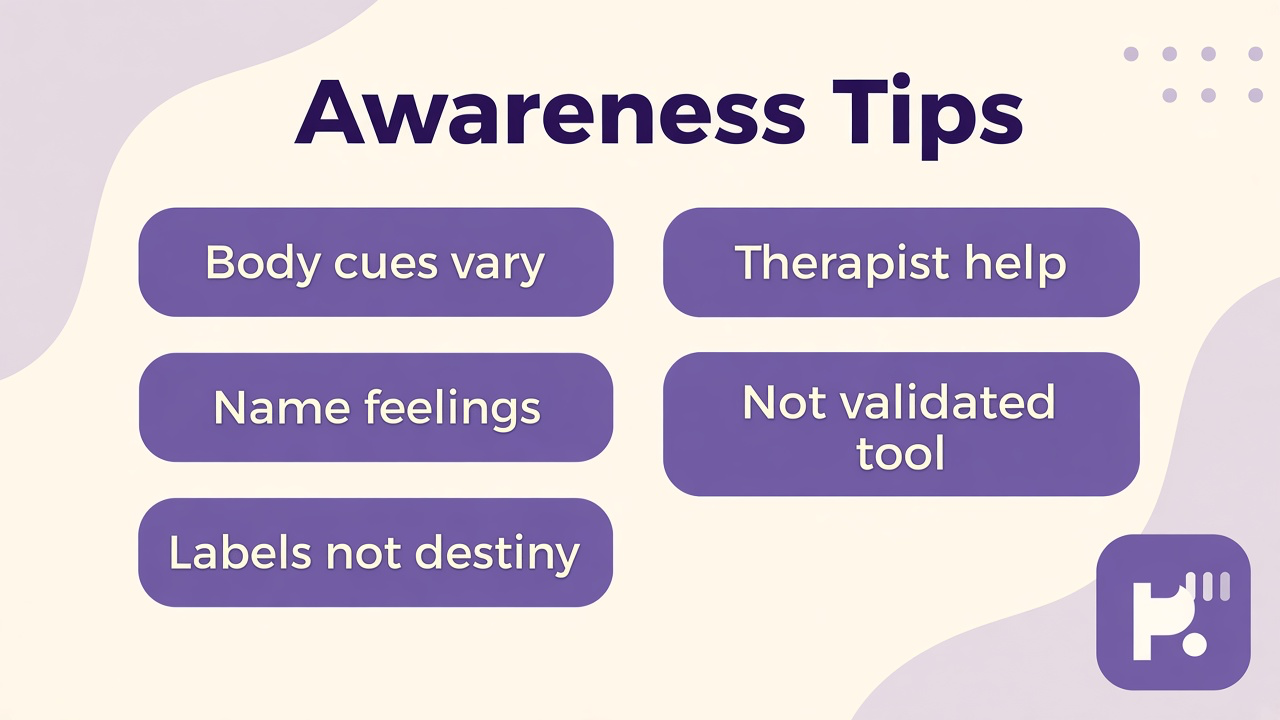
What this quiz can and cannot tell you
Can tell you
- Name body-cue, labeling, and shame patterns in plain language for intake
- Highlight when awareness bars run high enough to deserve compassion or care
- Support early conversations with therapists or coaches about stuck feeling loops
- Offer a baseline if you retake after one pause-plus-label experiment
Cannot tell you
- Replace validated emotional awareness or alexithymia instruments used in research
- Diagnose alexithymia, mood disorders, or trauma conditions without evaluation
- Prove you are unfeeling or over-sensitive from one score when context and culture matter
- Tell you that a feeling label defines your destiny or moral rank over others
Awareness without hype: body cues, labels, and limits
People search emotional awareness questionnaires when they want to feel less reactive yet cannot tell whether they are numb, overwhelmed, or simply tired. Social feeds reward instant feeling vocabulary, which can shame anyone whose cues arrive through tension, quiet, or delayed tears. This page scores frequency so your responses suggest where habits cluster, not whether you pass a wellness audition.
Body cues are the first domain because emotions often announce themselves physically before words arrive. Tight chest, shallow breath, jaw clench, and stomach drops are not proof someone else wronged you; they are data worth pausing on. Sleep debt, illness, and dehydration mimic irritability; checking basic care before moral stories is awareness, not excuse-making. Reverse items capture when you already scanned the body or rejected one-size-fits-all cue myths, signs literacy is growing, not proof cues will always be obvious.
Labeling feelings is the second domain because blame outruns vocabulary. Specific words, hurt, jealous, ashamed, relieved, give you something to regulate or share. Vague fine or stressed often hides loneliness or panic that leaks sideways. Mixed feelings are normal; forcing one label can flatten nuance therapists explore in session. Treating a mood word as permanent identity is the opposite of awareness; feelings describe moments you can work with, not a tattoo on your character.
Curious check-ins are the third domain because awareness without compassion becomes another performance metric. Comparing yourself to highly aware influencers, hiding from shame, or ranking sensitivity as failure can block the very noticing you want. Short walks, voice notes, and cooling-down size checks are low-tech habits clinicians encourage between sessions. Asking a therapist to help name loops that persist for weeks is awareness plus care, not defeat.
Labels not destiny are the fourth domain, patterned after YMYL honesty. Unofficial screeners cannot replace validated instruments clinicians use in research or specialty care. Low bars are not proof you are broken; high bars are not proof you are enlightened. Destiny thinking, treating one online total as who you will always be, should not inflate a habit index meant to track recent patterns. Our emotion recognition sibling focuses on reading others with humility rather than internal cue literacy. Our emotion regulation situations quiz emphasizes pause, label, and repair in heated scenes. The Bermond, Vorst Alexithymia Questionnaire (BVAQ) sibling offers another reflection lane when naming feelings feels persistently blocked. Browse the mental health and clinical test hub for more screeners with study-not-diagnosis language.
Retake after two weeks of one concrete experiment, one body pause, one feeling word aloud, or one therapist outreach, and compare domain bars. Your responses suggest whether habits are shifting, not whether you deserve care. Licensed clinicians turn examples into skills plans this page cannot deliver. If distress feels unbearable tonight, call or text 988 in the US or your local crisis line before debating results alone.
| Test | Focus |
|---|---|
| Emotion recognition | Reading others with cultural humility rather than internal body-cue and label habits |
| Emotion regulation situations quiz | Pause, label, and repair in heated moments rather than general awareness frequency |
| Bermond, Vorst Alexithymia Questionnaire (BVAQ) | Alexithymia-themed naming and expression patterns with unofficial screener limits |
Emotional Awareness Questionnaire FAQ
What does this quiz measure?
It measures how often you noticed body-cue habits, feeling labels, curious check-ins, and labels-not-destiny limits during the past two weeks. You get an index from 0 to 100 plus four domain bars. Your responses suggest self-reported frequency for reflection, not a clinical diagnosis.
Is this a validated Emotional Awareness Questionnaire?
No. This is an unofficial self-reflection screener inspired by awareness language in therapy and wellness education. It is not the validated research instrument some clinics use and cannot replace licensed evaluation.
Do body cues mean the same thing for everyone?
No. Culture, trauma history, neurotype, and family display rules change how emotions show up in the body. Awareness grows when you learn your patterns, not when you match a meme or influencer script.
Why are some statements worded as successful labels or check-ins?
Reverse-worded items catch over-reporting strain. Agreeing that you paused on body cues, named specific feelings, reflected with curiosity, sought clinicians, or kept labels separate from destiny should not inflate an index meant to track gap patterns on other days.
What should I do if my score is high or feelings feel stuck?
Contact a licensed therapist or your primary care clinician with domain examples from your results. Call or text 988 (US) if you feel hopeless, unsafe, or in emotional crisis. Stuck loops for weeks are a reasonable reason to seek skilled support, not proof you failed.
Who reviewed this quiz?
Dr. Elena Vasquez, PhD reviewed the YMYL framing, crisis resources, labels-not-destiny limits, unofficial instrument humility, and result explanations. See our editorial policy for review standards.
Reviewed by