What EKG Quiz measures
This quiz does not attach electrodes, certify you for telemetry, or score your intelligence. It measures how much you agree with introductory EKG study literacy grouped four ways: EKG terminology basics about EKG versus ECG labels, resting rate norms, calibration marks, and movement artifact; rhythm strip literacy about sinus rhythm language, R-R rate skills, premature beat awareness, and calm reading before shock-first panic; monitoring study habits about serial strip comparison, labeling time and symptoms, lead checks, and quizzes as warmup not orders; and study limits and safety about class prep, rejecting trivia credentialing myths, and leaving alarming symptoms to professionals. You answer 22 statements from strongly disagree to strongly agree, with reverse-worded myths so agreeing with every shortcut cannot inflate every bar. Your answers also feed a second chart on closeness and trust habits, because health worry sometimes pushes people toward quick internet certainty. The total becomes an index from 0 to 100 where higher means more reported EKG study literacy on this screener, not proof you should skip care when symptoms scare you.
EKG terminology basics
EKG versus ECG naming, resting rate norms, calibration marks, and artifact from movement or loose leads.
Rhythm strip literacy
Sinus rhythm vocabulary, R-R rate practice, premature beat awareness, and intro scope before advanced ischemia units.
Monitoring study habits
Serial comparisons, strip labels, lead verification, and checkoff warmup without solo order changes.
Study limits and safety
Class and boards prep, no DIY credentialing, and clinician follow-up for chest pain or syncope.
How it works
Answer 22 agreement items
Rate each statement from Strongly disagree to Strongly agree. Tap Next after each answer.
Answers sort into four domains
Each answer feeds one of four EKG study groups, and every item also feeds a closeness and trust layer.
See your index and charts
You get a 0 to 100 index, a band, and two bar charts you can use before a nursing or EMS rhythm unit.
Take the EKG Quiz
Answer 22 short statements to see your EKG study literacy index, four domain bars, and a closeness and trust chart.
What your result means
Your index is the average of all 22 answers, scaled from 0 to 100, with reverse-worded items flipped first. Higher means more reported EKG study literacy on this screener. Read study limits and rhythm strip bars together before you treat the total as clinical expertise.
| Band | Index range | Typical reading |
|---|---|---|
| Building EKG literacy | 0 to 35 | Fewer agreed facts on EKG naming, rhythm strips, monitoring habits, or study safety limits on this screener. |
| Mixed EKG literacy | 36 to 65 | Solid facts in some domains with myths about flat lines, shock-first panic, or trivia credentialing. |
| Strong EKG literacy | 66 to 100 | Frequent agreement with accurate EKG study trivia and healthy limits; still not credentialing. |
Tips at a glance
A quick takeaway graphic with topic tips (not your personal quiz scores). Start the quiz for your index, bands, and charts.
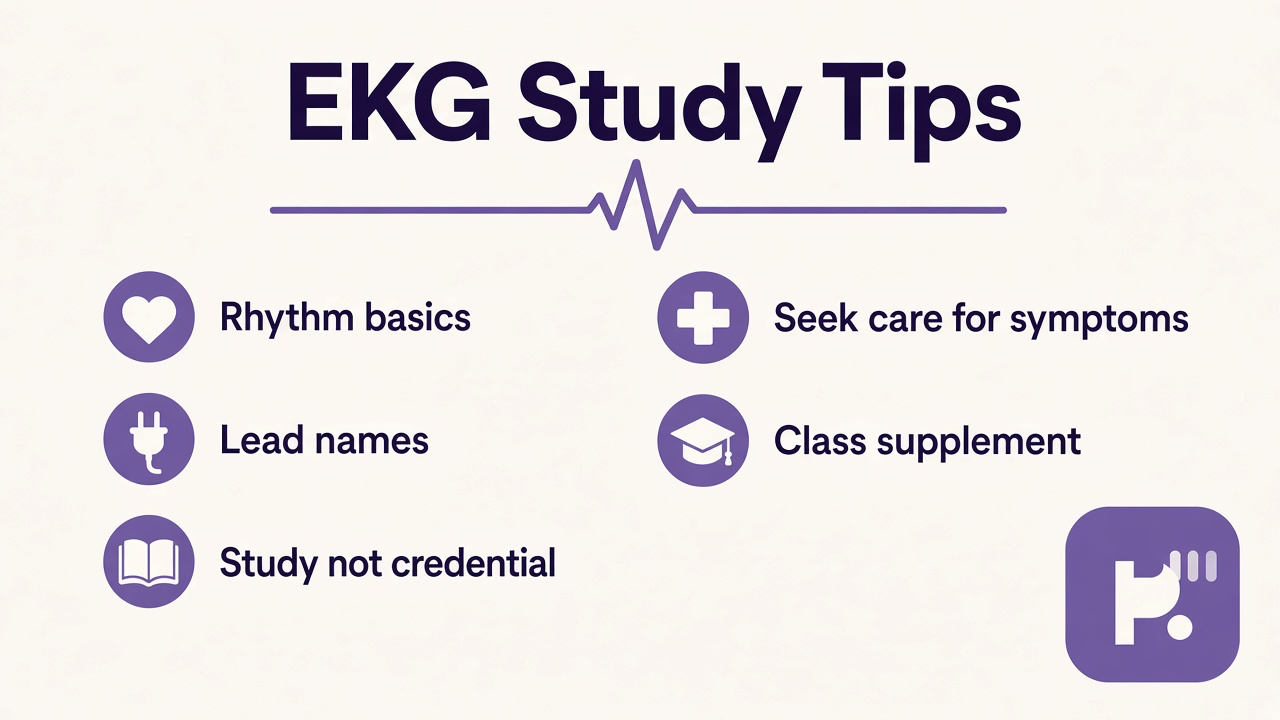
What this quiz can and cannot tell you
Can tell you
- Clarify EKG naming, resting rate norms, and artifact basics in plain language
- Highlight rhythm strip and monitoring habits worth practicing before checkoffs
- Encourage serial strip comparison and labeled practice without shame
- Spark better questions during skills lab or introductory monitor units
Cannot tell you
- Diagnose arrhythmia, ischemia, or electrolyte crisis from trivia answers
- Replace telemetry training, ACLS courses, or hands-on preceptor sign-off
- Certify you for monitored units, dosing, or medical licensing
- Prove your heart is healthy when chest pain, syncope, or sustained palpitations appear
EKG study literacy beyond one monitor beep
Students search EKG quiz when a nursing or EMS unit hands them a rhythm strip and every alarm tone feels personal. Electrocardiography records cardiac electrical activity over time; EKG and ECG name the same test with different spelling habits on monitors versus textbooks. Introductory teaching cites resting rate ranges and regularity before anyone expects you to parse subtle ischemia on a crowded floor.
Rhythm strip literacy starts with calm questions: Is the rate sensible for context? Is the rhythm regular? Do P waves line up with QRS complexes in the sinus pattern instructors describe? Measuring heart rate from R-R intervals when paper speed is known is a core student skill. Premature beats appear in practice strips to teach comparison, not to train hallway shock-first panic. Reverse items on this screener catch myths like treating every flat monitor line as asystole while the patient talks, or defibrillating before anyone checks a pulse.
Monitoring study habits belong beside vocabulary. Comparing today tracing to yesterday strip, labeling time and symptoms, and resetting loose leads are boring steps that prevent false drama in lab and on rotation. Retakes and flashcards are normal class prep; they do not clear telemetry credentialing or replace preceptor coaching when a patient looks unstable.
Study limits stay visible because trivia tempts overconfidence. Consumer wearables can spark useful conversations with clinicians; they do not replace full workups when chest pain, syncope, or sustained palpitations with dizziness appear. Agreeing that perfect online scores skip unit sign-off is another myth worth rejecting. Use this screener as warmup, not a verdict.
Pair results with siblings on this hub instead of cramming every cardiac topic into one share. Our ECG anatomy and physiology quiz leans lead placement and P-QRS-T conduction when you want structure beside rhythm habits. The cardiac axis quiz stays on vector recall for adjacent EKG coursework. Browse the IQ and cognitive test hub for more low-stakes study games. Retake after you can state rate and regularity on an unlabeled strip without peeking; literacy grows when layers stay in order, not when you memorize alarm tones and hope lead checks never matter.
| Test | Focus |
|---|---|
| ECG anatomy and physiology quiz | Lead placement and conduction path intro, not monitor slang and serial strip habits alone |
| Cardiac axis quiz | ECG axis and vector recall, not bedside rhythm strip warmup |
EKG Quiz FAQ
What does EKG Quiz measure?
It measures how much you agree with introductory EKG study literacy across terminology, rhythm strips, monitoring habits, and safety limits. You get an index from 0 to 100 and four bars. It reflects self-reported knowledge on this screener, not a clinical skills exam or IQ score.
Is EKG different from ECG on this page?
No. Study guides treat EKG and ECG as the same electrocardiography test with different spelling habits. This quiz uses EKG in the title because many nursing and EMS learners search that label.
Is this quiz enough to diagnose heart problems?
No. It is study trivia and care literacy. Chest pain, fainting, sustained palpitations with dizziness, or trouble breathing need a clinician or emergency care, not a high score here.
Why are some statements worded as myths?
Reverse-worded myths catch overconfidence. Agreeing that every flat monitor line proves cardiac arrest while the patient speaks, that shock always comes before pulse checks, or that trivia replaces telemetry sign-off should not inflate your literacy index.
Who reviewed this quiz?
Dr. James Whitfield, PhD reviewed the educational framing, EKG study limits, and result explanations. See our editorial policy for review standards.
Reviewed by