What Einstein Quiz measures
This quiz does not measure IQ, certify physics licensure, or rank how genius you are compared with strangers online. It measures how much you agree with beginner-friendly history and curiosity trivia grouped four ways: life and timeline about birth, patent work, Nobel timing, emigration, and Princeton years without archival depth; science curiosity about photoelectric fame, E equals mc squared, special and general relativity at intro storytelling level, and thought experiments as wonder tools; humble learning about enjoying science stories without Mensa fantasies, stepping back from intelligence dunk threads, and treating low bars as reading lists; and myths and pop culture about failed math debunks, misquoted posts, iconic photos, and source checks before sharing. You rate 22 statements from strongly disagree to strongly agree, with reverse-worded myths so one viral clip cannot inflate every bar. Your answers also feed a second chart on closeness and trust habits, because loud certainty sometimes chases performance over patient curiosity. The total becomes an index from 0 to 100 where higher means more reported history and curiosity literacy on this screener, not proof you should lecture coworkers or skip kindness when bars spike.
Life and timeline
Birth, patent office years, Nobel topic, US and Princeton chapters in standard biographies.
Science curiosity
Intro relativity language, mass-energy storytelling, and wonder without exam claims.
Humble learning
Fun quizzes without IQ wars, source humility, and welcoming beginner questions.
Myths and pop culture
Debunked school myths, quote traps, iconic photos, and check-before-share habits.
How it works
Answer 22 agreement items
Rate each statement from Strongly disagree to Strongly agree. Tap Next after each answer.
Answers sort into four domains
Each answer feeds one of four Einstein literacy groups, and every item also feeds a closeness and trust layer.
See your index and charts
You get a 0 to 100 index, a band, and two bar charts you can compare with a friend who loves science posters.
Take the Einstein Quiz
Answer 22 short statements to see your Einstein history and curiosity index, four domain bars, and a closeness and trust chart.
What your result means
Your index is the average of all 22 answers, scaled from 0 to 100, with reverse-worded items flipped first. Read humble learning and myths together before you treat a high timeline or science bar as license to IQ dunk. History trivia is for fun reflection; classrooms and labs deserve patience more than scoreboard wins.
| Band | Index range | Typical reading |
|---|---|---|
| Building Einstein literacy | 0 to 35 | Fewer agreed facts on life timeline, science curiosity, humble learning, or myth busting on this screener. |
| Mixed Einstein literacy | 36 to 65 | Solid recall in some domains with timeline traps, science myths, or humility blind spots in others. |
| Strong Einstein literacy | 66 to 100 | Frequent agreement with accurate history, curiosity framing, humble habits, and myth awareness; still fun only. |
Tips at a glance
A quick takeaway graphic with topic tips (not your personal quiz scores). Start the quiz for your index, bands, and charts.
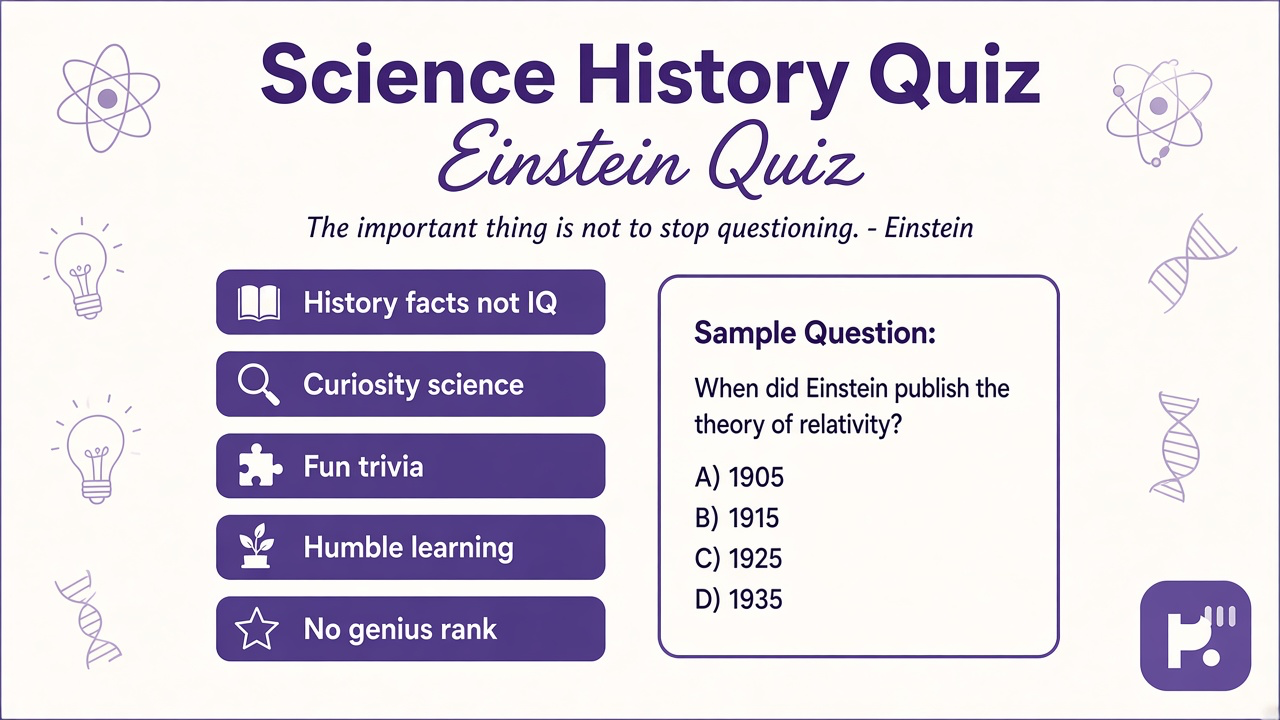
What this quiz can and cannot tell you
Can tell you
- Highlight biography timeline and intro science facts worth revisiting before trivia night
- Separate pop culture myths from Nobel and relativity basics without merging them into trick traps only
- Encourage humble sharing habits when friends mix memes with real curiosity
- Spark better questions for school projects, museum visits, and documentary queues
Cannot tell you
- Prove IQ, Mensa status, or classroom rank from one online screener
- Replace licensed physicists, engineers, teachers, or historians for graded or safety work
- Certify you understood every equation he wrote or every political letter he signed
- Turn history scores into harassment, quote spam without sources, or fake genius badges online
Einstein trivia as curiosity mirror, not IQ court
Search traffic around genius quizzes usually wants two things: share a clever score without opening a textbook, and learn one new fact for the group chat. Those goals help when readers notice that history trivia starts conversations, not courtroom verdicts on intelligence. They hurt when people treat bars like proof someone is stupid, or when threads reward misquoted lines and failed-math myths more than patient source checks.
Dr. Rachel Kim reviews fun novelty quizzes with a simple split: reward honest curiosity about biography timeline and intro science storytelling at the same time. Life and timeline tracks birth, patent work, Nobel timing, and US years without pretending every reader chases archival citations. Science curiosity tracks photoelectric fame, E equals mc squared, and relativity language at museum-grade depth without licensure fantasies. Humble learning keeps fun quizzes separate from IQ dunk threads and keeps low bars framed as reading lists, not shame. Myths and pop culture keeps failed math debunks, quote verification, and iconic photo context visible beside listicles that demand instant genius performance.
Real readers mix bars. You might score high on pop culture while keeping timeline moderate, which often describes poster fans who know the tongue photo yet forget Nobel topics. You might score high on science curiosity with moderate myth busting, which can mean strong intro physics memory yet little habit of checking quote graphics. Reverse items catch sloppy answers: denying Swiss patent years, claiming this screener replaces licensed physicists, demanding public shaming for low scores, or treating every social quote as authentic should not inflate bars meant to track layered history literacy.
Pair results with siblings on this hub instead of forcing one genius story. Our physics quiz leans broader science recall when you want stems beyond biography focus. The Dunning-Kruger effect test stays on confidence calibration when quiz scores tempt overclaiming. Browse the fun and novelty hub for more light screeners. Caption shares as fun history trivia and skip intelligence ambushes on friends who never asked for a rank war.
Memes travel faster than footnotes. A timeline bar might spike during a documentary week while myth busting sleeps until you read one biography sidebar. When you share results, say curiosity beats ranking. When you borrow science stories, credit teachers and museums who explain kindly and respect people who learn quietly. Retake after one exhibit visit or one sourced article and watch whether humble learning bars rise even if trivia bars lag, which often means you separated performative scoring from actual wonder.
| Test | Focus |
|---|---|
| Physics quiz | Broader physics recall rather than Einstein biography and myth lanes |
| Dunning-Kruger effect test | Confidence calibration habits rather than history timeline trivia |
Einstein Quiz FAQ
What does Einstein Quiz measure?
It measures how much you agree with statements about life timeline, science curiosity, humble learning, and myths and pop culture. You get an index from 0 to 100 plus four bars. It describes self-rated history trivia on this screener, not IQ, not physics licensure, and not proof you outrank other learners.
Is this an IQ test or genius certification?
No. This page uses beginner-friendly biography and science storytelling alongside myth corrections. It is playful trivia, not psychometric testing. Teachers, historians, and physicists remain the right guides for graded or professional work.
Does a high score mean I should call myself a genius online?
No. High bars mean you related to trivia statements here. Humble learning items explicitly reject intelligence dunking and public shaming. Use curiosity to listen and source-check, not to rank strangers.
Why mix history timeline with myth busting items?
Genius search intent blends real biography with failed math myths and misquoted graphics. Split bars keep timeline wins separate from science curiosity and quote habits so results stay honest about which parts you endorse.
Who reviewed this quiz?
Dr. Rachel Kim reviewed the fun-only framing, history-not-IQ limits, and humble curiosity tone. See our editorial policy for review standards.
Reviewed by