What this ECS-inspired screener measures
This quiz does not administer every copyrighted or validated Conflict of Environments Scale labeled ECS in research literature, and it cannot diagnose burnout, depression, anxiety, or relationship disorders. Only a qualified clinician using interview methods, history, and sometimes occupational or couples assessment can do that. It measures how often you have noticed environment conflict habits clinicians and workplace wellness educators discuss when jobs, homes, and other roles compete for the same hours and nervous system, grouped four ways: work home pull when deadlines, messages, or mental replay intrude on rest and relationships; role switching strain when moving between employee, caregiver, partner, or student hats feels abrupt or depleting; boundary habits when limits, notifications, and honest asks protect off hours or fail to; and therapy when stuck when counseling, employee assistance, or structured conversations enter the picture or get delayed while loops repeat. You answer 22 how-often statements about the past month, with reverse-worded items so one mindful week cannot hide frequent strain across other days. Your responses also feed a second chart on closeness and trust habits, because some people overwork or overgive when asking for help at home feels risky. The total becomes an index from 0 to 100 where higher means more frequent reported environment conflict on this unofficial screener, not proof you chose the wrong career or family.
Work home pull
How often work messages, guilt, or mental replay intruded on meals, rest, or personal time.
Role switching strain
How often changing hats between work, home, and care roles felt abrupt or draining.
Boundary habits
How often you communicated limits, muted alerts, or asked for deadline relief.
Therapy when stuck
How often you booked counseling, used employee assistance, or brought examples to intake.
How it works
Answer 22 frequency items
Rate each statement from Never to Very often for the past month. Tap Next after each answer.
Answers sort into four domains
Each answer feeds one of four environment conflict groups, and every item also feeds a closeness and trust layer.
See your index and charts
You get a 0 to 100 index, a band, and two bar charts you can bring to a clinician.
Take the ECS Conflict of Environments
Answer 22 short statements to see your environment conflict strain index, four domain bars, and a closeness and trust chart.
What your result means
Your index is the average of all 22 answers, scaled from 0 to 100, with reverse-worded items flipped first. Higher means more frequent reported environment conflict on this unofficial screener. Read work home pull and role switching bars together before the total, since spillover and abrupt transitions often stack on the same evening.
| Band | Index range | Typical reading |
|---|---|---|
| Lower reported environment conflict strain | 0 to 35 | Fewer frequent work home pull, switching strain, boundary slips, or help avoidance in the past month. |
| Mixed reported environment conflict strain | 36 to 65 | Some domains spike while boundary habits or help seeking look steadier on better weeks. |
| Higher reported environment conflict strain | 66 to 100 | Frequent work home spillover or blurred roles; professional support may help. |
Tips at a glance
A quick takeaway graphic with topic tips (not your personal quiz scores). Start the quiz for your index, bands, and charts.
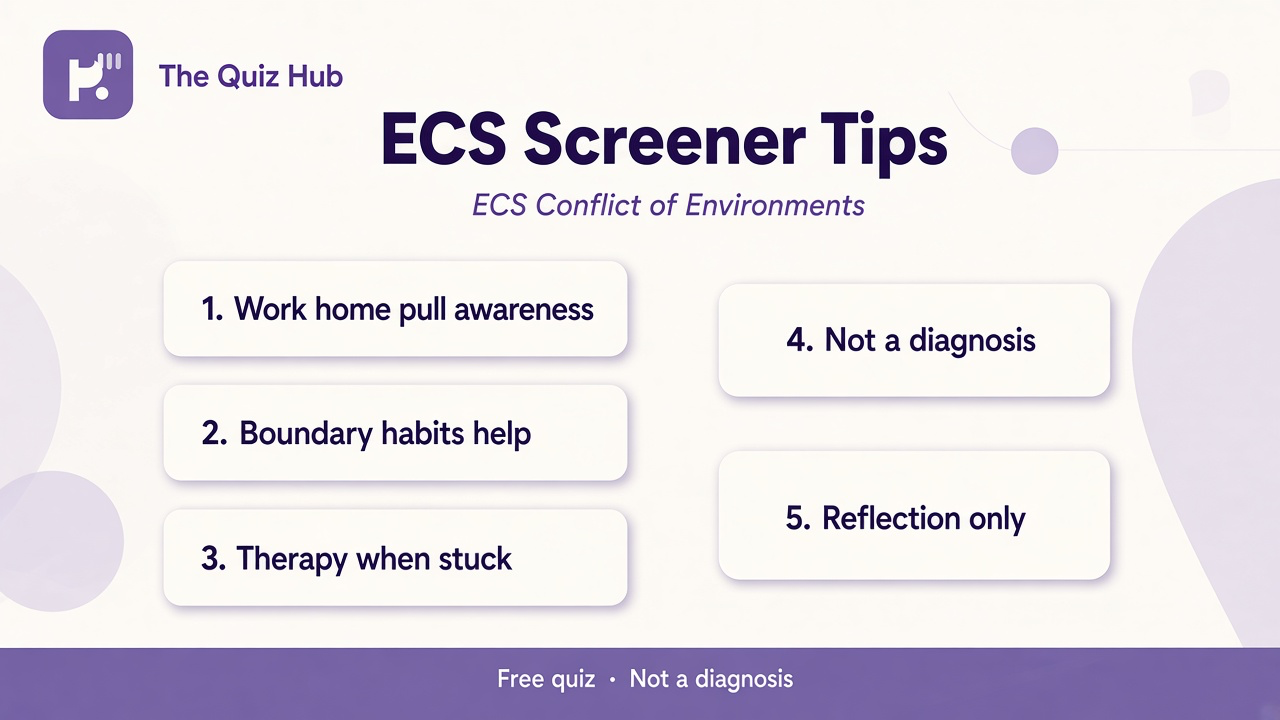
What this quiz can and cannot tell you
Can tell you
- Separate work home pull, switching strain, boundaries, and help delay in plain language
- Highlight loops that deserve compassion, schedule changes, or professional support
- Give you vocabulary for therapist, counselor, or employee assistance intake
- Offer a baseline if you retake after one boundary experiment
Cannot tell you
- Replace a validated Conflict of Environments Scale (ECS) or published research norms
- Diagnose burnout, anxiety, or relationship disorders without evaluation
- Tell your manager what to do or prove you must quit from one score
- Account for economic pressure, caregiving crises, or unsafe workplaces on its own
ECS-inspired environment conflict: work home pull, boundaries, and help
Researchers and clinicians use several environment conflict measures when they study how work, family, and other settings compete for attention. Some literature abbreviates related ideas as ECS or conflict of environments language. This page borrows that familiar label to organize self-reflection, but it is not an official instrument and your score cannot be compared to journal cutoffs. Treat the result as a map for conversations with therapists, partners, or HR wellness programs, not as homework from a research study.
Work home pull shows up when pings, guilt, or unfinished tasks colonize meals, bedtime, or weekends you already promised to someone you love. Role switching strain shows up when you enter the house still in boss voice, or when caregiver worry follows you into a meeting because every role shares one phone. Those bars describe demand and recovery gaps, not bad character.
Boundary habits matter because conflict sticks when limits stay vague. Always-on praise at work, fear of disappointing relatives, or hybrid desks that never close teach your nervous system that rest is theft. Small wins include one protected off hour, muted notifications during sleep, and asking for deadline relief before silent resentment grows. Therapy when stuck is the fourth bar because repeating loops rarely fix themselves when shame says you should cope alone.
If work home pull runs high while boundary habits stay moderate, schedule and communication experiments may help first: shared calendars, explicit stop times, or a couples check-in about spillover. If switching strain runs high with low therapy bars, a counselor can help design transitions and grief about roles you cannot drop overnight. Our drivers of mental health quiz adds sleep, stress load, and connection habits; our Dutch work addiction scale (DUWAS) sibling emphasizes work drive and rest resistance. Use them for YMYL reflection alongside this environment conflict screener, not instead of care when safety is at risk.
Retake after four weeks of one measurable boundary, such as no work chat after nine or a five minute walk before you greet your household, and compare domain bars, not only the total. Sustainable roles still include hard seasons; the goal is fewer months where every environment steals from the others without support.
| Test | Focus |
|---|---|
| Drivers of mental health | Sleep, stress, connection, and help seeking rather than work home role pull and boundary habits here |
| Dutch work addiction scale (DUWAS) | Work drive and rest resistance rather than home role switching and couples spillover language |
ECS Conflict of Environments FAQ
Is this the official Conflict of Environments Scale (ECS)?
No. This is an unofficial, ECS-inspired environment conflict screener written for self-reflection on our site. It does not use a single validated ECS item set or published norms and cannot be scored like every research clinic form labeled ECS.
What does environment conflict mean on this quiz?
It means how often competing roles and settings, especially work and home, pulled on your time, attention, and mood in the past month. You get an index from 0 to 100 plus four domain bars. It reports self-reported frequency, not a clinical diagnosis.
How is this different from a work life balance quiz?
This page stays focused on ECS-style work home pull, role switching strain, boundary habits, and therapy when stuck. A general balance quiz may emphasize leisure ratios or satisfaction labels. Stems here are written for frequency of spillover and limits, not duplicate balance slogans.
Can this quiz diagnose burnout or anxiety?
No. Only a licensed clinician can diagnose mental health or occupational conditions after full evaluation. Use this tool to describe environment conflict habits and decide whether therapy, counseling, or employee assistance might help.
What should I do if my score is high?
Try one concrete boundary, tell one trusted person the truth about spillover, and book a clinician or counselor if patterns persist. Call or text 988 (US) if you feel unsafe or are thinking about self-harm.
Who reviewed this quiz?
Dr. Elena Vasquez, PhD reviewed the YMYL framing, unofficial ECS limits, and crisis resource guidance. See our editorial policy for review standards.
Reviewed by