What this reflection measures
This screener does not stamp you as a fixed archetype or replace clinical assessment. It measures how much you agree with habit statements grouped four ways: leader momentum about initiative, timelines, and delegation; caregiver presence about noticing moods, private check-ins, and dignity; analyst lens about evidence, structure, and careful wording; and rebel spark about questioning wasteful rules and trying alternatives. You answer 22 statements from strongly disagree to strongly agree, with reverse-worded items so one lucky streak cannot inflate every bar. Your answers also feed a second chart on closeness and trust habits, because trait performance and vulnerability often trade places under stress. The total becomes a reflection index from 0 to 100 where higher means more reported endorsement of these habit clusters on this screener, not proof you must lean on every trait in every room.
Leader momentum
Naming next steps, owning logistics, speaking on timelines, and delegating when goals are clear.
Caregiver presence
Noticing fatigue, private check-ins, remembered comforts, and softening public embarrassment.
Analyst lens
Pros-and-cons lists, evidence questions, calming checklists, and catching inconsistencies.
Rebel spark
Challenging harmful rules, restlessness with tradition, fair unpopular ideas, and workflow experiments.
How it works
Answer 22 agreement items
Rate each statement from Strongly disagree to Strongly agree. Tap Next after each answer.
Answers sort into four domains
Each answer feeds one of four trait groups, and every item also feeds a closeness and trust layer.
See your index and charts
You get a 0 to 100 index, a band, four domain bars, and a second chart for intimacy habits.
Take the Dominant Character Trait Quiz
Answer 22 short statements to see your reflection index, four trait bars, and a closeness and trust chart.
What your result means
Your index is the average of all 22 answers, scaled from 0 to 100, with reverse-worded items flipped first. Higher means more reported endorsement of these habit clusters on this screener. Read the tallest domain bar before you tell a single-label story about yourself.
| Band | Index range | Typical reading |
|---|---|---|
| Quieter trait endorsement | 0 to 35 | Less agreement with leader, caregiver, analyst, and rebel habit items on this screener. |
| Mixed trait endorsement | 36 to 65 | Strong habits in some domains with softer agreement in others. |
| Broad trait endorsement | 66 to 100 | Frequent agreement across initiative, care, analysis, and independent challenge items. |
Tips at a glance
A quick takeaway graphic with topic tips (not your personal quiz scores). Start the quiz for your index, bands, and charts.
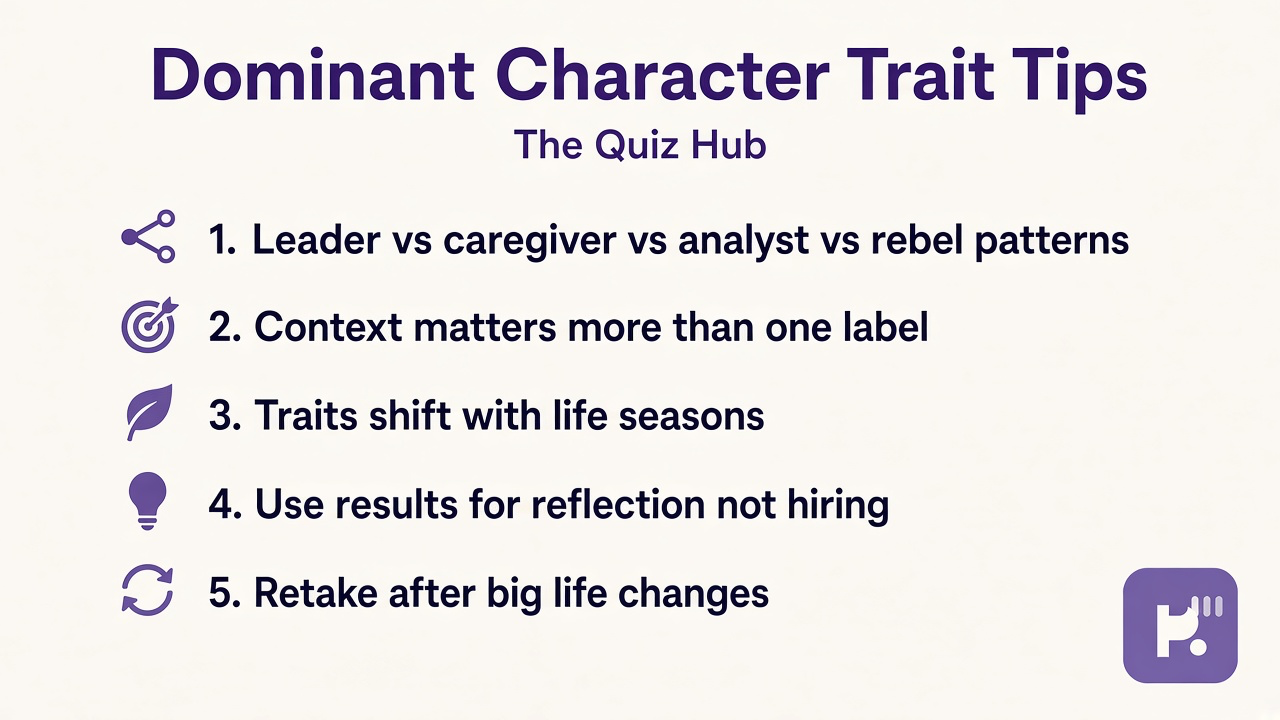
What this quiz can and cannot tell you
Can tell you
- Highlight which habit cluster your recent choices resemble
- Separate default role from mood-of-the-week noise
- Spark honest conversations with friends about how you show up
- Offer a baseline before you try a sibling trait model on this hub
Cannot tell you
- Diagnose personality disorders or assign permanent archetype labels
- Tell employers whom to hire based on one bar height
- Prove you must lead, nurture, analyze, or rebel in every context
- Replace therapy when traits mask burnout, trauma, or relationship harm
Why daily choices beat single-word archetypes
Archetype language is catchy because it turns a messy week into a badge. Leader, caregiver, analyst, and rebel are shorthand for clusters of behavior people already recognize in offices, families, and group chats. The useful question is not which sticker fits your forehead but which cluster your body reaches for when uncertainty arrives. Do you assign tasks, scan faces, open a notes app, or ask why the rule exists? Those moves repeat until they feel like identity.
Leader momentum shows up when groups lack direction. Naming the next step is not dominance for its own sake; it is relief when everyone is polite and stuck. The shadow version is hoarding decisions because trust feels slow. Caregiver presence is attunement: catching exhaustion, checking in privately, remembering the small comfort that makes apology easier. The shadow version is fixing people who did not ask, or performing warmth to avoid conflict. Analyst lens is love of clarity: lists, timelines, rewritten emails, and questions about evidence. The shadow version is stalling forever or using logic to dodge feelings. Rebel spark is fairness and freshness: pushing back when rules waste time or harm the quiet person. The shadow version is contrarian theater.
Real people rotate. You may lead at work, caregive at home, analyze finances, and rebel only online. Culture rewards some clusters and punishes others, especially across gender and race. A screener captures self-report in one window, not your whole biography. Reverse items catch performative answers: waiting for titles before speaking, ignoring moods until asked, trusting gut without follow-up, or obeying tradition without thought should not inflate bars meant to track active habits.
Pair bar charts with context notes. High caregiver with high fear-of-intimacy on the stack might mean you nurture others while hiding your own needs. High rebel with low leader might mean you critique systems but avoid running them. That tension is data, not failure. If you want research-backed trait percentiles beside habit language, follow with a Big Five style measure; if you want motivation language, try an Enneagram-style sibling on this hub. Save one bar to lean on this month and one to rest. Identity grows when choices stay conscious, not when a quiz picks a mascot forever.
| Test | Focus |
|---|---|
| Big Five personality test | Research-backed OCEAN trait percentiles rather than leader-caregiver-analyst-rebel habit clusters |
| Enneagram test | Nine motivation types with wings rather than four daily-choice habit bars |
Dominant Character Trait Quiz FAQ
What does the reflection index measure?
It measures how much you agree with habit statements about leading, caregiving, analyzing, and rebelling in everyday moments. You get an index from 0 to 100 and four bars. It reflects self-report on this screener, not a fixed archetype or clinical label.
Which trait is my dominant one?
Compare the four domain bars. The tallest bar is the best hint about which habit cluster you endorsed most here. The index average does not pick a winner when two bars tie; read the chart and your recent week together.
Why are some statements worded opposite to the trait?
Reverse-worded items catch autopilot responding. Agreeing that you wait for titles, ignore moods until asked, skip follow-up questions, or obey tradition without curiosity should not inflate bars meant to track active habits.
Can I be high on more than one trait?
Yes. Many people endorse several clusters, especially under responsibility pressure. Broad highs are a signal to choose boundaries, not proof you must play every role at once.
Who reviewed this quiz?
Dr. James Whitfield, PhD reviewed the reflection-only framing, habit wording, and limits on clinical or hiring use. See our editorial policy for review standards.
Reviewed by