What the Do You Think In Words Or Pictures Quiz measures
This quiz does not measure IQ or label you forever. It measures how you describe your own thinking right now, in four groups that cognitive researchers use when they talk about dual coding: inner speech, mental imagery, how you remember episodes, and whether you habitually pair words with pictures. You rate 22 statements from strongly disagree to strongly agree, and a few are reversed so agreeing with everything cannot inflate your score. Your answers also feed a second chart on closeness and trust habits, because people who live mostly in their heads sometimes pull back from sharing inner experience aloud. The total becomes an index from 0 to 100 where higher means a stronger picture-and-imagery lean relative to words on this screener, not better or worse thinking.
Inner speech
How much you think in sentences, self-talk, and named ideas rather than scenes.
Mental imagery
How vividly you see places, faces, and motion in your mind when you are awake.
Memory style
Whether you bring back episodes as stories, snapshots, or a mix when you remember.
Dual coding
How often you pair a label with a picture when you learn, plan, or explain something.
How it works
Answer 22 agree or disagree items
Rate each statement from Strongly disagree to Strongly agree. Tap Next after each answer.
Answers sort into four domains
Each answer feeds one of four cognitive style groups, and every item also feeds a closeness and trust layer.
See your index and charts
You get a 0 to 100 index, a band, and two bar charts you can compare with a friend who thinks differently.
Take the Do You Think In Words Or Pictures Quiz
Answer 22 short statements to see your words-versus-pictures index, four style bars, and a closeness and trust chart.
What your result means
Your index is the average of all 22 answers, scaled from 0 to 100, with reverse-worded items flipped first. Read the four bars before the total, since many people are verbal for work and visual for memories.
| Band | Index range | Typical reading |
|---|---|---|
| More verbal thinking | 0 to 35 | Inner speech and word-based memory outweigh vivid mental pictures. |
| Mixed verbal and visual | 36 to 65 | You switch between words and pictures depending on the task. |
| More visual thinking | 66 to 100 | Mental pictures and scene-based memory outweigh inner speech. |
Tips at a glance
A quick takeaway graphic with topic tips (not your personal quiz scores). Start the quiz for your index, bands, and charts.
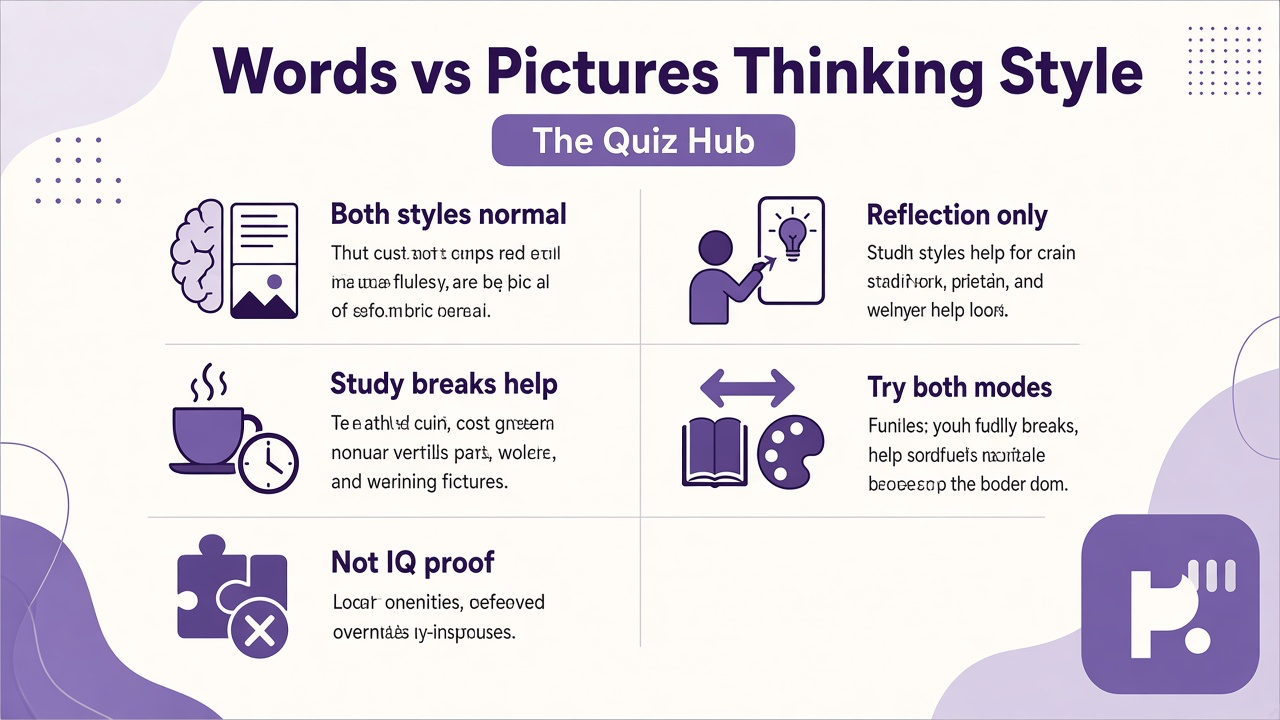
What this quiz can and cannot tell you
Can tell you
- Show whether you lean verbal, visual, or mixed on self-report items
- Highlight where dual coding might help you learn or explain ideas
- Give you language for talking with a tutor, therapist, or study partner
- Offer a baseline if you retake after practicing imagery or note-taking
Cannot tell you
- Measure intelligence, creativity, or neurological health
- Diagnose aphantasia, ADHD, or any clinical condition
- Replace lab tasks like the VVIQ or structured neuropsych testing
- Prove how you will think in ten years, since habits shift with training
Words, pictures, and dual coding in everyday thought
People who ask this question are usually comparing themselves to a friend who claims they never see pictures, or to someone who cannot stop narrating the day in their head. Neither side is fake. Cognitive psychologists have known for decades that memory and problem solving can run on language, on imagery, or on both, and that the mix changes with the task.
Allan Paivio's dual coding theory argues that information lasts longer when it is stored as words and as images. That is why textbooks add diagrams and why athletes rehearse both the feel and the name of a movement. Inner speech, studied in depth by researchers such as Charles Fernyhough, is the running commentary many adults notice when they read, worry, or plan. Mental imagery research, including work popularized through the Vividness of Visual Imagery Questionnaire, shows huge individual differences: some people see photorealistic scenes, others see faint blobs, and both groups can still be excellent at their jobs.
Your four result bars map onto that split. Inner speech and memory style capture the verbal track. Mental imagery captures the picture track. Dual coding captures whether you naturally link them. A high verbal score does not mean you lack imagination; many novelists and mathematicians report weak visual imagery but rich symbolic thought. A high visual score does not mean you cannot handle abstract ideas; designers and surgeons often think in space first and attach words second.
Use the index as a practical hint, not a personality verdict. If you lean verbal, try one sketch per study session. If you lean visual, try naming steps aloud or in writing so plans do not evaporate. Teachers and managers benefit from knowing their default channel, because presentations land better when you match the audience instead of insisting everyone think your way. If you want a research-aligned imagery check, follow up with our VVIQ test. And if imagery feels involuntary or upsetting rather than helpful, that is worth discussing with a mental health professional, because style and symptom are different questions.
Retake after a few months if you deliberately practice the weaker channel. Habits shift slowly, and the index is meant to track that shift, not to lock you into a type for life.
| Test | Focus |
|---|---|
| VVIQ test | Measures visual imagery vividness with a research-style questionnaire, not verbal thinking |
| Do I have a male or female brain quiz | Playful cognitive style tropes, not dual coding or imagery science |
Do You Think In Words Or Pictures Quiz FAQ
What does this quiz measure?
It measures how you rate your own inner speech, mental imagery, memory style, and word-plus-picture habits across 22 statements. You get an index from 0 to 100 and four domain bars. It describes your self-report style, not your intelligence.
Does a high score mean I have aphantasia or hyperphantasia?
No. This is a casual lean screener, not a clinical imagery test. For vividness-focused measurement, try the VVIQ test. Only a qualified clinician should interpret imagery problems that distress you.
Can I think in both words and pictures?
Yes. Many people land in the mixed band, using words for logic and pictures for places and faces. The domain bars show where you sit today, and practice can shift them.
Is this the same as being left-brained or right-brained?
No. The left-brain, right-brain story is oversimplified neuroscience. This quiz uses dual coding and imagery ideas that researchers still cite, without claiming a brain hemisphere type.
Who reviewed this quiz?
Dr. James Whitfield, PhD reviewed the framing, the limits note, and the result explanations. See our editorial policy for review standards.
Reviewed by