What the Dog Name Quiz measures
This quiz does not generate a random name or rank breeds. It measures how you rate your own dog-naming habits across four groups: favoring short clear names that train easily, keeping household agreement and one spelling on records, matching name tone to personality instead of only memes or coat color, and showing patience when a rescue rename needs overlap and treats. You answer 22 statements from strongly disagree to strongly agree, with reverse-worded items so aesthetic obsession cannot inflate every line. Your answers also feed a second chart on closeness and trust habits, because naming sometimes becomes a control battle instead of a shared welcome ritual. The total becomes an index from 0 to 100 where higher means more reported training-friendly, agreed-on naming habits on this screener, not proof you picked the only correct name on the internet.
Short name training
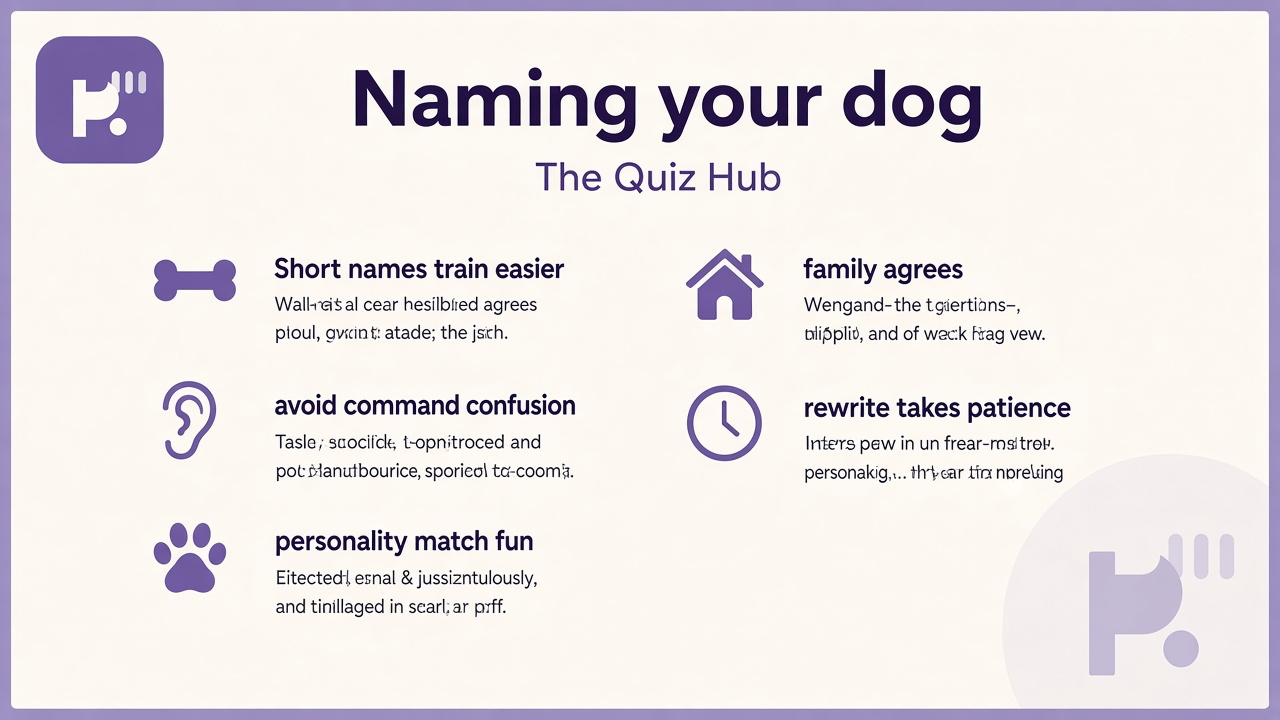
How much you favor brief names that are easy to say happily and firmly, without command confusion.
Family agreement
How much everyone who lives with the dog votes, sleeps on fights, and shares one spelling on tags.
Personality match
How much you match name vibe to energy and pass the busy-park yell test.
Rename patience
How much you give new names time, transition kindly, and avoid weekly rebrands.
How it works
Answer 22 agreement items
Rate each statement from Strongly disagree to Strongly agree. Tap Next after each answer.
Answers sort into four domains
Each answer feeds one of four naming habit groups, and every item also feeds a closeness and trust layer.
See your index and charts
You get a 0 to 100 index, a band, and two bar charts you can use before you engrave a tag.
Take the Dog Name Quiz
Answer 22 short statements to see your dog naming habit index, four domain bars, and a closeness and trust chart.
What your result means
Your index is the average of all 22 answers, scaled from 0 to 100, with reverse-worded items flipped first. Higher means more reported training-friendly, agreed-on naming habits. Read short-name training and family agreement bars together before you interpret the total.
| Band | Index range | Typical reading |
|---|---|---|
| Trend-first or solo naming | 0 to 35 | Few short-name, family, personality, or rename-patience habits reported. |
| Mixed naming habits | 36 to 65 | Some practical checks mixed with trends, solo picks, or quick renames. |
| Training-friendly naming habits | 66 to 100 | Frequent short-name, family, personality, and rename-patience habits. |
Tips at a glance
A quick takeaway graphic with topic tips (not your personal quiz scores). Start the quiz for your index, bands, and charts.
What this quiz can and cannot tell you
Can tell you
- Spot whether you chase trends more than trainable syllables
- Highlight household fights waiting to happen over spelling
- Separate meme names from personality-fit names
- Give a playful baseline to retake after you pick a final name
Cannot tell you
- Pick the single best name for your dog
- Replace trainers or behaviorists for recall problems
- Force family agreement without conversation
- Predict how much your dog likes any given syllable
Dog names that train easily and still feel like yours
People land on dog name quizzes when lists overflow and every friend votes. Generators spit out cute words; trainers whisper about syllables. Both can be true. A name you say fifty times a day should be easy to shout across a field and distinct from sit, stay, or no. That is not snobbery; it is acoustics in a distracted puppy brain.
Command confusion sneaks in when names rhyme with cues or sound like corrections. Testing a finalist in happy and stern voices catches names you will avoid in public. Short does not mean boring. It means your mouth can reach the dog before the squirrel wins. Two dogs in one home need names that do not blur together when both run toward the door.
Family agreement saves years of passive-aggressive nicknames on vet forms. One spelling on tags, microchips, and insurance beats three cute variants. Sleep on heated debates; backup names exist so nobody wins by exhaustion. Personality match keeps dignity off a zoomie gremlin, or leans into chaos on purpose. Coat-color names are fun; decade-long fit still tracks energy and the park yell test.
Renames need patience, especially for rescues. Overlap old and new words with treats beats day-one perfectionism. Weekly rebrands teach nothing except that words are optional. If recall stays weak after a solid name and training plan, the syllable count was never the whole story. Our dog breed quiz sibling nudges lifestyle and energy before you lock a heroic title. The dog breed identification quiz is for silhouette nerds, not naming fights at the dinner table.
Retake after you live with a name for two weeks. Bars that rise in family agreement and rename patience together mean less chaos at home, not internet bragging rights. The best name is one your people can say clearly, stick with, and say with affection when the dog chews something expensive.
| Test | Focus |
|---|---|
| Dog breed quiz | Lifestyle and breed tendency matching, not syllable and household naming habits |
| Dog breed identification quiz | Silhouette and coat ID craft, not training-friendly name picks |
Dog Name Quiz FAQ
What does this quiz measure?
It measures how you rate your dog-naming habits across short trainable names, family agreement, personality fit, and patient renames. You get an index from 0 to 100 and four bars. It reflects your approach, not a ranked list of perfect names.
Does a high score mean I picked the best name?
It means you reported more training-friendly, agreed-on naming habits on this screener. Your dog can adore a longer name if everyone trains consistently. Recall problems still deserve professional help.
Should dog names always be one syllable?
Not always, but brief clear names are easier to repeat during training. This quiz asks about habits like avoiding cue confusion, not a rigid syllable law.
Why are some items worded negatively?
Reverse-worded statements balance optimism. Agreeing that you rename weekly or pick from memes alone should not inflate a practical naming index.
Who reviewed this quiz?
Dr. Rachel Kim, PhD reviewed the framing, fun-only limits, and result explanations. See our editorial policy for review standards.
Reviewed by