What the Does Your Crush Like You Quiz For Girls 10-13 measures
This quiz does not read his mind. It measures how often you have noticed behaviors people commonly list when girls ages 10-13 wonder if a crush likes them back, grouped four ways: in-person effort such as sitting near you and remembering details, online warmth such as thoughtful replies and game invites, friend teasing and hint culture, and respect signals such as honoring your no and never pushing for private photos. You answer 22 how-often statements about recent weeks, with reverse-worded items so one dramatic gesture or one scary message cannot inflate your score the wrong way. Your responses also feed a second chart on closeness and trust habits, because crush hope and rejection fear often overlap at this age. The total becomes an index from 0 to 100 where higher means more reported kind attention on this screener, not a promise that he will ask you out or that you should ignore discomfort. If anything feels unsafe, talk with a parent, guardian, or school counselor before you chase a score.
In-person effort
How often he shows up near you, listens, and remembers real details at school or activities.
Online warmth
How often chats, reactions, and game invites feel personal and sustained.
Friend teasing
How often the friend group drops hints or smirks about him and you.
Respect signals
How often he honors limits, stays kind in public, and never pushes private photos or secret meetups.
How it works
Answer 22 frequency items
Rate each statement from Never to Very often for recent weeks. Tap Next after each answer.
Answers sort into four domains
Each answer feeds one of four signal groups, and every item also feeds a closeness and trust layer.
See your index and charts
You get a 0 to 100 index, a band, and two bar charts you can compare with a trusted friend or adult.
Take the Does Your Crush Like You Quiz For Girls 10-13
Answer 22 short statements to see your crush signal index, four domain bars, and a closeness and trust chart.
What your result means
Your index is the average of all 22 answers, scaled from 0 to 100. Higher means more reported signals. Read respect and online bars before the total, since screens and hallways often disagree at this age.
| Band | Index range | Typical reading |
|---|---|---|
| Few crush signs | 0 to 35 | Little in-person effort, online warmth, or friend buzz so far. |
| Mixed crush signs | 36 to 65 | Hot-and-cold moments without a steady pattern yet. |
| Several crush signs | 66 to 100 | Repeated effort and warmth; still confirm with words and respect. |
Tips at a glance
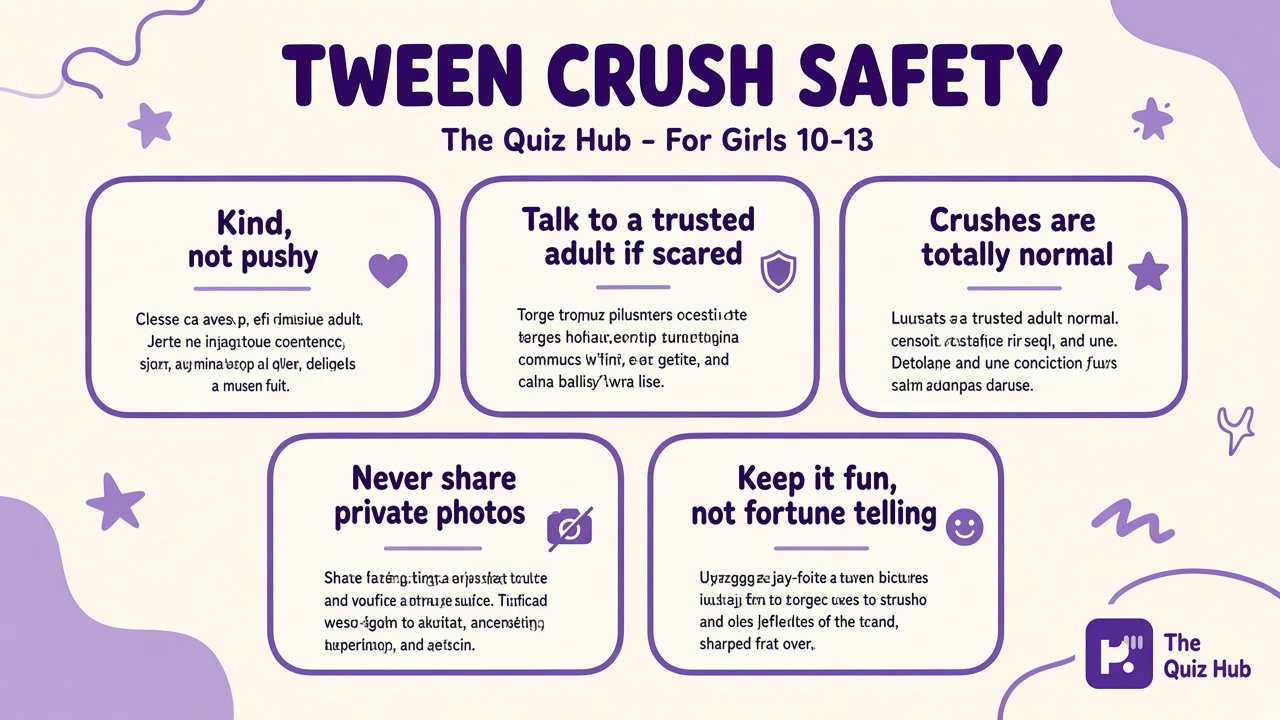
A quick takeaway graphic with topic tips (not your personal quiz scores). Start the quiz for your index, bands, and charts.
What this quiz can and cannot tell you
Can tell you
- Organize crush clues into effort, digital, friend, and respect buckets
- Highlight when respect bars lag behind flirt bars
- Give you language for a calm talk with a friend or trusted adult
- Offer a fun baseline to retake after more hangouts or a new semester
Cannot tell you
- Prove whether your crush likes you or will say so out loud
- Replace consent education, family rules, or safety planning online
- Tell shy apart from uninterested with certainty
- Tell you to pursue someone who ignores your no or asks for private photos
Crush signs for girls 10-13: kindness, friends, and safety
Search results love numbered lists: he likes you if he texts first, if he picks you for partners, if he stares in math. Real life at ages 10-13 is messier. Friends tease for sport. He may flood your notifications yet freeze at recess. This quiz keeps in-person effort, online warmth, friend noise, and respect separate so you can see which channel drives your guess without treating every smile as destiny.
Effort is more than staring. It is remembering your rehearsal day, choosing the seat near you, and listening when you talk about something boring to him. Digital warmth matters too, but laggy replies are not automatic rejection; some kids live on do-not-disturb or strict screen rules. Compare bars instead of letting one ghosted afternoon rewrite the story. Never send private photos to prove you like someone; kind crushes do not ask for them.
Friend teasing is the noisiest domain. Groups smirk when nothing is true and stay silent when something is. Treat hints as conversation starters with him or with a trusted adult, not as court transcripts. The respect domain is the non-negotiable one. Liking you should not cost your comfort. If warmth arrives with pressure for photos, grades, or alone time after you said no, that is a safety issue. Tell a parent, guardian, or counselor.
When you are ready, simple words beat oracle mode. You can ask whether he wants to sit together at a game without planning a whole relationship speech. No means no, and slow down means slow down. Compare with our does my crush like me quiz for girls if you want similar domains with slightly older wording, or the middle school quiz for campus and friend-buzz examples in grades 6-8.
Retake after a break or a new semester. Bars that rise together across effort and respect are worth attention. Bars that spike only in friend teasing often mean theater. Your worth is not his mood chart, and having a crush does not mean you must date anyone.
| Test | Focus |
|---|---|
| Does my crush like me quiz for girls | Similar four domains with phrasing aimed a bit older than ages 10-13 |
| Does he like me quiz middle school | Campus closeness and friend buzz for grades 6-8 without the girls 10-13 safety emphasis |
Does Your Crush Like You Quiz For Girls 10-13 FAQ
What does this quiz measure?
It measures how often you have noticed in-person effort, online warmth, friend teasing, and respect signals from your crush. You get an index from 0 to 100 and four bars. It reports what you have seen, not what he secretly feels.
Is this quiz only for ages 10 through 13?
The items describe settings many tweens know: lunch, recess, class apps, and group chats. Younger or older readers can still use it, but the examples and safety notes target girls in that age range.
Can he like me and still score low?
Yes. Shyness, strict screen rules, or a new schedule can hide signals. A low band means you reported few signs lately, not that you are unlikable.
What if online warmth is high but he ignores me at school?
Compare your in-person and online bars. Some kids are bolder on a screen. Still check respect: kindness should not flip off in public, and nobody should pressure you for private photos online.
Who reviewed this quiz?
Dr. James Whitfield, PhD reviewed the framing, respect limits, and tween safety disclaimer. See our editorial policy for review standards.
Reviewed by