What the Does He Like Me Quiz Middle School measures
This quiz does not read his mind. It measures how often you have noticed behaviors that tweens commonly list when they wonder if a classmate likes them, grouped four ways: campus closeness during the school day, after-school chats and shared apps, buzz from friends and classmates, and flustered or trying-hard moments around you. You answer 22 how-often statements about recent weeks, with a few reverse-worded items so wishful thinking alone cannot inflate your score. Your answers also feed a second chart on closeness and trust habits, because crush anxiety in middle school sometimes overlaps with fear of rejection or rushing intimacy before you are ready. The total becomes an index from 0 to 100 where higher means more reported signals on this screener, not a promise that he will ask you to a dance or that you should chase anyone who ignores your comfort. Parents and counselors sometimes use the language in your results to start a calm conversation, but this tool is not therapy, not a school record, and not permission to share private chats without consent.
Campus closeness
How often he drifts toward you during lunch, lockers, electives, and transitions.
After-school chats
How often he keeps conversations going on apps, games, or DMs after class.
Friend buzz
How often classmates tease, whisper, or drop hints that he asked about you.
Flustered moments
How often he seems extra shy, loud, or clumsy around you compared with other kids.
How it works
Answer 22 frequency items
Rate each statement from Never to Very often for recent weeks. Tap Next after each answer.
Answers sort into four domains
Each answer feeds one of four signal groups, and every item also feeds a closeness and trust layer.
See your index and charts
You get a 0 to 100 index, a band, and two bar charts you can compare with a friend who knows the situation.
Take the Does He Like Me Quiz Middle School
Answer 22 short statements to see your crush signal index, four signal bars, and a closeness and trust chart.
What your result means
Your index is the average of all 22 answers, scaled from 0 to 100. Higher means more reported signals. Read the four bars before the total, since many middle school crushes show up in chats but not at lunch.
| Band | Index range | Typical reading |
|---|---|---|
| Few crush signs | 0 to 35 | Little campus closeness, chat warmth, or friend buzz so far. |
| Mixed crush signs | 36 to 65 | Hot-and-cold moments without a steady pattern yet. |
| Several crush signs | 66 to 100 | Repeated signals across school and chat; still confirm with words when you can. |
Tips at a glance
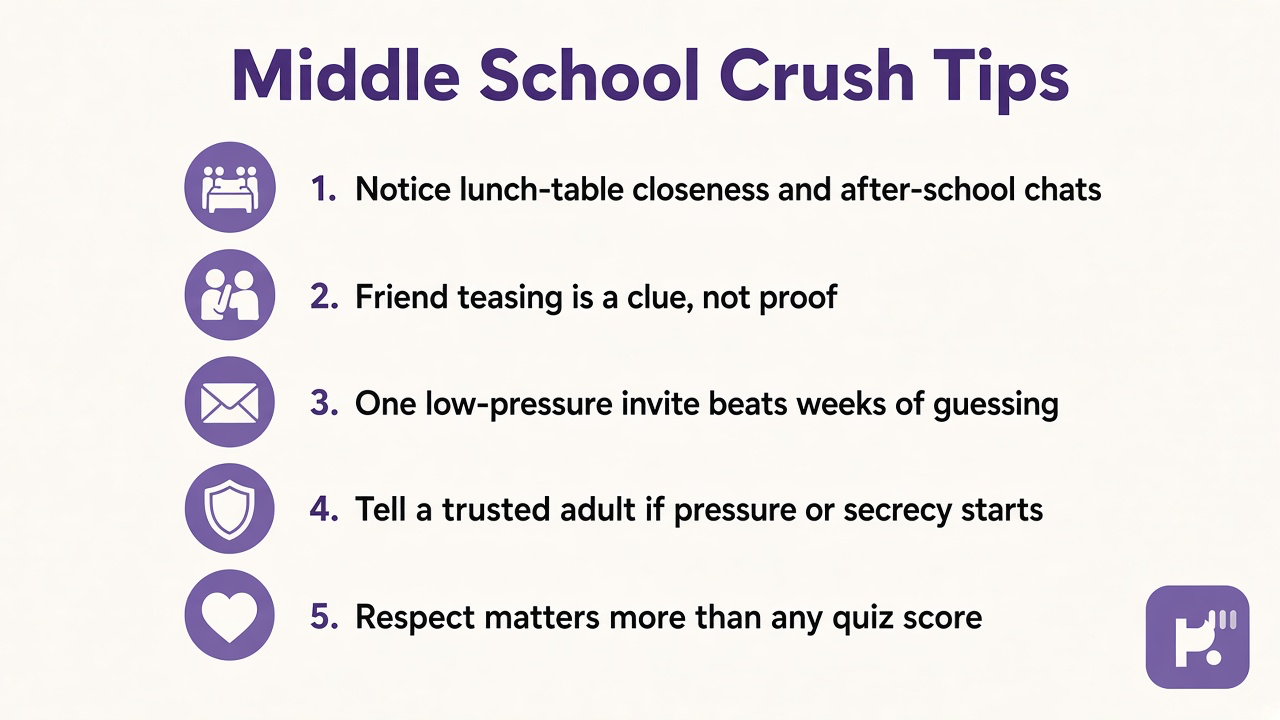
A quick takeaway graphic with topic tips (not your personal quiz scores). Start the quiz for your index, bands, and charts.
What this quiz can and cannot tell you
Can tell you
- Organize mixed signals into four clear domains
- Give you language for talking with a friend or trusted adult
- Highlight when attention might deserve a direct conversation
- Offer a fun baseline to retake after a semester change
Cannot tell you
- Prove whether he likes you or predict his next move
- Replace consent, boundaries, or safety planning for meetups
- Account for every cultural difference in how kids show interest
- Tell you whether you should date him
Middle school crushes: what helps beyond guessing
Middle school is often the first time crushes feel loud because almost everyone shares the same building, the same lunch period, and the same group chat by dinner. A boy who likes you might not say it outright. He might simply start appearing near your table, asking about your electives, or sending a meme after homework. That is why this quiz separates campus closeness, after-school chats, friend buzz, and flustered moments instead of treating every smile as destiny.
Researchers who study social attention in tweens note that kids overestimate both interest and rejection when hormones and reputation mix. Hope can make a borrowed pencil feel romantic; embarrassment can make a missed wave feel like proof he hates you. Reverse-worded items in the quiz help balance that optimism, but your own notes about respect still matter more than any index.
Digital warmth matters early now. Many sixth graders coordinate friendships through games and school apps before they coordinate face-to-face plans. A quick reply might mean interest, boredom, or group-chat reflex. In-person closeness still counts: choosing your partner in class, walking toward your locker, remembering what you said at recess. Friend buzz is the weakest evidence alone, because classmates enjoy teasing, yet repeated hints from people who actually know him can be worth listening to.
If your score is high, enjoy the possibility and still use your voice. A simple invite to sit together at a game or work on a project tells you more than another week of decoding. If your score is low, you are allowed to move on without a speech from him. Crushes pass, and your energy can go toward friends, hobbies, sleep, and school instead of replaying one hallway moment.
If his attention ever ignores your no, mocks you publicly, or pushes for secrets you are not ready to keep, talk to a parent, counselor, or trusted adult. Mutual liking should feel exciting, not scary. Screenshot culture starts early, so think before you share private chats with the whole grade. Loyalty to a friend matters, and so does loyalty to your own boundaries when gossip starts.
| Test | Focus |
|---|---|
| Does he like me back high school quiz | Hallway and upper-teen social cues for grades 9-12, not lunch-line tweens |
| Does he like me quiz | General crush signals without a middle school campus and friend-buzz focus |
Does He Like Me Quiz Middle School FAQ
What does this quiz measure?
It measures how often you have noticed crush-style behaviors from him across campus closeness, after-school chats, friends, and flustered moments. You get an index from 0 to 100 and four bars. It reports what you have seen, not what he secretly feels.
Is this quiz only for grades 6 through 8?
The items describe middle school settings like lunch lines, lockers, and class apps. Older or younger readers can still use it, but the examples target tweens in those grades.
Does a high score mean he will ask me out?
No. It means you reported several signals lately. He might still be shy, unsure, or friendly without romantic intent. A calm conversation or shared activity is still the clearest step.
What if he is nice online but ignores me at school?
That is common. Compare your after-school chats and campus closeness bars. Some kids flirt only on screens; others only in person. Look for respect in both places.
Who reviewed this quiz?
Dr. James Whitfield, PhD reviewed the framing, the tween safety notes, and the result explanations. See our editorial policy for review standards.
Reviewed by