What the Does The Hormone Quiz Really Work reflection measures
This reflection does not run your hormones, diagnose disorders, or recommend products. It measures how much you agree with statements about consumer hormone quizzes grouped four ways: what mail-in and web quizzes can and cannot prove about assays, how symptom checklists differ from causal lab interpretation, how marketing and influencer funnels shape trust, and when licensed clinicians must lead testing and treatment decisions. You answer 22 statements from strongly disagree to strongly agree, with reverse-worded items so a burst of healthy skepticism cannot hide agreement with risky DIY dosing ideas. Your answers also feed a second chart on closeness and trust habits, because body and energy fears sometimes push people toward quick online answers. The total becomes an index from 0 to 100 where higher means more reported alignment with hype-heavy or limitation-blind beliefs on this screener, not proof that any specific hormone quiz works or fails in the lab.
Test evidence limits
How much you treat quizzes like validated clinical tests with published methods.
Symptoms versus labs
How much you separate checklists from exam, history, and appropriate assays.
Marketing hype
How much ads, testimonials, and upsells shape what you trust.
Clinician role
How much you rely on licensed professionals for interpretation and safety.
How it works
Answer 22 agreement items
Rate each statement from Strongly disagree to Strongly agree. Tap Next after each answer.
Answers sort into four domains
Each answer feeds one of four belief groups, and every item also feeds a closeness and trust layer.
See your index and charts
You get a 0 to 100 index, a band, and two bar charts you can discuss with a clinician.
Take the Does The Hormone Quiz Really Work
Answer 22 short statements to see your hormone quiz evidence alignment index, four domain bars, and a closeness and trust chart.
What your result means
Your index is the average of all 22 answers, scaled from 0 to 100, with reverse-worded items flipped first. Higher means more reported trust in limitation-blind or hype-heavy beliefs on this screener. Read marketing hype and clinician role bars before you act on any kit offer.
| Band | Index range | Typical reading |
|---|---|---|
| Stronger evidence alignment | 0 to 35 | More agreement with limits on consumer quizzes and clinician-led interpretation. |
| Mixed evidence alignment | 36 to 65 | Some healthy skepticism mixed with trust in quiz marketing or symptom-only stories. |
| Weaker evidence alignment | 66 to 100 | Frequent trust in quiz hype or DIY dosing; seek clinician review before acting. |
Tips at a glance
A quick takeaway graphic with topic tips (not your personal quiz scores). Start the quiz for your index, bands, and charts.
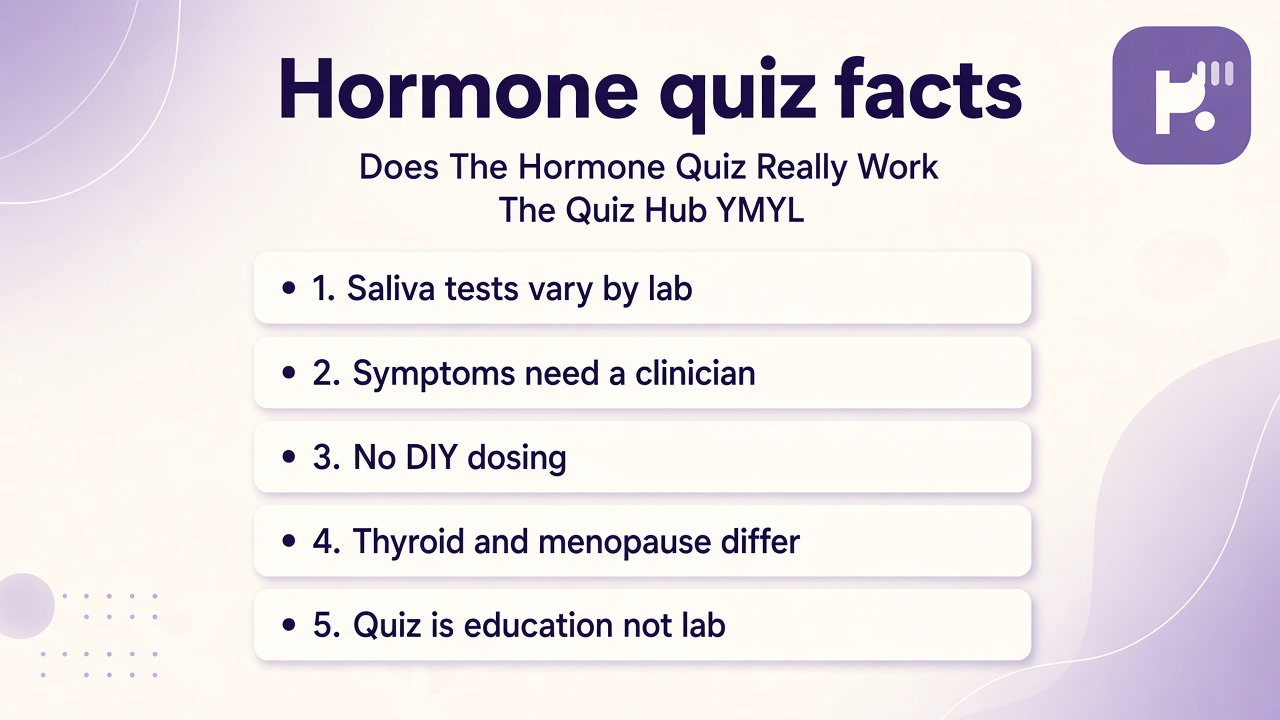
What this quiz can and cannot tell you
Can tell you
- Clarify what consumer hormone quizzes cannot prove
- Separate symptom stories from lab interpretation needs
- Flag when marketing upsells outrun evidence
- Give language for a grounded clinician conversation
Cannot tell you
- Tell whether your specific mail-in kit is accurate
- Diagnose thyroid, menopause, PCOS, or any hormone disorder
- Recommend supplements, doses, or DIY hormone protocols
- Replace licensed interpretation of labs and safety monitoring
Do online hormone quizzes really work?
Search and social feeds are full of hormone quizzes tied to saliva kits, supplement stacks, and influencer brands. Many people arrive with real complaints: stubborn fatigue, cycle changes, low libido, anxiety, or weight shifts. The question is not whether hormones matter. They do. The question is whether a twenty-question funnel with a shopping cart can replace the slow work of history, exam, and appropriately ordered labs. Credible patient education from the Endocrine Society and the National Institute of Diabetes and Digestive and Kidney Diseases stresses professional interpretation, not DIY dosing from a web score.
Consumer kits vary by matrix (saliva versus blood), timing, and reference ranges. Two kits can disagree without either being a conspiracy. Quizzes that map symptoms to a single hormone story rarely account for medications, pregnancy, perimenopause, thyroid autoimmunity, sleep apnea, depression, or anemia. That is the symptom versus lab gap: overlap is not proof. Thyroid concerns, menopause transitions, and testosterone questions need different workups; one-size quiz copy cannot hold all three safely.
Marketing hype is the second trap. Before-and-after photos, podcast ads, and celebrity funnels borrow legitimate symptom language then sell certainty. Free quizzes that upsell proprietary panels are not neutral second opinions. When profit sits on both the quiz and the kit, skepticism is rational, not anti-science. You can want answers and still refuse to let an algorithm authorize hormones.
Clinicians integrate labs with blood pressure, family history, fertility goals, cancer risk, and drug interactions. Pharmacists catch dangerous overlaps. Endocrinologists and gynecologists adjust plans when symptoms persist despite normal-looking panels. Bringing quiz printouts to a visit can help you organize questions; letting them replace the visit cannot. If you are weighing menopause symptoms specifically, our do I need HRT quiz is another reflection tool with strict non-prescription limits, still not a substitute for care.
Retake this screener after you read a clinic handout or complete a visit if you want to see whether your beliefs shifted. Save domain bars when a new ad campaign hits your feed. If you already bought kits or supplements from a quiz, tell your clinician exactly what you used. Evidence-aligned habits protect you from hype; they do not dismiss the symptoms that led you to search.
| Test | Focus |
|---|---|
| Do I need HRT quiz | Menopause symptom burden reflection when hormone therapy is on your mind, not consumer kit marketing literacy |
| Mental health and clinical tests | Broader YMYL screeners and education hub rather than hormone quiz evidence alone |
Does The Hormone Quiz Really Work FAQ
What does this reflection measure?
It measures how much you agree with statements about limits of consumer hormone quizzes, symptom versus lab reasoning, marketing hype, and clinician-led care. You get an index from 0 to 100 plus four domain bars. It reports belief patterns, not your hormone levels.
Does a high score mean the hormone quiz I saw is fake?
No. A higher index means you reported more agreement with hype-heavy or limitation-blind beliefs on this screener. Some kits use real labs; the issue is whether quiz copy oversells what results mean. Ask a clinician before you act.
Can an online saliva test replace my doctor?
No. Home collection can inform a visit when ordered thoughtfully, but interpretation needs your history, exam, and sometimes repeat testing. Quizzes that skip clinicians cannot safely authorize treatment.
Are thyroid and menopause quizzes interchangeable?
No. Thyroid disorders, perimenopause, PCOS, and testosterone concerns need different questions and assays. One generic funnel cannot responsibly cover all of them.
Who reviewed this reflection?
Dr. Elena Vasquez, PhD reviewed the YMYL framing, educational limits, and patient safety language. See our editorial policy for review standards.
Reviewed by