What the Does My Mom Love My Sister More Than Me Quiz measures
This quiz does not read your mother's mind or label your family abusive. It measures how often you have noticed favoritism-style patterns grouped four ways: parental attention balance when praise and perks lean toward your sister, sibling comparison pain when you feel ranked or double standards sting, one-on-one time with you when solo mom moments feel rare, and warmth and repair when jealousy talks end in validation or freeze-outs. You answer 22 how-often statements about recent weeks at home, with reverse-worded items so one good weekend cannot erase a month of scoreboard comments. Your responses also feed a second chart on closeness and trust habits, because feeling second can overlap with trouble asking for help elsewhere. The total becomes an index from 0 to 100 where higher means more reported favoritism signals on this screener, not proof she loves your sister more or that you should accept fear as normal. If you are scared at home, tell a trusted adult before debating scores.
Parental attention balance
How often patience, praise, and perks lean toward your sister when both need your mom.
Sibling comparison pain
How often you feel ranked, invisible, or punished by different rules than your sister.
One-on-one time with you
How often she makes real solo space for your news, events, and hard days.
Warmth and repair
How often she validates hurt, says love plainly, and repairs after jealousy talks.
How it works
Answer 22 frequency items
Rate each statement from Never to Very often for recent weeks at home. Tap Next after each answer.
Answers sort into four domains
Each answer feeds one of four favoritism pattern groups, and every item also feeds a closeness and trust layer.
See your index and charts
You get a 0 to 100 index, a band, and two bar charts you can share with a counselor if you choose.
Take the Does My Mom Love My Sister More Than Me Quiz
Answer 22 short statements to see your sibling favoritism index, four domain bars, and a closeness and trust chart.
What your result means
Your index is the average of all 22 answers, scaled from 0 to 100, with reverse-worded items flipped first. Higher means more reported favoritism signals. Read attention balance and comparison pain before you interpret the total.
| Band | Index range | Typical reading |
|---|---|---|
| Few favoritism signals | 0 to 35 | Little extra lean toward your sister on attention, comparison, solo time, or repair. |
| Mixed favoritism signals | 36 to 65 | Some leaning toward your sister without a steady story in every domain. |
| Several favoritism signals | 66 to 100 | Repeated lean toward your sister; still choose safety over score debates. |
Tips at a glance
A quick takeaway graphic with topic tips (not your personal quiz scores). Start the quiz for your index, bands, and charts.
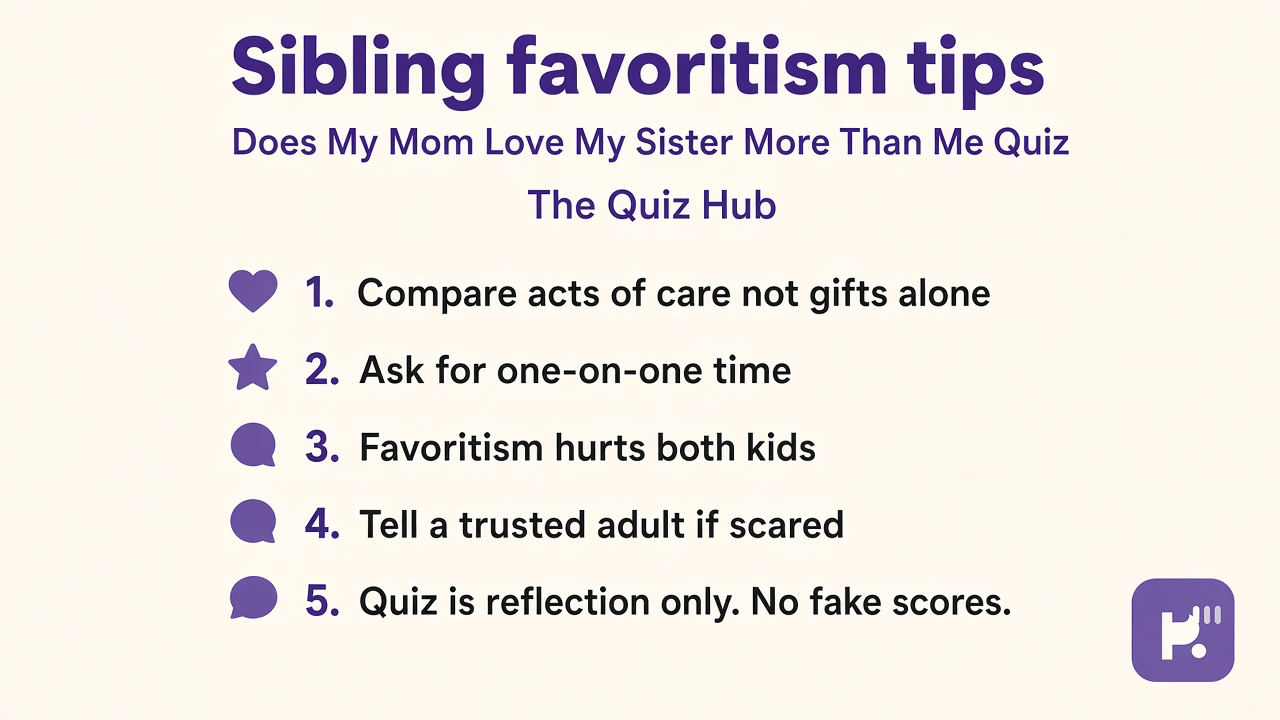
What this quiz can and cannot tell you
Can tell you
- Separate gift spikes from steady attention patterns
- Give you language for a trusted adult or counselor talk
- Highlight when fear matters more than favoritism debate
- Track whether bars shift after a family agreement or school break
Cannot tell you
- Prove whether your mom loves your sister more than you
- Replace therapy, mediation, or child protective services
- Diagnose abuse or excuse violence as parenting stress
- Force fair treatment without your parent's participation
Sibling favoritism: attention, comparison, and solo time
Teens search does my mom love my sister more than me when every story at dinner stars someone else, or when your request waits while her yes is instant. Love and fair attention are not always the same skill. This quiz separates attention balance, comparison pain, one-on-one time with you, and warmth after conflict so you can see which bar hurts, not only whether one fight felt fatal.
Dr. Priya Sharma reviews family reflection tools with a safety-first lens. Compare acts of care, not gifts alone. Your sister may get rides because of age or schedule while you still need words and solo time. You are allowed to want both fairness and affection. Asking for one predictable ritual with your mom is reasonable when home is emotionally safe enough to try.
Favoritism hurts both kids. Golden-child labels can spoil one sibling and shrink the other. Double standards teach resentment, not gratitude. If relatives call you the difficult one, say so to someone outside the house. Our does my mom love me quiz looks at love signals toward you without centering a sibling rivalry frame.
One-on-one time is often the bar that empties first. Shared family meals are not the same as ten minutes where you are the only topic. Request a walk, car ride, or weekly check-in in plain language. If she punishes jealousy talk with silence, that belongs in warmth and repair, not as proof you are too sensitive. Tell a trusted adult if freeze-outs feel scary, not only unfair.
Retake after a known change like counseling, a parent job shift, or a family agreement month. Progress might look like fewer public comparisons, not identical gifts. If comparison pain stays high while fear spikes, let that data override guilt. Support exists even when parents move slowly. Our children's rivalry scale frames envy and resentment when you want adult language for sibling strain.
| Test | Focus |
|---|---|
| Does my mom love me quiz | Love signals toward you without sibling comparison as the main frame |
| Children's rivalry scale 1886 | Envy and resentment frequency when sibling tension runs both ways |
Does My Mom Love My Sister More Than Me Quiz FAQ
What does this quiz measure?
It measures how often you notice attention leaning toward your sister, comparison pain, thin solo time with you, and uneven repair after jealousy talks. You get an index from 0 to 100 and four bars. It describes your experience, not your mom's secret ranking.
Does a high score mean my mom loves her more?
It means you reported more favoritism-style patterns on this screener lately. She may still love you deeply while showing it unevenly. Fear or threats deserve adult help regardless of the score.
What if she buys me things but spends more time with my sister?
Gifts and time split across different bars. Compare acts of care and solo attention, not only presents. You can ask for the kind of connection you miss when it is safe to talk.
Should I tell someone if favoritism hurts?
Yes when pain is steady or home feels scary. A school counselor, relative outside the house, or therapist can help you ask for fairness without turning you into the problem kid.
Who reviewed this quiz?
Dr. Priya Sharma, PhD reviewed the family reflection limits, the favoritism hurts both kids note, and the result explanations. See our editorial policy for review standards.
Reviewed by