What the Does My Husband Respect Me Quiz measures
This quiz does not label your husband abusive or tell you to stay or leave. It measures how often you have noticed respect-related behaviors spouses describe when they wonder if they are treated as an equal, grouped four ways: attentive listening without mockery, boundary honor when you say no, shared decision making on life choices, and contempt or control cues such as insults, ranking, or monitoring. You answer 22 how-often statements about the past month, with reverse-worded items so one polite dinner cannot hide a month of eye rolls. Your answers also feed a second chart on closeness and trust habits, because fear can make neutral tone feel like contempt or make control feel like jealousy. The total becomes an index from 0 to 100 where higher means more reported respectful partnership signals on this screener, not proof he will never slip again. Control, threats, and violence need professional and community support, not a retake.
Attentive listening
How often he listens without mockery, interruption, or dismissing your feelings.
Boundary honor
How often he stops when you set limits on sex, time, money, or privacy.
Shared decisions
How often he treats your input as equal on choices that affect both of you.
Contempt and control
How often insults, ranking, or monitoring shrink your dignity at home.
How it works
Answer 22 frequency items
Rate each statement from Never to Very often for the past month. Tap Next after each answer.
Answers sort into four domains
Each answer feeds one of four respect groups, and every item also feeds a closeness and trust layer.
See your index and charts
You get a 0 to 100 index, a band, and two bar charts you can compare if you retake after a talk.
Take the Does My Husband Respect Me Quiz
Answer 22 short statements to see your marital respect index, four partnership bars, and a closeness and trust chart.
What your result means
Your index is the average of all 22 answers, scaled from 0 to 100, with reverse-worded items flipped first. Higher means more reported respect signals. Read contempt and control alongside attentive listening before you interpret the total.
| Band | Index range | Typical reading |
|---|---|---|
| Few respect signals | 0 to 35 | More mockery, boundary pushes, or unilateral decisions reported. |
| Mixed respect signals | 36 to 65 | Warm days mixed with mockery, veto power, or control flashes. |
| Several respect signals | 66 to 100 | Listening, boundary honor, and shared decisions mostly steady. |
Tips at a glance
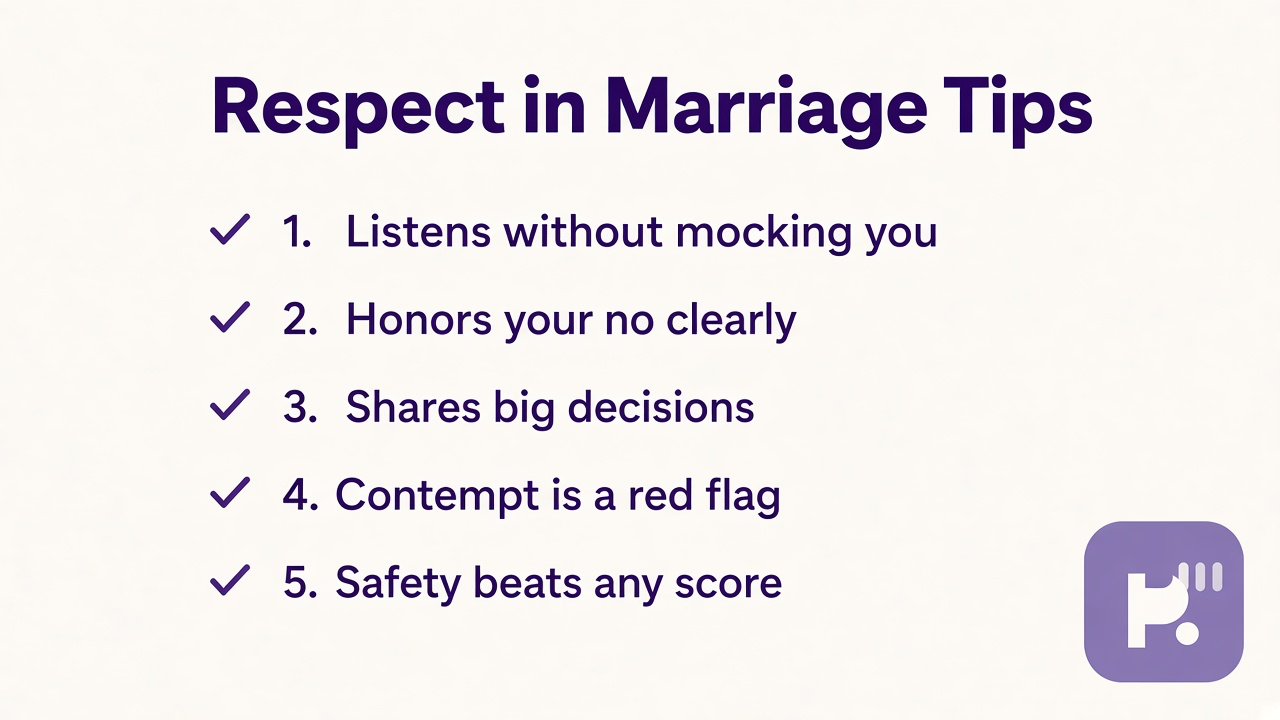
A quick takeaway graphic with topic tips (not your personal quiz scores). Start the quiz for your index, bands, and charts.
What this quiz can and cannot tell you
Can tell you
- Separate respect from affection when warmth and mockery mix
- Give you language for boundaries and shared decision talks
- Highlight when contempt patterns deserve counseling or safety planning
- Offer a baseline to retake after agreed behavior experiments
Cannot tell you
- Prove abuse or innocence in a legal sense
- Replace therapy, advocacy, or domestic violence services
- Detect every covert control tactic in one score
- Tell you whether divorce is right
Respect versus control: what mockery and no really signal
Respect searches spike when love words still exist but dignity feels thin. He may say I love you while rolling his eyes at your job, pushing past your no, or announcing plans you never agreed to. Control can dress as jealousy or tradition. This quiz separates attentive listening, boundary honor, shared decisions, and contempt or control so you react to patterns, not one cruel joke you wish you had imagined.
Researchers such as John Gottman highlight contempt, defensiveness, stonewalling, and criticism as relationship risk signals. Contempt is especially corrosive because it ranks you as beneath him. Listening without mockery is the everyday opposite: curiosity, follow-up questions, and remembering what mattered to you. Boundary honor shows up when no on sex, guests, spending, or privacy sticks without punishment or sulking.
Shared decisions are respect in action. Equal partnership does not mean identical preferences; it means your input changes outcomes on money, parenting, and time. When decisions become veto power, you are not debating logistics; you are debating rank. Monitoring phones or location without consent is control, not closeness, even when he calls it care.
If your score is low, name two behaviors and one boundary with a consequence you will keep. If fear spikes, talk to an advocate before couples counseling. Our does my husband love me anymore quiz tracks affection and distance when love is the louder question. The does he still love me quiz offers partner-neutral bond language for comparison.
Retake after agreed experiments and compare bars. Respect should feel steady enough to disagree without insults. If contempt stays high, safety planning matters more than another apology.
| Test | Focus |
|---|---|
| Does my husband love me anymore quiz | Affection, repair, and distance signals, not mockery or control |
| Does he still love me quiz | Partner-neutral bond cues after emotional distance |
Does My Husband Respect Me Quiz FAQ
What does this quiz measure?
It measures how often you notice listening, boundary honor, shared decisions, and contempt or control cues in the past month. You get an index from 0 to 100 and four bars. It reflects your experience, not a legal finding.
Can he love me but still score low on respect?
Yes. Affection and respect can diverge. Low respect scores deserve attention even when love words still appear.
Is jealousy the same as control?
Sometimes jealousy motivates control, but monitoring, threats, and punishing your no are respect problems regardless of the label.
Should I show him my results?
Only if you feel safe. Many people review results with a counselor first. If confrontation could escalate risk, skip showing him.
Who reviewed this quiz?
Dr. Priya Sharma, PhD reviewed the respect framing, safety notes, and result explanations. See our editorial policy for review standards.
Reviewed by