
What the Does My Hair Need Protein Or Moisture Quiz measures
This quiz does not diagnose scalp disease or prescribe a product list. It measures how much you agree with everyday hair balance statements grouped four ways: protein deficit signs like mushy wet strands, moisture deficit signs like brittle frizz, routine mismatch when masks backfire, and simple strand test patterns many stylists mention online. You answer 22 statements from strongly disagree to strongly agree, with reverse-worded items so one good hair day cannot hide a month of breakage. Your answers also feed a second chart on closeness and trust habits, because appearance stress sometimes amplifies how bad a wash day feels. The total becomes an index from 0 to 100 where higher means more reported mismatch signals on this screener, not proof you must buy protein or oil today. Patch test, change one thing at a time, and see a clinician for pain, patches, or sudden shedding.
Protein deficit signs
How much hair acts mushy, limp, or over-stretched after moisture-heavy care.
Moisture deficit signs
How much hair feels dry, rough, frizzy, or tangled after conditioning.
Routine mismatch
How much weekly treatments seem to make texture worse instead of better.
Strand tests
How much damp stretch and dry feel match common protein-versus-moisture clues.
How it works
Answer 22 agreement items
Rate each statement from Strongly disagree to Strongly agree. Tap Next after each answer.
Answers sort into four domains
Each answer feeds one of four balance groups, and every item also feeds a closeness and trust layer.
See your index and charts
You get a 0 to 100 index, a band, and two bar charts to compare after one routine change.
Take the Does My Hair Need Protein Or Moisture Quiz
Answer 22 short statements to see your hair balance index, four signal bars, and a closeness and trust chart.
What your result means
Your index is the average of all 22 answers, scaled from 0 to 100, with reverse-worded items flipped first. Higher means more reported mismatch signals. Read protein deficit and moisture deficit bars together before you shop.
| Band | Index range | Typical reading |
|---|---|---|
| Few mismatch signs | 0 to 35 | Balanced stretch tests; fewer mushy or straw-like patterns. |
| Mixed balance signals | 36 to 65 | Some mushy days and some brittle days, or conflicting product results. |
| Several mismatch signs | 66 to 100 | Clear mush, brittleness, or product backfire patterns. |
Tips at a glance
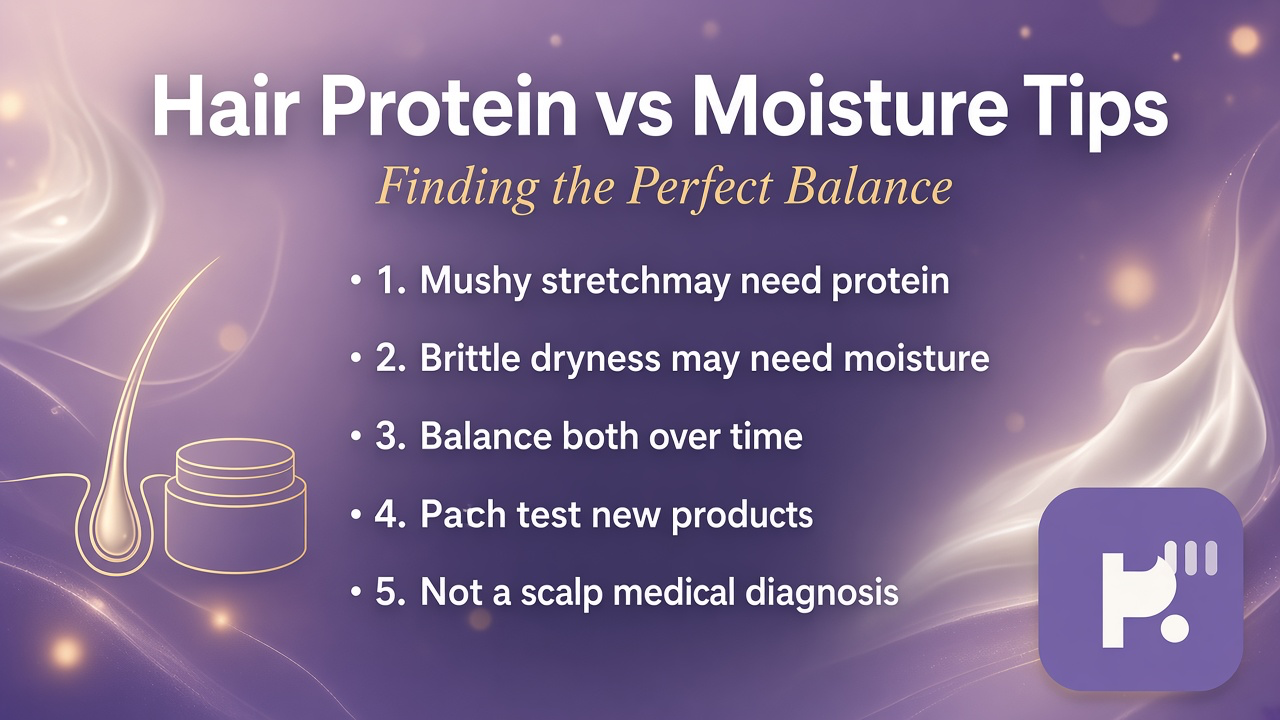
A quick takeaway graphic with topic tips (not your personal quiz scores). Start the quiz for your index, bands, and charts.
What this quiz can and cannot tell you
Can tell you
- Separate mushy protein clues from brittle moisture clues
- Give you language for a stylist or friend who understands your texture
- Highlight when simplifying products beats adding more
- Offer a baseline to retake after one controlled experiment
Cannot tell you
- Diagnose alopecia, infection, or scalp disorders
- Replace patch tests or professional trichology care
- Predict exact products for your porosity in one score
- Account for medication, hormones, or diet on its own
Protein versus moisture: what mushy and brittle really mean
Creators talk about protein and moisture as if hair were a battery with two slots. Real hair is messier. Porosity, damage, hard water, and overlapping products can make moisture masks feel like mush or protein sprays feel like straw. This quiz groups protein deficit signs, moisture deficit signs, routine mismatch, and strand test patterns so you react to a week of behavior, not one viral video.
Protein deficit signs often show up as gummy wet hair, limp curls after a rich mask, or strands that stretch too far and stay limp. Moisture deficit signs often show up as rough ends, constant frizz, and tangles right out of the shower. Many people need both over a month, just not on the same day. Alternating helps more than stacking bond builder plus butter plus oil in one session.
The damp stretch test is a rough home clue, not a lab assay. A strand that snaps fast may need moisture; a strand that turns to taffy may need protein support. Buildup can fake dryness, so a gentle clarify once in a while belongs in the conversation. Patch test anything new behind your ear or on a hidden section for forty-eight hours.
If your protein bar is high, try one light protein treatment and watch the next wash. If your moisture bar is high, focus on hydration and sealing without adding more protein. If both bars are high, simplify for two weeks. Our self image and appearance tests hub holds related reflection tools when confidence dips after a bad hair week.
Retake after one controlled change and compare bars, not mirror panic. Hair grows slowly; products work gradually. When in doubt, ask a licensed stylist who respects your texture and a dermatologist when scalp skin hurts.
| Test | Focus |
|---|---|
| Self image and appearance tests | Broader appearance and confidence screeners, not wash-day chemistry |
| Does he like me or my body quiz | Relationship attention patterns, not hair product balance |
Does My Hair Need Protein Or Moisture Quiz FAQ
What does this quiz measure?
It measures how much you agree with protein-versus-moisture balance statements across mushy signs, dry signs, product mismatch, and strand tests. You get an index from 0 to 100 and four bars. It reflects your recent observations, not a lab test.
Does mushy hair always mean I need protein?
Often, but not always. Buildup, over-conditioning, or damage can mimic mush. Use your protein deficit bar plus a stretch test before you change everything.
Can I need both protein and moisture?
Yes, many routines alternate them. This quiz helps you see which bar is louder right now so you change one variable at a time.
Should I use this instead of seeing a doctor?
No. Scalp pain, patches, infection signs, or sudden shedding need a clinician. This tool is for everyday product balance reflection.
Who reviewed this quiz?
Dr. James Whitfield, PhD reviewed the reflection limits, the non-diagnosis language, and the result explanations. See our editorial policy for review standards.
Reviewed by
