What the Does He Like Me Or My Body Quiz measures
This quiz does not decide whether you are beautiful or whether he is a bad person. It measures how you describe his attention lately across four ideas drawn from relationship and self-objectification research: whether he engages your mind and daily life, whether compliments balance character and appearance, whether he respects you publicly, and whether you notice ranking, comparing, or pressure that shrinks you to a body. You rate 22 statements from strongly disagree to strongly agree, with reverse-worded items so easy agreement cannot hide a one-note focus. Your answers also feed a second chart on closeness and trust habits, because fear of losing him sometimes makes people tolerate being seen as a prop. The total becomes an index from 0 to 100 where higher means more body-focused attention in your report, not a measure of your worth.
Whole person
How much he asks about your thoughts, work, friends, and moods, not only your appearance.
Compliment balance
Whether praise covers character and effort or stays glued to body parts and outfits.
Public respect
Whether he introduces you with dignity and avoids treating you like a trophy or a secret.
Objectifying cues
How often he ranks, compares, or zooms in on your body in ways that shrink you to an image.
How it works
Answer 22 agree or disagree items
Rate each statement from Strongly disagree to Strongly agree. Tap Next after each answer.
Answers sort into four domains
Each answer feeds one of four attention groups, and every item also feeds a closeness and trust layer.
See your index and charts
You get a 0 to 100 index, a band, and two bar charts you can use before a boundary conversation.
Take the Does He Like Me Or My Body Quiz
Answer 22 short statements to see your person-versus-body index, four attention bars, and a closeness and trust chart.
What your result means
Your index is the average of all 22 answers, scaled from 0 to 100, with reverse-worded items flipped first. Higher means more body-focused attention in your answers. Read objectifying cues and whole-person bars together before you interpret the total.
| Band | Index range | Typical reading |
|---|---|---|
| More whole-person focus | 0 to 35 | He notices your mind, mood, and life at least as much as your appearance. |
| Mixed person and body focus | 36 to 65 | Real interest shows up, but appearance-heavy moments still stand out. |
| More body-focused attention | 66 to 100 | Praise, contact, or comparisons center on your body more than on you. |
Tips at a glance
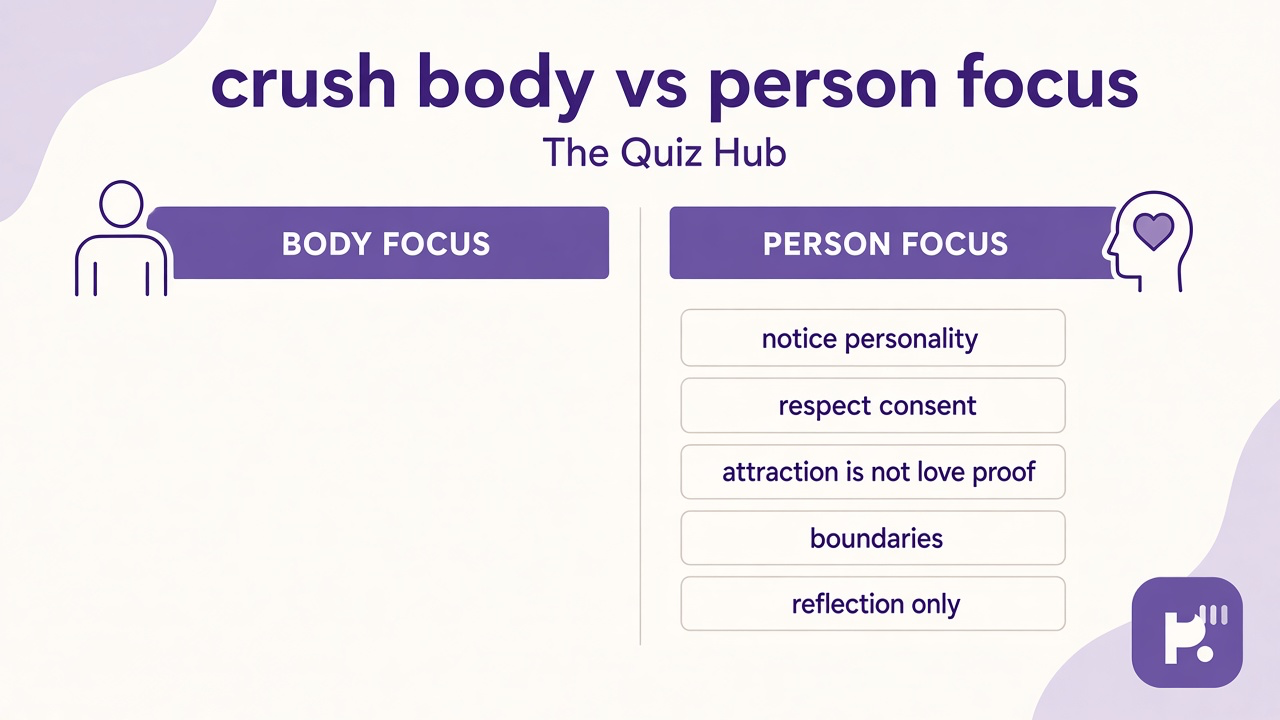
A quick takeaway graphic with topic tips (not your personal quiz scores). Start the quiz for your index, bands, and charts.
What this quiz can and cannot tell you
Can tell you
- Separate appearance appreciation from body-only focus in your experience
- Highlight public disrespect or photo pressure worth addressing early
- Give you words for a boundary talk about compliments and sharing
- Support reflection if you wonder whether to stay invested
Cannot tell you
- Prove objectification in a clinical or legal sense
- Measure your attractiveness or his morality score
- Replace support if you face coercion or harassment
- Predict whether he will change without new behavior
Being desired versus being known
Physical attraction is normal. Most people want a partner they find appealing. The pain starts when appeal becomes the whole story, when conversations shrink to outfits, when praise never reaches your mind, or when your body feels like something he collects rather than someone he knows. Filters and gym culture can make that pain sharper, because you may wonder whether he would still choose you on a plain Tuesday.
Psychologist Barbara Fredrickson and philosopher Tom Roberts have written about objectification as seeing a person as a body first and a subject second. In dating, that can look like relentless appearance comments, comparing you to strangers, or warmth that vanishes when you are sick or sad. Self-objectification research by Rachel Calogero and others shows that living under a gaze can make you monitor yourself constantly, even when nobody says a harsh word.
Healthy desire can still include you look great tonight. The balance matters. Does he ask how your interview went? Does he cool down when you set a photo boundary? Does he introduce you with your name and pride, not only as arm candy? The four bars in your result mirror those questions so you can see whether worry is scattered or concentrated in one channel.
If your score is high, you do not need to shame yourself for wanting to be wanted. You can ask for more. Name what being seen as a whole person would sound like. Watch whether he adjusts for two weeks. Friends who see you both in daylight can offer reality checks when you are stuck in your mirror. Our do I seek male validation quiz can help if you notice you tolerate body-only praise because validation feels scarce. And if anxiety about losing him dominates, pair this with the relationship anxiety quiz. Being liked for you is not asking too much.
Social media rewards body-first praise, so notice whether his comments copy influencer language that never mentions your mind. You can redirect the conversation once; if he cannot follow, that is information too. Retake after you set a boundary to see whether the person-versus-body bars shift in real life, not only in hope.
| Test | Focus |
|---|---|
| Do I seek male validation quiz | Looks at your validation habits, not how he distributes compliments |
| Does he like me or just want sex quiz | Separates hookup timing from being seen as a whole person |
Does He Like Me Or My Body Quiz FAQ
What does this quiz measure?
It measures how you rate his attention across whole-person interest, compliment balance, public respect, and objectifying cues. You get an index from 0 to 100 and four bars. Higher means more body-focused attention in your answers.
Can he like my body and still like me?
Yes. Attraction usually includes looks. The issue is balance and respect. If character, boundaries, and daily life get airtime too, a lower score here is more likely.
What if I like the body compliments?
Enjoying praise is normal. This quiz is for when compliments feel one-sided or pressure follows. You decide what mix feels good.
Does a high score mean he is toxic?
Not automatically. It means your reported experience leans body-heavy. Use it to guide a conversation or boundary test, and seek help if disrespect or coercion appears.
Who reviewed this quiz?
Dr. James Whitfield, PhD reviewed the framing, the limits note, and the result explanations. See our editorial policy for review standards.
Reviewed by