What the Does My Child Have Sleep Apnea Quiz measures
This quiz does not diagnose sleep apnea. Only a clinician who examines your child, reviews growth and airway history, and sometimes orders a sleep study can do that. It measures how often you have noticed patterns that pediatricians and ENT doctors often discuss when obstructive sleep apnea is on the worry list, grouped four ways: loud habitual snoring, witnessed pauses or gasping, daytime sleepiness that outlasts a single late bedtime, and restless sleep with mouth breathing or morning headaches. You answer 22 how-often statements about the past month, with reverse-worded items so a string of never cannot hide a cluster of very often answers. Your responses also feed a second chart on closeness and trust habits, because child health fear sometimes makes it hard to ask for help or share worries with a partner. The total becomes an index from 0 to 100 where higher means more frequent concern on this screener, not a confirmed sleep disorder.
Loud snoring
How often snoring is loud, frequent, and not explained by a short cold alone.
Breathing pauses
How often gasping, choking, or observed pauses showed up during sleep or naps.
Daytime sleepiness
How often mornings, school, or homework come with unusual fog or sleep attacks.
Restless sleep
How often nights look restless, mouth-breathing heavy, or tied to behavior and headaches.
How it works
Answer 22 frequency items
Rate each statement from Never to Very often for the past month. Tap Next after each answer.
Answers sort into four domains
Each answer feeds one of four sign groups, and every item also feeds a closeness and trust layer.
See your index and charts
You get a 0 to 100 index, a band, and two bar charts you can bring to your pediatrician.
Take the Does My Child Have Sleep Apnea Quiz
Answer 22 short statements to see your pediatric sleep concern index, four domain bars, and a closeness and trust chart.
What your result means
Your index is the average of all 22 answers, scaled from 0 to 100. Higher means more frequent reported concerns on this screener. Read the domain bars before the total, since loud snoring can dominate while daytime sleep still looks typical.
| Band | Index range | Typical reading |
|---|---|---|
| Lower reported concern | 0 to 35 | Fewer frequent snoring, pause, or sleepiness worries in the past month. |
| Mixed reported concern | 36 to 65 | Some nights worry you; other nights look typical. |
| Higher reported concern | 66 to 100 | Frequent breathing or sleep signs; book pediatric evaluation, not a web diagnosis. |
Tips at a glance
A quick takeaway graphic with topic tips (not your personal quiz scores). Start the quiz for your index, bands, and charts.
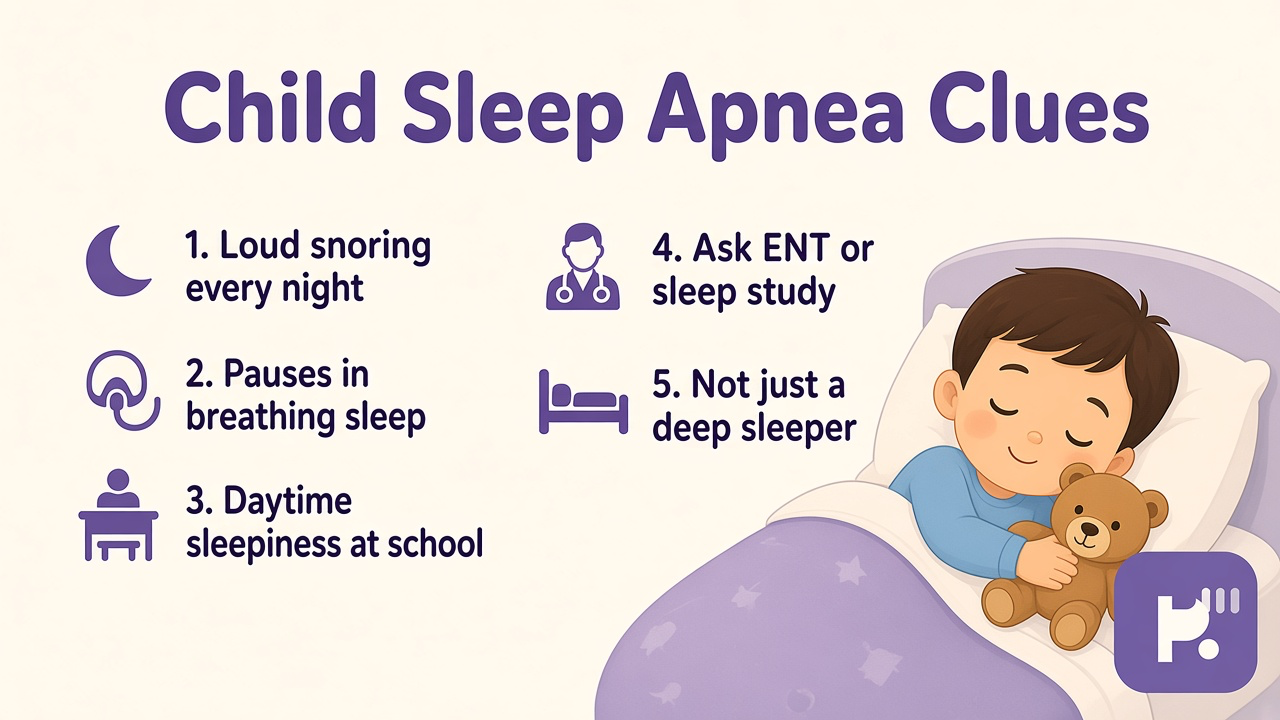
What this quiz can and cannot tell you
Can tell you
- Organize worries into snoring, pauses, sleepiness, and restless sleep buckets
- Give you language for a pediatric or ENT visit
- Show which domain feels heaviest this month
- Offer a baseline if you retake after treatment starts
Cannot tell you
- Diagnose obstructive sleep apnea or any sleep disorder
- Replace polysomnography, imaging, or hands-on airway exam when indicated
- Account for every medication or medical condition without your doctor's input
- Tell you to delay care because a score was low once
Child snoring and sleep apnea worries: what parents can do next
Pediatric obstructive sleep apnea happens when the upper airway narrows during sleep, often with snoring, pauses, and restless nights. Parents who search this question are usually exhausted themselves, listening through the door for gasps or fighting a child who melts down every morning. Fear is normal, and so is the need to separate occasional snoring from patterns that deserve evaluation. Colds, allergies, and room dryness change noise for a week; nightly loud snoring with daytime sleepiness is a different conversation.
The American Academy of Pediatrics and sleep medicine groups treat habitual snoring and witnessed apneas as red flags worth clinician review, not as cute deep-sleep jokes. A child who breathes through an open mouth all night, sleeps in odd positions, or naps hard at school may be compensating for fragmented sleep even when they are in bed long enough. This quiz groups parent reports the way many visits start: snore volume, pause observations, daytime function, and restless nights.
Enlarged tonsils and adenoids, obesity, craniofacial differences, and neuromuscular conditions can all contribute. That is why a high index here means call the doctor, not label sleep apnea in a group chat. ENT surgeons and sleep labs exist to measure what parents hear imperfectly at 2 a.m. Treatment ranges from allergy control and nasal support to tonsillectomy or positive airway pressure in selected cases.
Bring a sleep log and safe audio if your clinician welcomes it. Note whether snoring stops when your child rolls to their side, whether pauses happen every night, and whether teachers report sleepiness. Mention ADHD or learning concerns, because sleep fragmentation sometimes masquerades as attention trouble. You can also try our sleep apnea quiz for adult-oriented reflection, but pediatric decisions still belong with your child's doctor.
Caregiver sleep matters too. Chronic worry shrinks patience and makes every grunt sound catastrophic. If anxiety about your child's breathing is overwhelming daily life, tell your clinician; parent support is part of pediatric care. Retake this screener after a visit if you want to track whether reported frequency eases once you have a plan.
| Test | Focus |
|---|---|
| Sleep apnea quiz | Adult-oriented sleep apnea reflection rather than pediatric snoring and school sleepiness items |
| Why am I so tired quiz | Parent fatigue patterns rather than your child's nighttime breathing |
Does My Child Have Sleep Apnea Quiz FAQ
What does this quiz measure?
It measures how often you have noticed loud snoring, breathing pauses, daytime sleepiness, or restless sleep in the past month. You get an index from 0 to 100 plus four domain bars. It reports parent observation frequency, not a clinical diagnosis.
Can this quiz tell me if my child has sleep apnea?
No. Sleep apnea is diagnosed by a qualified clinician, often with a sleep study. This tool helps you organize worries to discuss with your pediatrician or ENT.
Is snoring always sleep apnea in kids?
No. Many children snore briefly with congestion. Habitual loud snoring, especially with pauses or daytime sleepiness, deserves evaluation rather than being dismissed as deep sleep.
When should I call the doctor urgently?
Call emergency services for trouble breathing while awake, blue lips, or unresponsiveness. Call your pediatrician soon for frequent witnessed pauses, gasping, or school-day sleep attacks.
Who reviewed this quiz?
Dr. Elena Vasquez, PhD reviewed the YMYL framing, medical limits, and pediatric care guidance. See our editorial policy for review standards.
Reviewed by