What the Does My Cat Have Dementia Quiz measures
This quiz does not replace a veterinarian. It measures how often you have noticed behaviors that owners and clinicians often discuss when an older cat may have cognitive dysfunction, grouped four ways: spatial disorientation, sleep-wake changes, shifts in social greeting or hiding, and litter-box accidents or misses. You answer 22 how-often statements about recent months, with reverse-worded items so one bad week cannot dominate. Your answers also feed a second chart on closeness and trust habits, because caring for a declining pet can strain sleep and guilt. The total becomes an index from 0 to 100 where higher means more reported cognitive-change signs on this screener, not a label of dementia or a treatment plan.
Disorientation
How often your cat seems lost in familiar rooms, stares at walls, or misses obvious landmarks.
Sleep-wake shift
How often night restlessness, pacing, or loud vocalizing has changed from their old pattern.
Social change
How often affection, avoidance, or neediness has shifted in ways that feel new for their personality.
House-soiling
How often they miss the box, forget where it is, or soil outside it despite prior training.
How it works
Answer 22 frequency items
Rate each statement from Never to Very often for recent months. Tap Next after each answer.
Answers sort into four domains
Each answer feeds one of four sign groups, and every item also feeds a closeness and trust layer.
See your index and charts
You get a 0 to 100 index, a band, and two bar charts to bring as notes to a vet visit.
Take the Does My Cat Have Dementia Quiz
Answer 22 short statements to see your senior cat cognitive index, four sign bars, and a closeness and trust chart.
What your result means
Your index is the average of all 22 answers, scaled from 0 to 100, with reverse-worded items flipped first. Higher means more reported signs. Read house-soiling and disorientation bars together, and book a vet visit for any sudden change.
| Band | Index range | Typical reading |
|---|---|---|
| Few cognitive signs | 0 to 35 | Little disorientation, sleep shift, social change, or soiling beyond ordinary aging. |
| Mixed cognitive signs | 36 to 65 | Some new quirks without a steady decline in every domain. |
| Several cognitive signs | 66 to 100 | Repeated disorientation, sleep disruption, social change, or soiling. |
Tips at a glance
A quick takeaway graphic with topic tips (not your personal quiz scores). Start the quiz for your index, bands, and charts.
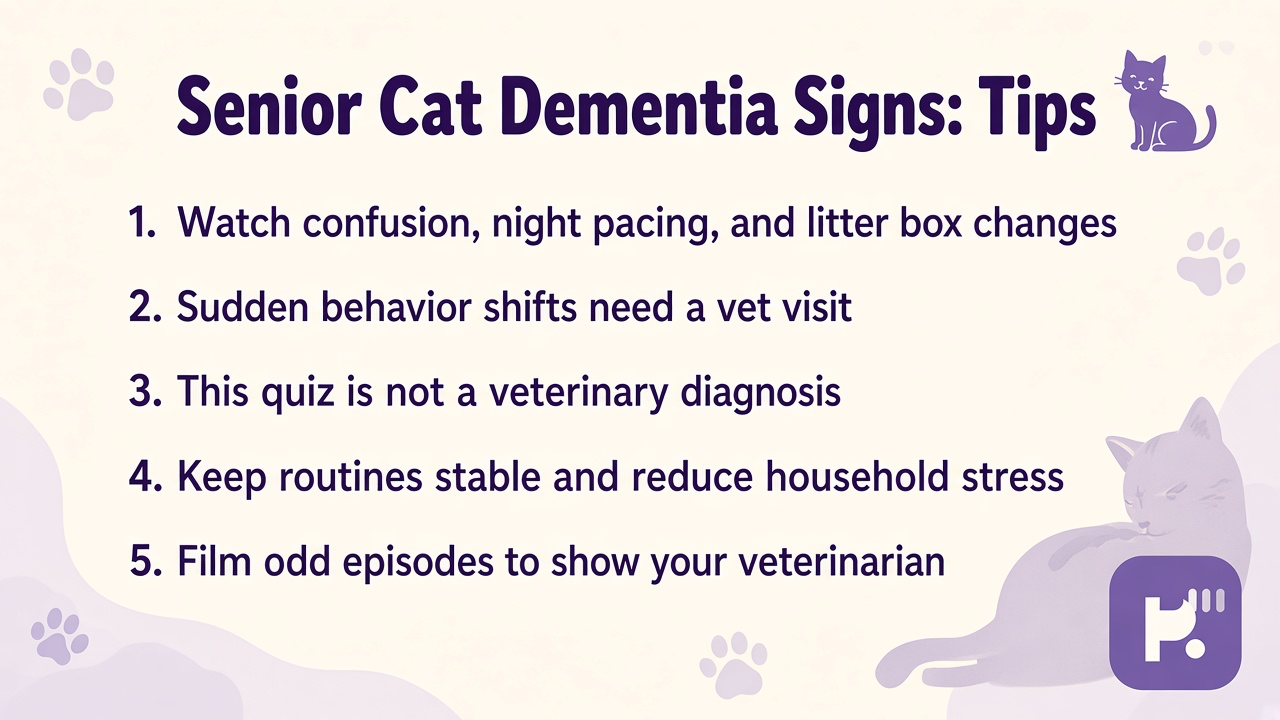
What this quiz can and cannot tell you
Can tell you
- Organize worrying behaviors into four clear domains
- Help you describe patterns with dates at a wellness visit
- Highlight when sleep or soiling shifts deserve prompt care
- Support reflection while you wait for an appointment
Cannot tell you
- Diagnose dementia, pain, or any medical condition
- Tell you which medication or diet to use
- Replace bloodwork, imaging, or a physical exam
- Predict how fast symptoms will progress
Senior cats, confusion, and when to call the vet
Owners who search this question are usually watching a cat they have known for years act like a stranger in their own home. Maybe the litter box is suddenly wrong. Maybe nights are loud. Maybe they stand in the hallway and meow as if the food bowl moved miles away. Fear of dementia is real, and so is the guilt that you should have noticed sooner. Most of the time, several medical causes need sorting before anyone says cognitive dysfunction.
Veterinarians use the acronym DISHA for many feline cognitive discussions: disorientation, interaction changes, sleep-wake shifts, house-soiling, and activity or anxiety changes. Not every senior cat fits the label, and not every odd behavior is memory. Hyperthyroid disease, kidney illness, arthritis, dental pain, and high blood pressure can all change sleep, mood, and box use. That is why this page insists on a visit rather than a quiz verdict.
Disorientation can look dramatic on video: a cat stares, pivots slowly, or gets stuck behind a chair. Social changes cut both ways. Some cats cling; others withdraw. House-soiling breaks hearts because it feels personal, yet it is often a mapping problem in an aging brain or a protest against a box that hurts arthritic hips. The four bars in your result mirror those channels so you can see whether one domain dominates.
If your score is high, treat it as a scheduling nudge, not a death sentence. Bring dates, clips, and diet notes. Ask about pain control, blood pressure checks, and environmental tweaks such as night lights, low-sided boxes, and stable furniture paths. The American Association of Feline Practitioners publishes senior care guidance that many clinics follow. Our does my cat have separation anxiety quiz can help if clinginess and destruction spike when you leave, which sometimes overlaps with aging stress. The does my cat love me quiz looks at attachment when you wonder whether withdrawal means less bond or more pain.
Retake after a vet visit if treatment helps. Compare bars month to month. Comfort is the goal, whether the story is cognitive decline, treatable illness, or both. You are allowed to grieve the young cat while loving the old one in front of you.
| Test | Focus |
|---|---|
| Does my cat have separation anxiety quiz | Measures distress when you leave, not confusion in familiar rooms |
| Does my cat love me quiz | Looks at attachment behaviors, not senior cognitive signs |
Does My Cat Have Dementia Quiz FAQ
What does this quiz measure?
It measures how often you have noticed senior cognitive-style signs in four areas: disorientation, sleep-wake shifts, social changes, and house-soiling. You get an index from 0 to 100 and four bars. It describes what you have seen, not a veterinary diagnosis.
Can this quiz diagnose cat dementia?
No. Only a veterinarian can evaluate your cat after an exam and often bloodwork or other tests. Many medical problems mimic cognitive decline.
My cat is only seven. Should I still take this?
You can, but most cognitive patterns show up in older cats. Sudden confusion at any age deserves a vet visit regardless of score.
What should I tell my vet?
Share when each behavior started, whether it is worsening, and which domain bar is highest. Short videos of pacing, staring, or box misses help.
Who reviewed this quiz?
Dr. Elena Vasquez, PhD reviewed the framing, the not-a-diagnosis limits, and the urge-to-see-a-vet messaging. See our editorial policy for review standards.
Reviewed by