What the Does My Boyfriend Like His Female Friend Quiz measures
This quiz does not read his heart or hers. It measures how often you have noticed behaviors that partners commonly list when a close female friendship feels threatening, grouped four ways: extra time and praise toward her, secrecy or vagueness about contact, your own jealousy and reassurance loops, and whether he includes you and honors limits. You answer 22 how-often statements about recent weeks, with reverse-worded items so one angry week cannot inflate everything. Your answers also feed a second chart on closeness and trust habits, because fear of losing a partner sometimes makes people swallow concerns or spy instead of speaking. The total becomes an index from 0 to 100 where higher means more reported tension on this screener, not proof that he likes her romantically or that you should break up.
Extra attention
How often he gives her time, praise, or emotional energy that feels larger than an ordinary friendship.
Secrecy cues
How often contact with her stays private, vague, or framed as something you would not understand.
Your reassurance
How often you feel jealous, ask for reassurance, or walk away from talks still unsettled.
Boundary signals
How often he includes you around her, names limits, and treats your comfort as real data.
How it works
Answer 22 frequency items
Rate each statement from Never to Very often for recent weeks. Tap Next after each answer.
Answers sort into four domains
Each answer feeds one of four signal groups, and every item also feeds a closeness and trust layer.
See your index and charts
You get a 0 to 100 index, a band, and two bar charts you can use before a boundary talk.
Take the Does My Boyfriend Like His Female Friend Quiz
Answer 22 short statements to see your triad tension index, four signal bars, and a closeness and trust chart.
What your result means
Your index is the average of all 22 answers, scaled from 0 to 100, with reverse-worded items flipped first. Higher means more reported tension. Read secrecy and boundary bars together before you treat the total as a verdict.
| Band | Index range | Typical reading |
|---|---|---|
| Lower triad tension | 0 to 35 | Little extra attention or secrecy; boundaries feel ordinary. |
| Mixed triad tension | 36 to 65 | Some extra attention or secrecy without a steady disrespect pattern. |
| Higher triad tension | 66 to 100 | Repeated attention, secrecy, or dismissed comfort around her. |
Tips at a glance
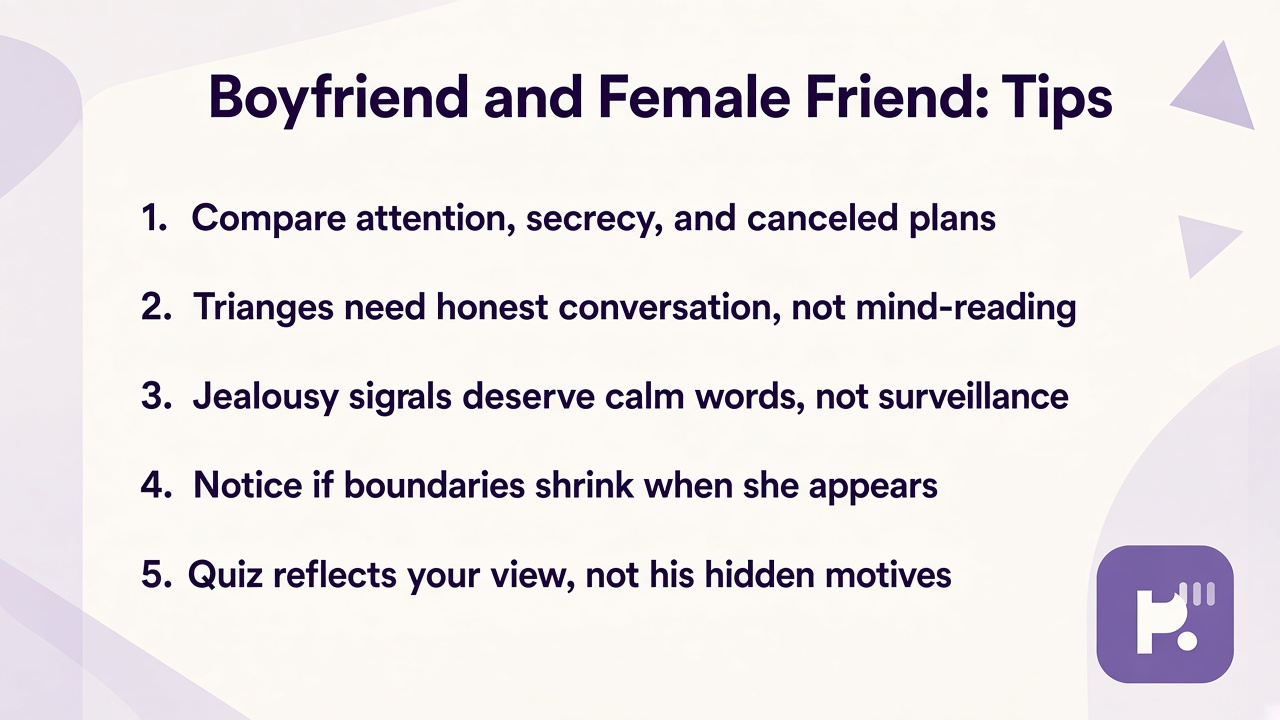
A quick takeaway graphic with topic tips (not your personal quiz scores). Start the quiz for your index, bands, and charts.
What this quiz can and cannot tell you
Can tell you
- Sort mixed worry into four clear domains
- Give you language for a calmer check-in about time and transparency
- Highlight when reassurance loops deserve their own attention
- Offer a baseline to retake after you set a boundary
Cannot tell you
- Prove whether he likes her, is cheating, or will leave
- Replace an honest conversation about exclusivity and trust
- Tell you whether jealousy is always justified or always wrong
- Diagnose attachment disorders in either of you
His female friend: jealousy, boundaries, and what helps
Most people who search this question are not looking for drama. They are tired. They notice a name on his phone, a laugh at a party, or a late reply and wonder whether they are insecure or whether something real is shifting. Female friendships in couples are normal, yet culture still trains people to treat every close bond as a threat. Your job is not to win a debate about whether jealousy is feminist or petty. It is to notice whether you feel chosen, informed, and respected.
Relationship researchers distinguish jealousy from envy and from justified alarm. Jealousy often shows up when a valued bond feels at risk. Envy compares. Alarm points to concrete disrespect, such as hidden contact, broken agreements, or mocking your concerns. The four domains in this quiz separate his behavior toward her, secrecy patterns, your inner loop, and whether boundaries hold when you speak up. That split matters because some partners are transparent with a close friend and still trigger old wounds from a past betrayal.
Secrecy is the lever that turns friendship stress into crisis for many couples. Not every private text is an affair. People deserve friendships. Yet when answers stay vague, phones turn away, and you hear that you are crazy for asking, trust erodes even if nothing sexual happened. Extra attention can be benign too: he may admire her career or lean on her through grief. The question is whether you still get steadiness, not whether she exists.
If your score is high, slow down before you accuse. Write two facts and one feeling. Ask for a specific change, such as introducing you, sharing plans, or pausing one-on-one late nights for a month. Watch behavior, not promises. Our relationship anxiety quiz can help if worry spreads beyond this one friend. The do I have trust issues quiz looks at your wider trust habits when history, not present facts, may be loud. And if he refuses transparency while demanding your silence, treat that as respect data, not as proof you are too much.
Retake after you try one boundary. Compare bars instead of chasing a single number. Friendships can shrink or grow without romance entering, and couples can also discover they need different rules about emotional intimacy. Either way, you deserve a partner who can hear discomfort without punishing you for naming it.
| Test | Focus |
|---|---|
| Relationship anxiety quiz | Measures worry and reassurance loops across the relationship, not one friendship |
| Do I have trust issues quiz | Looks at your trust patterns with partners generally, not his contact with her |
Does My Boyfriend Like His Female Friend Quiz FAQ
What does this quiz measure?
It measures how often you have noticed tension signals around his female friendship across extra attention, secrecy, your reassurance needs, and boundaries. You get an index from 0 to 100 and four bars. It reports your observations, not his secret feelings.
Does a high score mean he likes her romantically?
No. It means you reported several concerning patterns lately. He might still see her as a friend while you need clearer limits, or you might be anxious while he is transparent. Use the bars to guide a talk, not a verdict.
Am I wrong to feel jealous?
Jealousy is information, not a character flaw. The issue is what you do with it. Accusations without facts hurt; calm requests for transparency can be healthy. If jealousy is constant across relationships, wider trust work may help.
Should I ask him to end the friendship?
That is your call, but ultimatums often backfire unless safety is involved. Many couples negotiate boundaries first: shared social time, openness about plans, and limits on emotional venting. See whether respect returns before you demand a cut-off.
Who reviewed this quiz?
Dr. Priya Sharma, PhD reviewed the framing, the limits on mind-reading, and the result explanations. See our editorial policy for review standards.
Reviewed by