What the Does He Like Me Back High School Quiz measures
This quiz does not read his mind. It measures how often you have noticed behaviors that teens commonly list when they wonder if a crush is mutual, grouped four ways: focused attention at school, digital warmth, signals from the friend circle, and nervous or trying-hard energy around you. You answer 22 how-often statements about recent weeks, with a few reverse-worded items so optimism alone cannot inflate your score. Your answers also feed a second chart on closeness and trust habits, because crush anxiety sometimes overlaps with fear of rejection or rushing intimacy. The total becomes an index from 0 to 100 where higher means more reported signals on this screener, not a promise that he will ask you out or that you should chase anyone who ignores your comfort.
Focused attention
How often he singles you out with eye contact, proximity, and small remembered details.
Digital warmth
How often he replies fast, reacts to your posts, or starts chats that feel personal.
Friend circle
How often friends tease, nudge, or drop hints that he asked about you.
Nervous energy
How often he seems extra awkward, loud, or careful around you compared with others.
How it works
Answer 22 frequency items
Rate each statement from Never to Very often for recent weeks. Tap Next after each answer.
Answers sort into four domains
Each answer feeds one of four signal groups, and every item also feeds a closeness and trust layer.
See your index and charts
You get a 0 to 100 index, a band, and two bar charts you can compare with a friend who knows the situation.
Take the Does He Like Me Back High School Quiz
Answer 22 short statements to see your crush signal index, four signal bars, and a closeness and trust chart.
What your result means
Your index is the average of all 22 answers, scaled from 0 to 100. Higher means more reported signals. Read the four bars before the total, since many crushes show up online but not in the hallway.
| Band | Index range | Typical reading |
|---|---|---|
| Few crush-back signs | 0 to 35 | Little focused attention, digital warmth, or friend hints so far. |
| Mixed crush-back signs | 36 to 65 | Hot-and-cold moments without a clear pattern yet. |
| Several crush-back signs | 66 to 100 | Repeated attention across channels; still confirm with words when you can. |
Tips at a glance
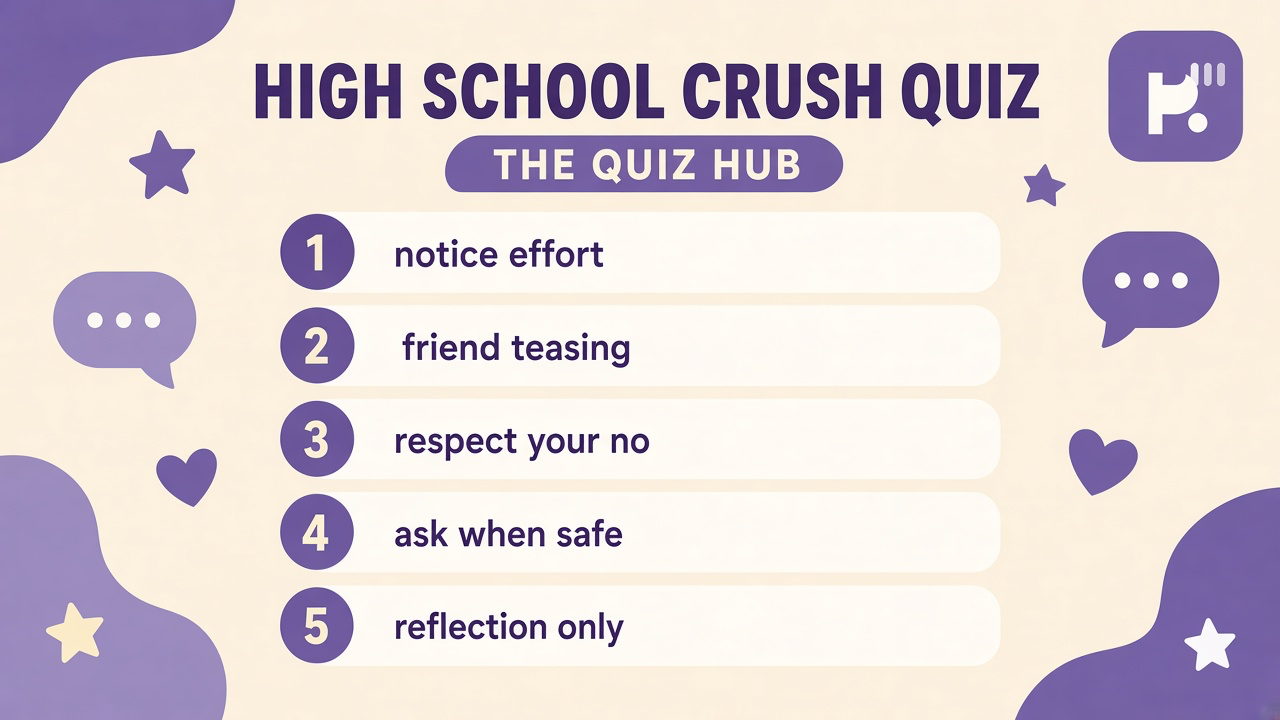
A quick takeaway graphic with topic tips (not your personal quiz scores). Start the quiz for your index, bands, and charts.
What this quiz can and cannot tell you
Can tell you
- Organize mixed signals into four clear domains
- Give you language for talking with a friend or trusted adult
- Highlight when attention might deserve a direct conversation
- Offer a fun baseline to retake after a few weeks
Cannot tell you
- Prove whether he likes you or predict his next move
- Replace consent, boundaries, or safety planning for dates
- Account for cultural differences in how boys show interest
- Tell you whether you should date him
Crush signals in high school: what actually helps
High school crushes move fast because every glance happens in front of an audience. A look in homeroom becomes a group chat thread by lunch. Most students who search this question already have a highlight reel of moments and want to know if the reel means something shared or something one-sided. Timing matters too: finals week, sports season, or a new ex can make someone hot and cold without a hidden crush at all.
Psychologists who study the liking gap find that people often assume others notice them less than they do, yet the opposite mistake happens in crushes too: friendly behavior gets read as romance because hope is loud. The four domains in this quiz separate attention, digital habits, friend noise, and nervous energy so you can see which channel is driving your guess.
Digital warmth matters more than it did a decade ago, but it is also the easiest to misread. A quick reply might mean interest, boredom, or group-chat reflex. In-person focus still counts: choosing your table, remembering a detail, laughing at your joke when nobody else did. Friend hints are the weakest evidence on their own, because peers love a story, yet repeated hints from people who actually know him can be worth listening to.
If your score is high, enjoy the possibility and still use your voice. A simple invite to sit together at an event or study in the library tells you more than another week of decoding. If your score is low, you are allowed to move on without a speech from him. Crushes pass, and your energy can go toward friends, sports, art, or sleep instead of replaying one hallway moment. And if his attention ever ignores your no, your comfort, or your privacy, talk to a trusted adult. Mutual liking should feel exciting, not scary.
Screenshot culture makes every signal public forever, so think before you share private chats with the whole grade. Loyalty to a friend matters, and so does loyalty to your own boundaries when gossip starts. If you retake this quiz after winter break or a class change, compare bars instead of chasing one perfect total.
| Test | Focus |
|---|---|
| Does he like me quiz | General crush signals without a high school and friend-circle focus |
| Do you have a secret admirer quiz | Looks for anonymous or hidden interest, not a classmate you already have in mind |
Does He Like Me Back High School Quiz FAQ
What does this quiz measure?
It measures how often you have noticed crush-style behaviors from him across attention, texting, friends, and nervous energy. You get an index from 0 to 100 and four bars. It reports what you have seen, not what he secretly feels.
Does a high score mean he will ask me out?
No. It means you reported several signals lately. He might still be shy, unsure, or friendly without romantic intent. Asking directly or inviting a low-pressure hangout is still the clearest step.
What if he acts different online and at school?
That is common. Compare your digital warmth and focused attention bars. Some teens flirt only in DMs; others only in person. Look for respect in both places.
I am not out yet. Is this quiz still for me?
Yes. The items describe behaviors, not who you are allowed to like. Keep safety in mind: you never owe anyone public answers before you are ready.
Who reviewed this quiz?
Dr. James Whitfield, PhD reviewed the framing, the teen safety notes, and the result explanations. See our editorial policy for review standards.
Reviewed by