What this AP psych quiz measures
This AP psych quiz estimates how confidently you recall AP Psychology Course and Exam Description themes from research methods through social psychology. Twenty original agree-disagree items group into research methods, biological bases, cognition and memory, and development and social psychology. Each item also maps to a fear-of-intimacy stack layer. A second results chart inspired by FOIS-style intimacy avoidance themes from Descutner and Thelen (1991), adapted to AP study topics. Your AP psychology knowledge index averages these patterns into a 0 to 100 score.
Research methods
Variables, random assignment, ethics, and descriptive statistics.
Biological bases
Brain structures, neurons, neurotransmitters, and split-brain research.
Cognition and memory
Memory models, interference, language theories, and heuristics.
Development and social
Piaget, attachment, conformity, obedience, and Erikson stages.
How it works
Answer 20 agree-disagree items
Rate each agree-disagree statement from Strongly disagree to Strongly agree. You click Next after each answer.
Items map to domains and intimacy stack
Answers accumulate percentages for four primary domains plus four fear-of-intimacy stack layers.
View index, band, and charts
Results show Lower, Mixed, or Higher signal bands with domain bars and stack chart.
Take the ap psych quiz
Complete 20 items to receive your AP psychology knowledge index, four domain bars, fear-of-intimacy stack chart, and band label.
What your result means
Your AP psychology knowledge index is the normalized total across all 20 items on a 0 to 100 scale. Domain bars show which psychology theme drives your result most.
| Band | Index range | Typical reading |
|---|---|---|
| Lower AP Psychology Knowledge | 0 to 35 | Gaps in AP Psychology recall are common without recent AP Psychology CED review |
| Mixed AP Psychology Knowledge | 36 to 65 | Solid recall mixed with fuzzy spots worth targeting before mock exams |
| Higher AP Psychology Knowledge | 66 to 100 | Steady recall across domains; still not a substitute for proctored AP exams |
What your report looks like
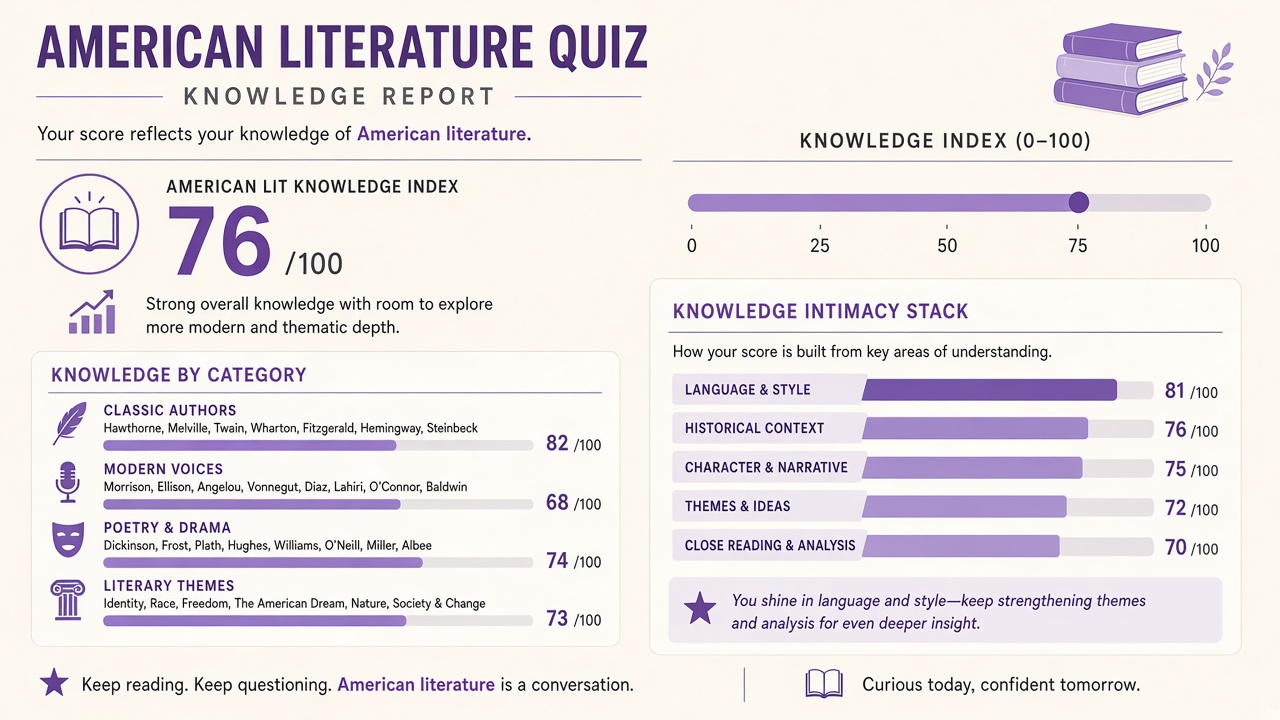
What this quiz can and cannot tell you
Can tell you
- How confidently you report recalling AP Psychology CED themes on this screener
- An AP psychology knowledge index and four domain bars plus fear-of-intimacy stack
- Which domain (methods, biology, cognition, development) feels strongest or weakest today
- A baseline before mock exams or research design FRQs
Cannot tell you
- Diagnose mental health conditions or personality disorders
- Predict your AP exam score from 1 to 5
- Replace College Board released exams or teacher feedback
- Certify course completion for school transcripts
AP psych flashcards vs structured knowledge index
Memorizing neurotransmitter lists alone rarely shows whether research methods or social psych units lag. This quiz adds a 0 to 100 index with four domains spanning classic AP experiments and models taught in Myers and Barron review books.
Sample items ask about random assignment, Piaget stages, and Milgram obedience. Pair with our unit 2 quiz for biological bases drill-down. Browse the IQ and cognitive hub for study siblings.
| Test | Focus |
|---|---|
| AP psych unit 2 quiz | Unit 2 biological bases only with distinct questions |
| Anatomy and physiology quiz | Body systems recall, not psychology experiments |
| Animal brain quiz | Comparative neuroanatomy trivia with zero overlap |
AP Psych Quiz FAQ
What does this AP psych quiz measure?
20 agree-disagree items map to research methods, biological bases, cognition, and development domains plus a fear-of-intimacy stack. You receive a knowledge index from 0 to 100. Study aid only.
Can this quiz diagnose ADHD or anxiety?
No. Items measure course recall confidence, not symptoms. Seek licensed clinicians for mental health evaluation.
How is this different from the unit 2 quiz?
This full-course quiz spans methods through social psychology. The unit 2 sibling focuses on neuroscience, endocrine, genetics, and neural communication only.
What is the fear-of-intimacy stack?
A second chart with vulnerability pull-back, trust hesitation, self-disclosure limits, and closeness anxiety adapted to academic stress.
How long does the quiz take?
About 4 minutes for 20 items with session autosave.
Who reviewed this content?
Dr. James Whitfield, PhD, reviewed the test framing and result explanations. See our editorial policy for review standards.
Reviewed by