What this angles quiz measures
This angles quiz estimates angle measurement knowledge aligned with NCTM geometry standards for degree measure and classification. Twenty agree-disagree items map to degree measurement, angle types, protractor skills, and angle notation. Each item also maps to a fear-of-intimacy stack layer when math confidence feels socially risky.
Degree measurement
Reading and estimating angle measures in degrees from diagrams and real objects.
Angle types
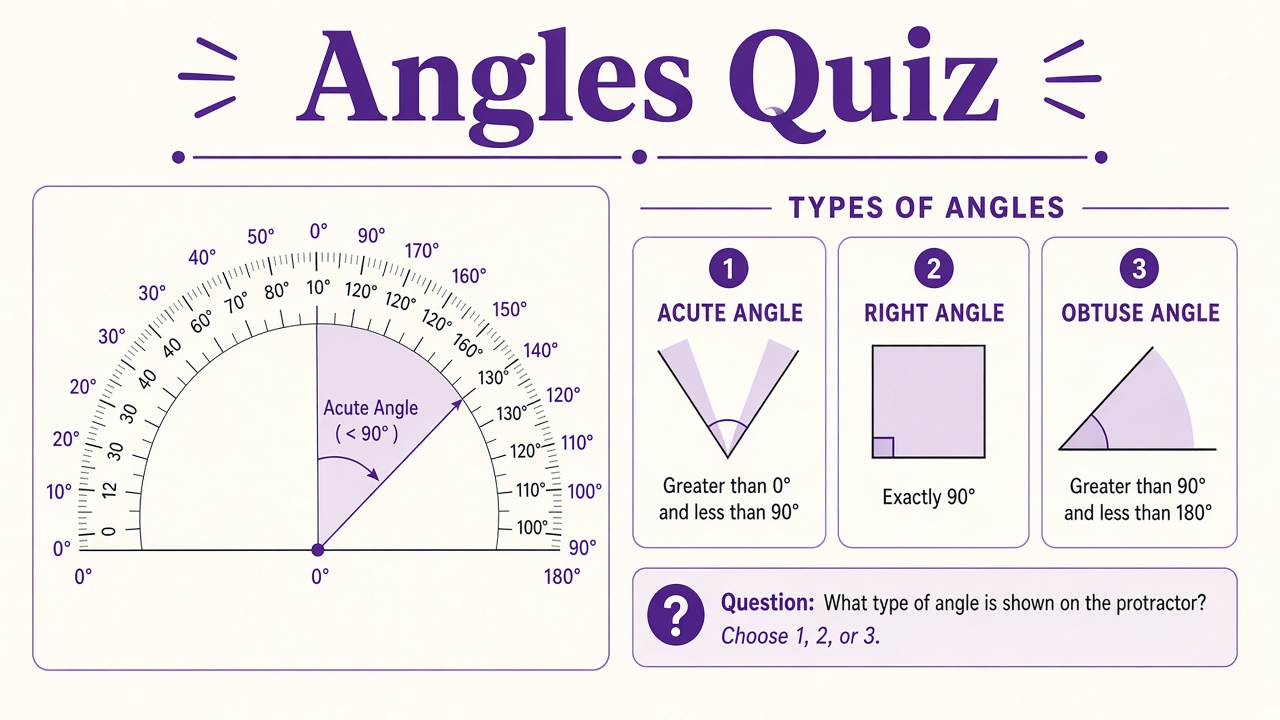
Classifying acute, right, obtuse, straight, and reflex angles by size.
Protractor skills
Using protractors to measure and draw angles accurately.
Angle notation
Naming angles with vertices, arcs, and three-letter labels.
How it works
Answer 20 agreement items
Rate each statement from Strongly disagree to Strongly agree. You click Next after each answer.
Items map to domains and stack
Your answers accumulate percentages for four primary domains plus four fear-of-intimacy stack layers.
View index and dual charts
Results show your angle measurement knowledge index, band label, domain bars, and intimacy stack chart.
Take the angles quiz
Answer 20 original items about reading, classifying, and naming angles. Your responses produce an index from 0 to 100, four domain scores, and a fear-of-intimacy stack chart.
What your result means
Your angle measurement knowledge index is the normalized total across all items on a 0 to 100 scale. Higher scores mean more agreement on this screener. Domain bars show whether degrees, types, protractor skills, or notation drive your result most.
| Band | Index range | Typical reading |
|---|---|---|
| Lower Angle Measurement Knowledge Signals | 0 to 35 | Fewer endorsed measurement and notation habits |
| Mixed Angle Measurement Knowledge Signals | 36 to 65 | Blend of solid and shaky measurement habits |
| Higher Angle Measurement Knowledge Signals | 66 to 100 | Strong self-reported measurement familiarity |
What your report looks like
What this quiz can and cannot tell you
Can tell you
- How strongly angle measurement habits showed up in this self-report screener
- An index from 0 to 100 plus fear-of-intimacy stack index with domain bars
- Which measurement domain feels strongest in your current answers
Cannot tell you
- Graded geometry exam scores or proof-writing grades
- Timed performance under proctored test conditions
- What teachers would score on a standardized assessment
Why people search angles quizzes
Students search angles quiz when protractor labs or classification units approach and they want a quick self-check before homework. The Quiz Hub built this as an original agree-disagree screener distinct from the angle relationships quiz, which focuses on complementary, vertical, and transversal pair rules.
Sample items ask whether you can classify acute versus obtuse angles, align a protractor correctly, or name angle ABC with the vertex in the middle. Compare with our angle relationships quiz, am I good at math quiz, or the IQ and cognitive hub. Read our editorial policy for review standards.
Angles Quiz FAQ
What does the angles quiz measure?
Twenty agree-disagree items ask how much you endorse degree reading, angle type classification, protractor use, and angle notation habits. You receive an angle measurement knowledge index from 0 to 100 where higher scores mean more agreement on this screener.
How is this different from the angle relationships quiz?
The angle relationships quiz focuses on how angle pairs relate: complementary sums, vertical equality, adjacent linear pairs, and parallel-line transversal rules. This quiz focuses on reading degrees, classifying angle types, using protractors, and standard notation.
Can this quiz replace a geometry exam?
No. Graded exams use timed diagram and calculation tasks. This screener uses self-report agreement items rather than scored measurement problems.
What is the fear-of-intimacy stack?
The stack chart shows vulnerability pull-back, trust hesitation, self-disclosure limits, and closeness anxiety layers that may pair with hiding math confusion in class.
Who reviewed this content?
Dr. James Whitfield reviewed the test framing and result explanations. See our editorial policy for review standards.
Reviewed by