What this ancient Rome map quiz measures
This ancient Rome map quiz estimates how confidently you recall Roman geography from self-report items. Twenty original agree-disagree statements group into four domains: Italian peninsula, imperial provinces, frontier boundaries, and landmark recall. Each item also maps to a fear-of-intimacy stack layer. Your ancient Rome map knowledge index averages these patterns into a 0 to 100 score where higher numbers mean stronger map recall endorsement on this screener.
Italian peninsula
Rome, Latium, the Apennines, and how the city sits on the Tiber
Imperial provinces
Gaul, Hispania, Egypt, and other provinces you can place on a mental map
Frontier boundaries
Rhine, Danube, Hadrian Wall, and frontier zones that marked empire limits
Landmark recall
Colosseum, Forum, Pompeii, and famous sites tied to Roman geography
How it works
Three steps from first question to your map knowledge report with domain bars and fear-of-intimacy stack.
Answer 20 agree-disagree items
Rate each geography recall statement from Strongly disagree to Strongly agree. You click Next after each answer; nothing auto-advances.
Items map to map domains and intimacy stack
Your answers accumulate percentages for peninsula, provinces, frontiers, and landmarks, plus four fear-of-intimacy stack layers.
View index, band, and dual charts
Results show Lower, Mixed, or Higher map knowledge bands with domain bars and a fear-of-intimacy stack chart.
Take the ancient Rome map quiz
Complete 20 items to receive your ancient Rome map knowledge index, domain bars, fear-of-intimacy stack chart, and band label.
Opens in a focused modal. No account required. Results stay on screen.
What your ancient Rome map result means
Your ancient Rome map knowledge index is the normalized total across all 20 items on a 0 to 100 scale. Domain bars show which geography area drives your result most. The fear-of-intimacy stack chart shows parallel closeness-guarding layers.
| Band | Index range | Typical reading |
|---|---|---|
| Lower Ancient Rome Map Knowledge | 0 to 35 | Fewer endorsed recall items; gaps in Roman map recall are common without recent study |
| Mixed Ancient Rome Map Knowledge | 36 to 65 | Blend of solid recall and fuzzy spots worth targeting before trivia night |
| Higher Ancient Rome Map Knowledge | 66 to 100 | Steady recall across domains; still not a substitute for proctored exams |
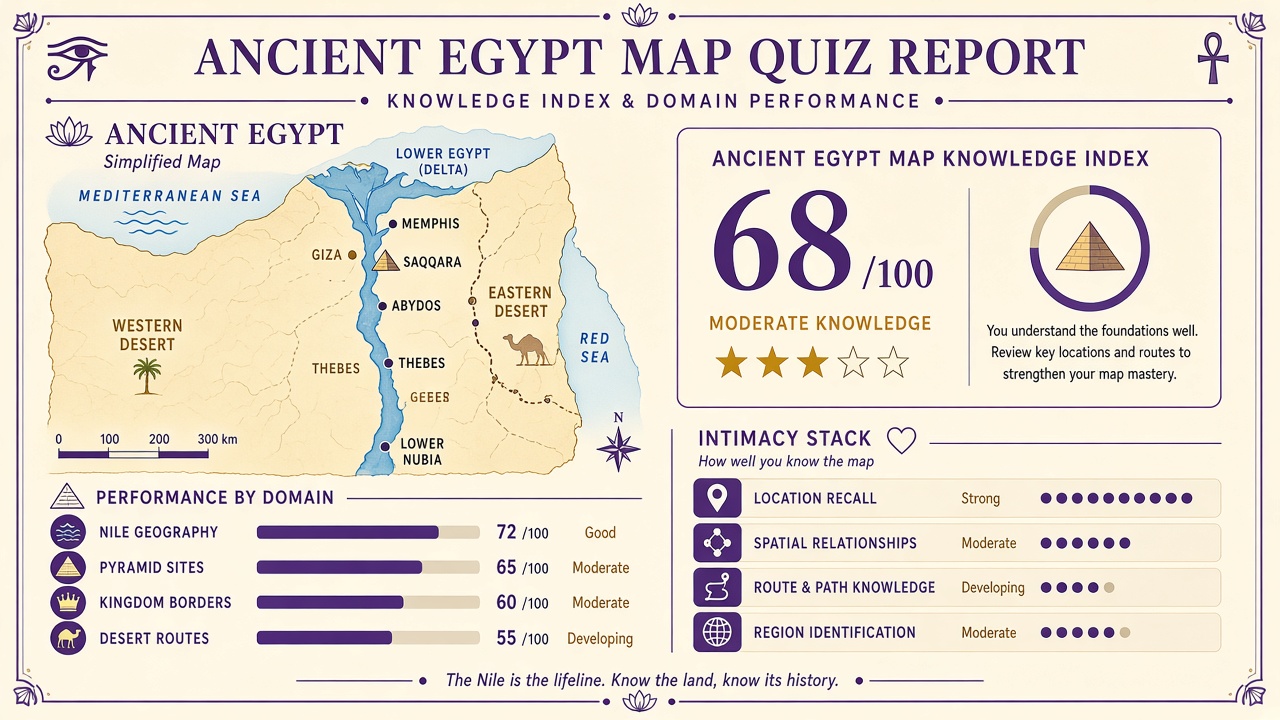
What your map knowledge report looks like
After all 20 items, you get a map knowledge index from 0 to 100, a band label, four domain bars, and a fear-of-intimacy stack chart.
What this quiz can and cannot tell you
Can tell you
- How often peninsula, province, frontier, and landmark recall patterns showed up in your self-report
- An ancient Rome map knowledge index and fear-of-intimacy stack index with domain bars
- Which map domain feels strongest in your current study or travel planning habits
- A starting point for comparing with sibling ancient history quizzes
Cannot tell you
- Whether you would pass a proctored geography or archaeology exam without study
- Exact border lines historians debate in specialist journals
- Permanent labels about how locals would judge your knowledge
- What a professor would conclude from one ungraded self-report screener
Roman geography, provincial maps, and the fear-of-intimacy stack
Ancient Rome map literacy shows up in school curricula, travel planning, and strategy games that ask players to hold provinces in mind. The Cambridge Ancient History and Oxford Classical Dictionary treat provincial geography as core context for understanding how the Republic became an empire. Our screener borrows that framing as self-report recall, not a reproduction of any single textbook exam.
The Quiz Hub built this quiz as an original agree-disagree screener with a parallel fear-of-intimacy stack inspired by FOIS-style closeness themes from Descutner and Thelen (1991). Our ancient Rome history quiz uses a separate 20-item bank focused on republic, military, and daily life recall rather than map placement.
| The Quiz Hub test | What it adds |
|---|---|
| Ancient Rome history quiz | Republic, military, and culture recall rather than map placement |
| American Revolution quiz | Founding-era geography and civic recall in a different civilization |
| Fear of intimacy quiz | General closeness avoidance without history content |
| Big Five personality test | OCEAN trait percentiles rather than map knowledge |
| This quiz | Map-focused 20-item index plus fear-of-intimacy stack for peninsula, provinces, frontiers, and landmarks |
Sample item types include whether you can place Gaul and Hispania on a mental map or whether Hadrian Wall reads as a northern frontier in Britannia. Read our editorial policy or browse the fun and novelty tests hub. The Britannica entry on ancient Rome offers a stable overview of geography and expansion timelines.
Ancient Rome Map Quiz FAQ
What does the ancient Rome map knowledge index measure?
Twenty agree-disagree items ask how confidently you recall peninsula geography, imperial provinces, frontier boundaries, and famous landmarks. You receive an index from 0 to 100 where higher scores mean stronger map recall endorsement on this screener.
Is this a school geography exam?
No. This is a self-report recall screener for study reflection and trivia practice. It cannot grade coursework or replace proctored exams.
What is the fear-of-intimacy stack on this quiz?
A second results chart with vulnerability pull-back, trust hesitation, self-disclosure limits, and closeness anxiety layers adapted to map recall habits.
How is this different from the ancient Rome history quiz?
The history quiz uses a separate 20-item bank on republic, military, culture, and sources with zero question text overlap. Both include domain bars and a fear-of-intimacy stack chart.
Who reviewed this content?
Dr. James Whitfield, PhD, reviewed the test framing and result explanations. See our editorial policy for review standards.
Who reviewed this content?
Dr. James Whitfield, reviewed the test framing and result explanations. See our editorial policy for review standards.
Reviewed by