What this quiz measures
This analyzing arguments quiz screens claim-evidence links, assumption spotting, fallacy recognition, and conclusion evaluation habits inspired by critical thinking education from the Foundation for Critical Thinking and introductory logic syllabi. Twenty agree-disagree items map to four domains. Each item also maps to a fear-of-intimacy stack layer when being wrong in public feels risky.
Claim-evidence links
Checking whether headlines, posts, and essays actually support their boldest sentences.
Assumption spotting
Naming hidden premises and correlation-causation slips before you share a take.
Fallacy recognition
Noticing ad hominem, straw man, false dichotomy, and slippery slope moves in live debate.
Conclusion evaluation
Judging whether a conclusion follows from the premises given, not from your mood.
How it works
Three steps from first question to your report with domain bars and fear-of-intimacy stack.
Answer 20 agreement items
Rate how much you agree with each statement. You click Next after each answer.
Items map to argument domains
Your answers accumulate percentages for four argument analysis domains plus intimacy stack layers.
View index and dual charts
Results show your argument analysis skill index, band label, domain bars, and intimacy stack chart.
Take the analyzing arguments quiz
Answer 20 original items about argument analysis habits. Your responses produce an index from 0 to 100, four domain scores, and a fear-of-intimacy stack chart.
Opens in a focused modal. No account required. Results stay on screen.
What your result means
Your argument analysis skill index is the normalized total across all items on a 0 to 100 scale. Higher scores mean more agreement on this screener. Domain bars show whether claim-evidence links, assumptions, fallacies, or conclusions drive your result most.
| Band | Index range | Typical reading |
|---|---|---|
| Lower Argument Analysis Skill Signals | 0 to 35 | Fewer endorsed patterns on these self-report items |
| Mixed Argument Analysis Skill Signals | 36 to 65 | Blend of stronger and moderate domain scores |
| Higher Argument Analysis Skill Signals | 66 to 100 | Frequent endorsement worth reflection and practice |
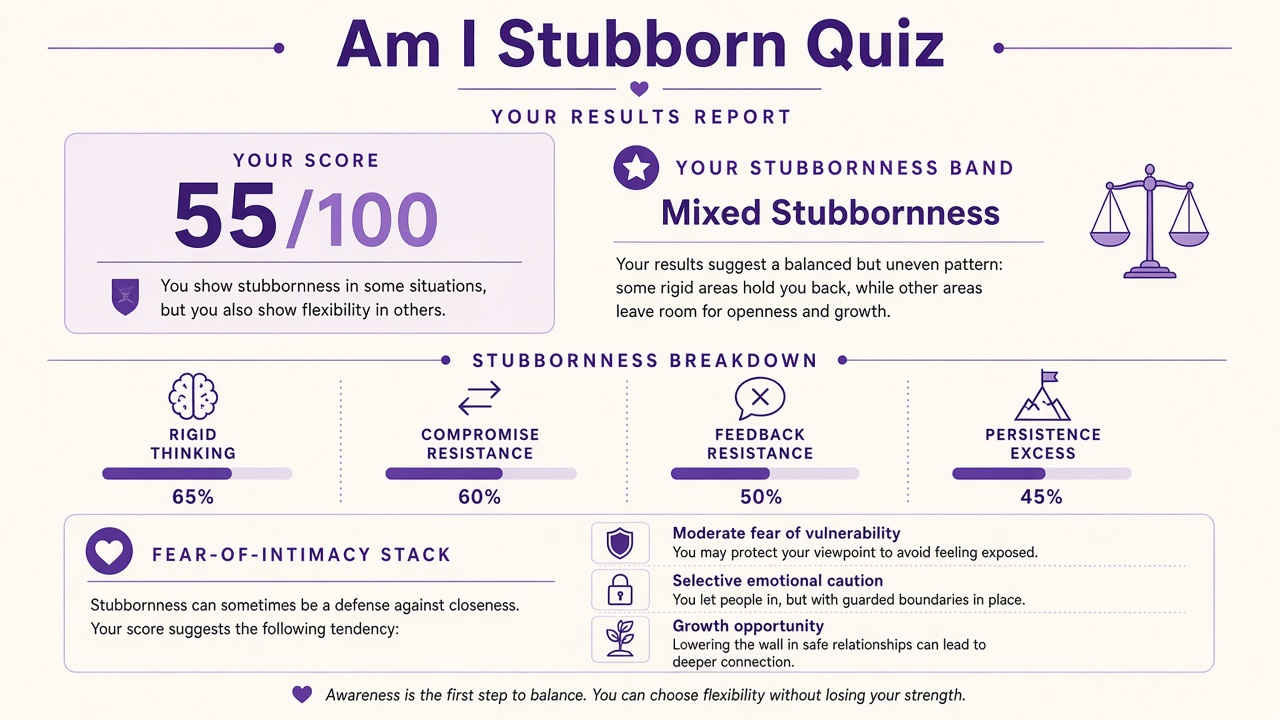
What your analyzing arguments quiz report looks like
After all 20 items, you get an argument analysis skill index, band label, four domain bars, and a fear-of-intimacy stack chart.
What this quiz can and cannot tell you
Can tell you
- How strongly argument analysis habits showed up in this self-report screener
- An index from 0 to 100 plus fear-of-intimacy stack index with domain bars
- Which argument domain feels strongest in your current answers
- A starting point for logic coursework or debate club reflection
Cannot tell you
- LSAT logical reasoning scores or philosophy course grades
- Proof you always spot fallacies in real-time heated arguments
- What employers would rank on a hiring logic test
- Clinical judgment impairment diagnosis
Why people search analyzing arguments quizzes
People search analyzing arguments quiz when news cycles, group chats, and comment sections reward fast takes over slow reasoning. Critical thinking educators emphasize separating claims from evidence and naming fallacies without mockery. This screener turns those skills into agree-disagree domains with an index from 0 to 100.
Unlike single-score trivia, this quiz reports four argument domains plus a fear-of-intimacy stack when being wrong feels socially costly. Pair with our analogy quiz for verbal relationship habits or cognitive reflection test for timed trap puzzles.
| The Quiz Hub test | What it adds |
|---|---|
| Analogy quiz | Verbal relationship habit screener with domain bars |
| Cognitive reflection test | Three classic logic trap puzzles |
| IQ test hub sibling | Broader cognitive practice collection on the hub |
| This quiz | Claim, assumption, fallacy, and conclusion domains with intimacy stack, not timed LSAT items. |
Retake after a logic or rhetoric course if you want to track self-report shifts. Strong scores are a prompt for practice, not proof you win every debate.
Analyzing Arguments Quiz FAQ
What does the analyzing arguments quiz measure?
Twenty agree-disagree items ask how much you endorse claim-evidence checking, assumption spotting, fallacy recognition, and conclusion evaluation habits. Each item also maps to a fear-of-intimacy stack layer. You receive an argument analysis skill index from 0 to 100 where higher scores mean more agreement on this screener.
Does a higher argument analysis skill index mean I ace LSAT logical reasoning?
No. LSAT sections use timed multiple-choice items with official scoring. This quiz screens self-reported critical thinking habits rather than proctored exam performance.
What is the fear-of-intimacy stack on this quiz?
The stack chart shows vulnerability pull-back, trust hesitation, self-disclosure limits, and closeness anxiety layers that may pair with debate avoidance or hiding confusion when groups reward confident takes.
How is this different from the analogy quiz?
The analogy quiz focuses on verbal relationship mapping between word pairs. This analyzing arguments quiz focuses on claims, assumptions, fallacies, and conclusions in reasoning and media consumption.
Can this quiz teach formal logic notation?
No. Items use plain-language self-report stems. For symbolic logic coursework, use textbooks and instructor feedback rather than this screener alone.
Who reviewed this content?
Dr. James Whitfield, reviewed the test framing and result explanations. See our editorial policy for review standards.
Reviewed by