What this american literature quiz measures
This american literature quiz estimates how often american lit knowledge patterns show up in your self-report. 20 original agree-disagree items group into four domains: classic authors, modern voices, poetry and drama, literary themes. Each item also maps to a fear-of-intimacy stack layer. Your american lit knowledge index averages these patterns into a 0 to 100 score where higher numbers mean more frequent endorsement on this screener.
Classic authors
Twain, Hemingway, Fitzgerald, Morrison, and other canon names you can place in context.
Modern voices
Contemporary American novelists, essayists, and poets beyond one school assignment.
Poetry and drama
Whitman, Hughes, Williams plays, and spoken-word traditions tied to U.S. history.
Literary themes
American dream critiques, frontier myths, civil rights narratives, and regional realism patterns.
How it works
Answer 20 agree-disagree items
Rate each statement from Strongly disagree to Strongly agree. You click Next after each answer.
Items map to domains and intimacy stack
Answers accumulate percentages for four primary domains plus four fear-of-intimacy stack layers.
View index, band, and charts
Results show Lower, Mixed, or Higher signal bands with domain bars and stack chart.
Take the american literature quiz
Complete 20 items to receive your american lit knowledge index, domain bars, fear-of-intimacy stack chart, and band label.
What your result means
Your american lit knowledge index is the normalized total across all 20 items on a 0 to 100 scale. Higher scores mean more frequent endorsement on this screener. Domain bars show which area drives your result most. The fear-of-intimacy stack chart shows parallel closeness-guarding layers.
| Band | Index range | Typical reading |
|---|---|---|
| Lower American Lit Knowledge Signals | 0 to 35 | Fewer pattern signals; occasional spikes still possible |
| Mixed American Lit Knowledge Signals | 36 to 65 | Blend of stable stretches and recurring concern worth monitoring |
| Higher American Lit Knowledge Signals | 66 to 100 | Frequent pattern signals; consider professional support when appropriate |
What your report looks like
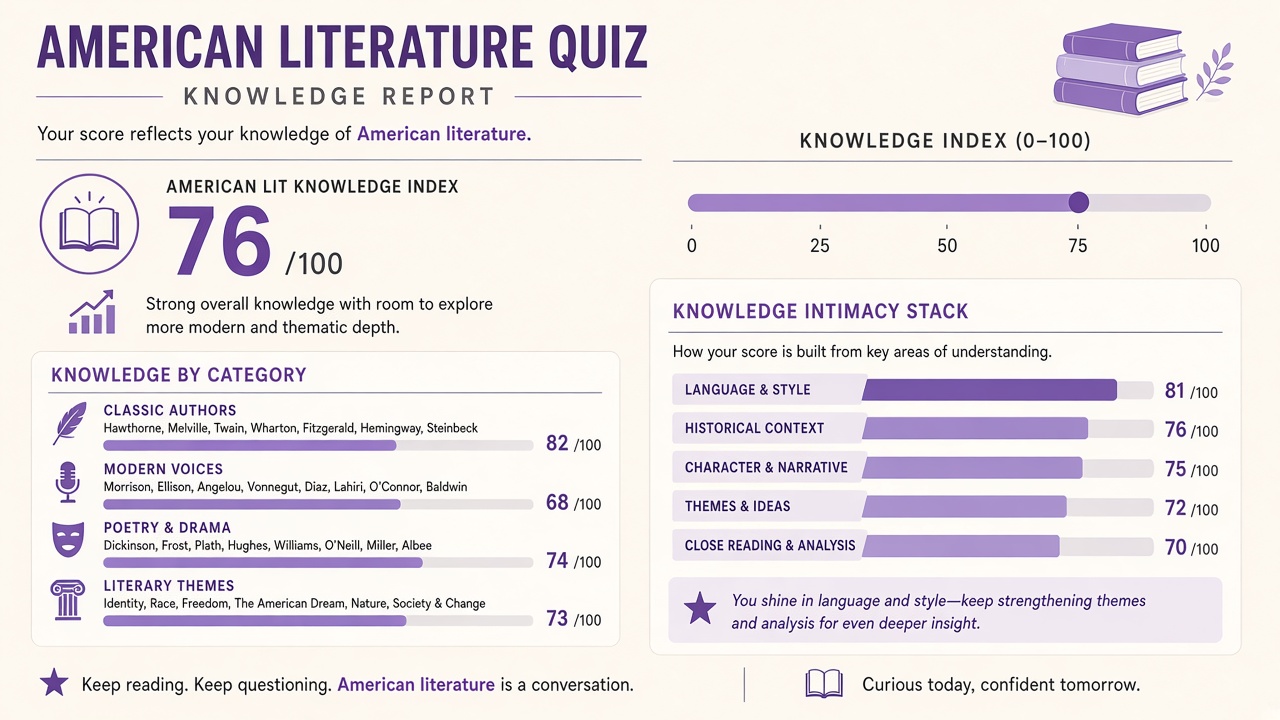
What this quiz can and cannot tell you
Can tell you
- How often american lit knowledge patterns showed up in this self-report screener
- A american lit knowledge index and four domain bars plus fear-of-intimacy stack
- A starting point for reflection or comparing with sibling tests
Cannot tell you
- Any diagnosis, legal outcome, or medical certainty
- What professionals would conclude without exam and history
- Permanent labels about who you are
Why people search this quiz
People search american literature quiz when everyday worry spikes and they want plain-language reflection before talking to friends or professionals. The Quiz Hub built this as an original self-report screener with a parallel fear-of-intimacy stack inspired by FOIS-style closeness themes from Descutner and Thelen (1991), not a reproduction of any single published clinical scale.
Sample item types use agree-disagree ratings matched to this topic. Compare with sibling tests on our iq & cognitive hub or read our editorial policy.
American Literature Quiz FAQ
What does this american literature quiz measure?
20 original agree-disagree items map to four domains plus a fear-of-intimacy stack. You receive a american lit knowledge index from 0 to 100 where higher scores mean more frequent endorsement on this screener. Not a diagnosis.
What is the fear-of-intimacy stack?
A second results chart with vulnerability pull-back, trust hesitation, self-disclosure limits, and closeness anxiety layers adapted to this topic.
Can this quiz diagnose me?
No. Your responses suggest pattern signals for self-reflection only. Professional evaluation is needed for medical, legal, or clinical questions.
How long does the american literature quiz take?
About 4 minutes for 20 items with session autosave.
Who reviewed this content?
Dr. James Whitfield, PhD, reviewed the test framing and result explanations. See our editorial policy for review standards.
Reviewed by