What this Ambivalent Sexism Inventory measures
This Ambivalent Sexism Inventory estimates agreement with hostile and benevolent sexism statements inspired by Glick and Fiske ASI framework. Twenty-two original items group into four domains: hostile sexism, benevolent sexism, gender complementarity, and protective paternalism. Your ASI ambivalent sexism index averages these patterns into a 0 to 100 score where higher numbers mean more sexist belief signals on this screener.
Hostile sexism
Openly antagonistic beliefs that women seek unfair advantage or manipulate men
Benevolent sexism
Seemingly positive beliefs that women need protection and belong in nurturing roles
Gender complementarity
Views that men and women fit naturally different social and family roles
Protective paternalism
Beliefs that men should shield women from hardship even when women can choose for themselves
How it works
Three steps from first question to your ASI report with domain bars and fear-of-intimacy stack.
Answer 22 agreement items
Rate how much you agree with each gender belief statement, from Strongly disagree to Strongly agree.
Items map to ASI domains and intimacy stack
Your answers accumulate percentages for hostile sexism, benevolent sexism, complementarity, and paternalism, plus four fear-of-intimacy stack layers.
View band and dual charts
Results show Lower, Mixed, or Higher ASI Ambivalent Sexism with domain bars and stack chart.
Take the Ambivalent Sexism Inventory
Rate 22 statements about gender beliefs. Get an ASI ambivalent sexism index from 0 to 100, intimacy stack index, and domain bars.
Opens in a focused modal. No account required. Results stay on screen.
What your ASI result means
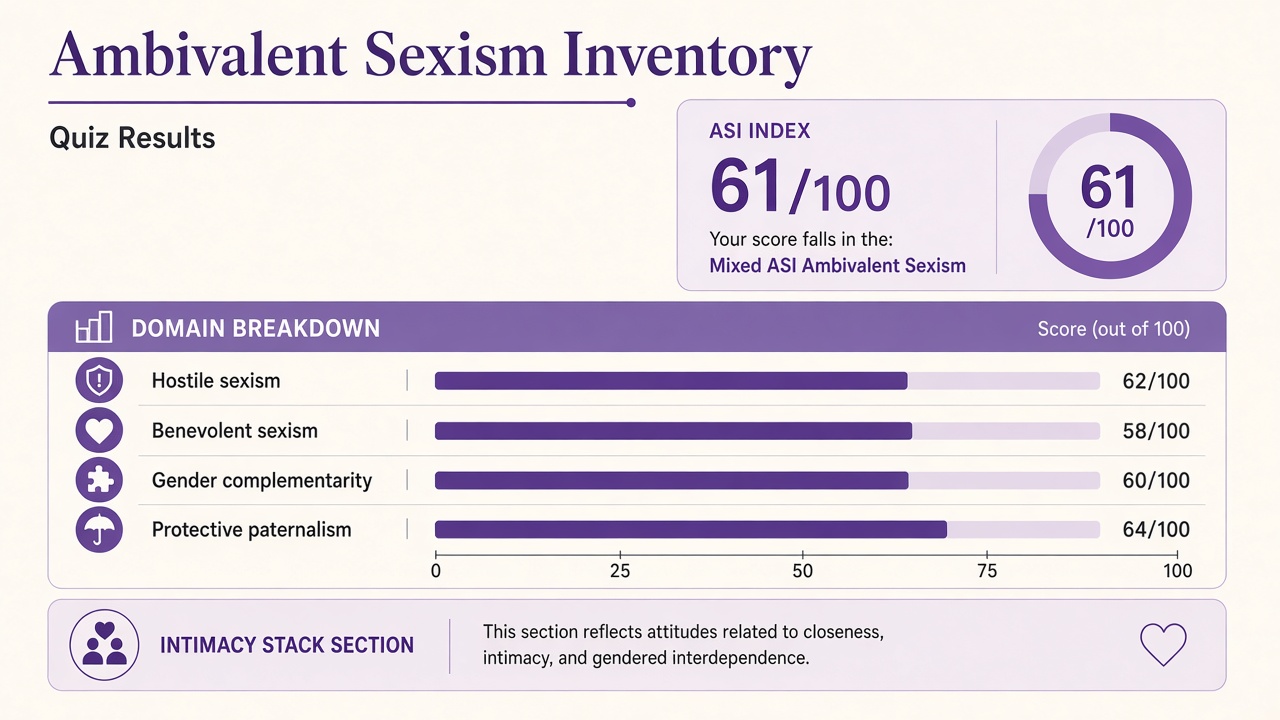
Your ASI ambivalent sexism index is normalized across all 22 items on a 0 to 100 scale. Higher scores mean stronger agreement with sexist belief items on this screener, including seemingly positive benevolent statements.
| Band | Index range | Typical reading |
|---|---|---|
| Lower ASI Ambivalent Sexism | 0 to 35 | Fewer hostile and benevolent sexism signals |
| Mixed ASI Ambivalent Sexism | 36 to 65 | Blend of egalitarian and sexist beliefs; domain chart shows strongest pattern |
| Higher ASI Ambivalent Sexism | 66 to 100 | Frequent hostile or benevolent sexism signals on this screener |
What your ASI report looks like
After 22 items, you get an ASI ambivalent sexism index, band label, four domain bars, and a fear-of-intimacy stack chart.
What this quiz can and cannot tell you
Can tell you
- How strongly hostile and benevolent sexism items matched your self-report
- An ASI index and fear-of-intimacy stack with domain bars
- Which ASI domain feels strongest in your current beliefs
Cannot tell you
- Whether you treat people fairly in every situation without their perspective
- Whether you are a good or bad person from one attitude screener
- Clinical diagnosis of prejudice or personality disorders
Glick and Fiske ASI, hostile sexism, and benevolent sexism
Psychologists Peter Glick and Susan Fiske published the Ambivalent Sexism Inventory in 1996 in the Journal of Personality and Social Psychology. Their framework shows that hostile sexism (open antagonism toward women) and benevolent sexism (subjectively positive but limiting beliefs) often coexist and predict discrimination in hiring, relationships, and politics.
The Quiz Hub built this inventory as an original agreement screener inspired by ASI themes, not a reproduction of the published 22-item instrument. Our am I sexist quiz uses a separate question bank with different domains. The am I racist quiz screens prejudice patterns on a different topic.
| The Quiz Hub test | What it adds |
|---|---|
| Am I sexist quiz | Separate 22-item bank on gender role stereotypes and workplace bias |
| Am I racist quiz | Prejudice screener on a different topic |
| Am I a fascist quiz | Authoritarian ideology framing, not ASI gender domains |
| This quiz | 22-item ASI ambivalent sexism index with hostile, benevolent, complementarity, and paternalism domains |
Sample items include whether you agree that women should be cherished and protected by men, or that feminism has gone too far. High benevolent sexism with high protective paternalism often lands in Mixed bands when polite chivalry masks limiting assumptions. Read our editorial policy or browse the personality and psychology hub.
Ambivalent Sexism Inventory FAQ
What is the Ambivalent Sexism Inventory?
The Ambivalent Sexism Inventory (ASI) is a framework by Peter Glick and Susan Fiske measuring hostile and benevolent sexism. This Quiz Hub screener uses 22 original agreement items across four domains plus a fear-of-intimacy stack. It is not the published clinical instrument.
What is benevolent sexism?
Benevolent sexism includes seemingly positive beliefs that women need protection, purity, or male sacrifice. Glick and Fiske research shows these beliefs can limit women's autonomy while feeling polite or romantic.
How is this different from the am I sexist quiz?
The am I sexist quiz uses a separate 22-item bank focused on gender role stereotypes and workplace bias. This ASI inventory follows hostile and benevolent sexism domains from Glick and Fiske research with zero question overlap.
Can this quiz diagnose prejudice?
No. The ASI index describes self-reported belief patterns on this abbreviated screener for education and reflection only.
What is the fear-of-intimacy stack?
A second results chart with vulnerability pull-back, trust hesitation, self-disclosure limits, and closeness anxiety layers adapted to ASI framing.
Who reviewed this content?
Dr. James Whitfield, reviewed the test framing and result explanations. See our editorial policy for review standards.
Reviewed by