What this am I trustworthy quiz measures
This am I trustworthy quiz estimates how much your partner habits align with what people usually mean by trustworthiness. Twenty original agree-or-disagree items group into four domains inspired by interpersonal trust research and everyday relationship advice: honest communication, consistency and reliability, loyalty and confidentiality, and repair accountability. Each item also maps to a fear-of-intimacy stack layer so you can see whether vulnerability pull-back, trust hesitation, self-disclosure limits, or closeness anxiety undermines transparency. Your trustworthiness index averages these signals into a 0 to 100 score where higher numbers mean stronger trustworthy habit endorsement.
Honest communication
Telling hard truths, admitting gaps in knowledge, sharing news promptly, and correcting misleading statements.
Consistency and reliability
Following through on commitments, showing up on time, honoring boundaries, and updating plans early.
Loyalty and confidentiality
Keeping confidences, speaking kindly in their absence, avoiding flirtation outside the bond, and defending their character.
Repair and accountability
Apologizing sincerely, avoiding blame reversal, asking what repair helps, and changing hurtful habits.
How it works
Three steps from first question to your trustworthiness report with fear-of-intimacy stack. Click Start Quiz to open the interactive quiz in a full-screen modal.
Answer 20 agree-or-disagree items
Rate how much you agree with each trustworthiness habit statement, from Strongly disagree to Strongly agree. You click Next after each answer; nothing auto-advances.
Items map to trust domains and intimacy stack
Your answers accumulate percentages for honest communication, reliability, loyalty, and repair accountability, plus four fear-of-intimacy stack layers.
View band, domain bars, and stack chart
Results show Lower Trustworthiness Signals, Mixed Trustworthiness Signals, or Higher Trustworthiness Signals with domain bars, stack layers, and reflection prompts.
Take the am I trustworthy quiz
Rate 20 statements about how you show up in close relationships. Your answers produce a trustworthiness index from 0 to 100, four domain scores, a fear-of-intimacy stack chart, and a band label for reflection or couples talks.
Opens in a focused modal. No account required. Results stay on screen.
What your trustworthiness result means
Your trustworthiness index is the normalized total across all 20 items on a 0 to 100 scale. Higher scores mean stronger agreement with honest communication, reliability, loyalty, and repair accountability items on this screener. Domain bars show endorsement rates so you can see whether honesty, follow-through, loyalty, or repair drives your result most. The fear-of-intimacy stack chart shows parallel layers for vulnerability pull-back, trust hesitation, self-disclosure limits, and closeness anxiety that can block transparency even when you care.
| Band | Index range | Typical reading |
|---|---|---|
| Lower Trustworthiness Signals | 0 to 35 | Several habit gaps worth naming; stress or intimacy fear may be involved |
| Mixed Trustworthiness Signals | 36 to 65 | Blend of strong habits and growth areas; one domain may lag behind the rest |
| Higher Trustworthiness Signals | 66 to 100 | Strong honesty, reliability, loyalty, and repair signals on this screener |
What your trustworthy report looks like
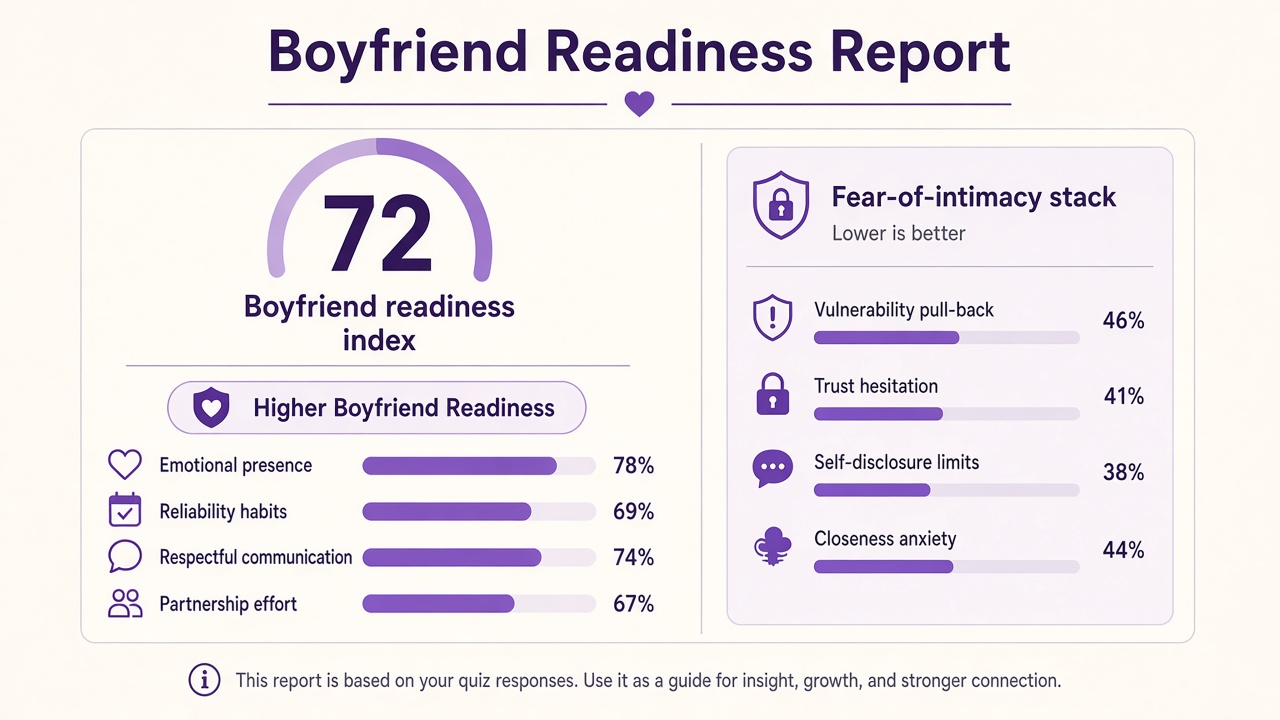
After all 20 items, you get a trustworthiness index from 0 to 100, a band label, four domain bars for honest communication, consistency and reliability, loyalty and confidentiality, and repair accountability, plus a fear-of-intimacy stack chart with vulnerability, trust, disclosure, and closeness anxiety layers.
What this quiz can and cannot tell you
Can tell you
- How much trustworthiness habit signals showed up in your self-report on this screener
- A trustworthiness index and four domain bars for honesty, reliability, loyalty, and repair
- A fear-of-intimacy stack showing which closeness-avoidance layer may undermine transparency
- A starting point for honest talks, habit changes, or couples counseling
Cannot tell you
- Whether your partner should trust you without their lived experience and context
- Whether low scores mean you are irredeemable or high scores guarantee relationship success
- Whether past betrayal on either side is fully repaired based on a quiz score alone
- What treatment or coaching you need without licensed professional guidance
Interpersonal trust, repair habits, and intimacy fear
Search interest in am I trustworthy quizzes often spikes when someone wants a concrete answer beyond vague advice to be more honest. Social psychologist John Rempel and colleagues published influential work on interpersonal trust in close relationships, separating predictability, dependability, and faith in a partner. Those ideas overlap with what people mean by trustworthiness: telling hard truths, keeping small promises, protecting confidences, and owning mistakes with repair effort instead of blame reversal.
The Quiz Hub built this am I trustworthy quiz as an original self-report screener inspired by interpersonal trust themes plus FOIS-style intimacy avoidance layers from Karen M. Descutner and Mark H. Thelen (1991), not a reproduction of any single published instrument. Readers often compare it to sibling tools on this site. Our do I have trust issues quiz screens doubt patterns toward partners rather than your own habits. The fear of intimacy quiz measures general intimacy avoidance frequency rather than trustworthiness agreement items. The am I boyfriend material quiz screens partner readiness habits for men rather than trustworthiness across any gender or role.
| The Quiz Hub test | What it adds |
|---|---|
| Do I have trust issues quiz | Partner doubt and hypervigilance, not your own trustworthiness habits |
| Fear of intimacy quiz | General intimacy avoidance frequency, not trustworthiness agreement items |
| Am I boyfriend material quiz | Boyfriend readiness habits for men, not trustworthiness across roles |
| Am I the problem quiz | Conflict responsibility during fights, not honesty or loyalty habits broadly |
| Relationship test | Six partnership health domains, not self-rated trustworthiness habits |
| This am I trustworthy quiz | Trustworthiness index plus fear-of-intimacy stack for honesty, reliability, loyalty, and repair |
Sample item types include agreement ratings such as whether you keep private things your partner shares between the two of you, or whether you hide small details to avoid conflict. Low honesty with high vulnerability pull-back on the stack often lands in Mixed or Lower Trustworthiness Signals. Busy work seasons or shame after a fight can lower scores without meaning you cannot rebuild trust. Read how we review quizzes in our editorial policy or browse more tools on our relationships and dating hub.
Am I trustworthy quiz FAQ
What does it mean to be trustworthy in a relationship?
Trustworthy partners tend to tell hard truths, keep promises, protect confidences, and own mistakes with repair effort. Social psychologist John Rempel and colleagues studied interpersonal trust through predictability, dependability, and faith dimensions in close bonds. This am I trustworthy quiz measures how much you agree with those habit patterns on a self-report screener. It is not a verdict on your character or a label your partner must accept.
What does this am I trustworthy quiz measure?
Twenty original agree-or-disagree items ask how much you show honest communication, consistency and reliability, loyalty and confidentiality, and repair accountability in close relationships. Scores map to four trustworthiness domains plus a parallel fear-of-intimacy stack with vulnerability pull-back, trust hesitation, self-disclosure limits, and closeness anxiety layers. You receive a trustworthiness index from 0 to 100 where higher scores mean stronger trustworthy habit signals on this screener, plus a band from Lower through Higher Trustworthiness Signals.
What is the fear-of-intimacy stack on this quiz?
The fear-of-intimacy stack is a second results chart inspired by FOIS-style intimacy avoidance themes, adapted to trustworthiness habits. Each of the 20 items also maps to one of four stack layers: vulnerability pull-back, trust hesitation, self-disclosure limits, and closeness anxiety. The stack index summarizes how often you hide details to avoid conflict, dodge repair talks, or treat transparency like a threat while trying to be a trustworthy partner.
How is this different from the do I have trust issues quiz?
The do I have trust issues quiz screens doubt patterns toward partners: hypervigilance, reassurance seeking, secrecy assumptions, and repair doubt. This am I trustworthy quiz focuses on your own trustworthiness habits: telling hard truths, keeping promises, protecting confidences, and owning mistakes. It adds a fear-of-intimacy stack layer that the trust issues quiz does not include.
Can this quiz tell me if my partner should trust me?
No. The trustworthiness index describes self-reported habit patterns on this abbreviated screener. Stress, shame, past betrayal, or a mismatched relationship can lower scores without meaning you cannot rebuild trust. Only you, your partner, and honest dialogue over time can define whether trust feels safe again. Online quizzes cannot confirm or deny whether someone should trust you in every context.
Who reviewed this content?
Dr. Priya Sharma, PhD, reviewed the test framing and result explanations. See our editorial policy for review standards.
Reviewed by