What this am I the problem quiz measures
This am I the problem quiz estimates how often problem-person patterns show up in your self-report across groups and conflict. Twenty-two agree-disagree items group into conflict initiation, accountability gaps, social friction, and drama magnetism. Each item maps to a fear-of-intimacy stack layer inspired by Gottman conflict themes and FOIS-style closeness ideas from Descutner and Thelen (1991). Your problem-person signal index averages these patterns into a 0 to 100 score.
Conflict initiation
Starting arguments, sharp comebacks, sarcasm, and treating silence as proof others are wrong.
Accountability gaps
Deflecting fault, but-apologies, remembering intent over impact, and slow ownership.
Social friction
Groups going quiet, plans shifting, and coworkers walking on eggshells around your mood.
Drama magnetism
Chaos following you, hot-and-cold bonds, and being the main character in every conflict story.
How it works
Answer 22 agree-disagree items
Rate each agree-disagree statement from Strongly disagree to Strongly agree. You click Next after each answer.
Items map to domains and intimacy stack
Answers accumulate percentages for four primary domains plus four fear-of-intimacy stack layers.
View index, band, and charts
Results show Lower, Mixed, or Higher signal bands with domain bars and stack chart.
Take the am i the problem quiz
Complete 22 items to receive your problem-person signal index, domain bars, fear-of-intimacy stack chart, and band label.
What your result means
Your problem-person signal index is the normalized total across all 22 items on a 0 to 100 scale. Higher scores mean more frequent agreement on this screener.
| Band | Index range | Typical reading |
|---|---|---|
| Lower Problem-Person Signals | 0 to 35 | Fewer conflict or friction patterns; normal disagreements still happen |
| Mixed Problem-Person Signals | 36 to 65 | Blend of repair skills and habits that can read as the problem |
| Higher Problem-Person Signals | 66 to 100 | Frequent conflict or accountability gaps worth addressing with support |
What your report looks like
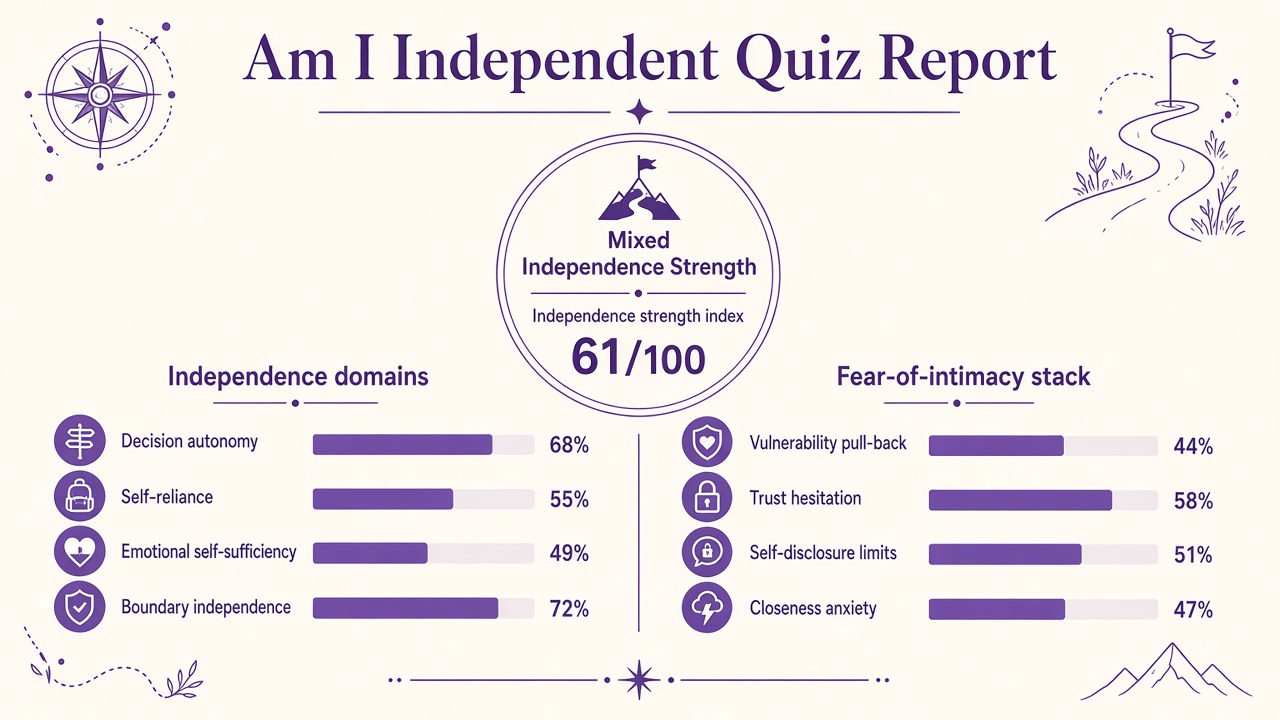
What this quiz can and cannot tell you
Can tell you
- How often problem-person patterns showed up in this self-report screener
- A problem-person signal index with four domain bars plus fear-of-intimacy stack
- A starting point before therapy or honest friend feedback
Cannot tell you
- Proof that you are a bad person or toxic friend
- What every group member would say about you
- Clinical diagnosis of any personality disorder
Why people search am I the problem
People search am I the problem after friend group exits, partner complaints, or work feedback that sounds familiar. The Quiz Hub built this as an original agree-disagree screener with a parallel fear-of-intimacy stack, inspired by John Gottman conflict research themes, not a published problem-person scale.
Sample items ask about starting fights, deflecting accountability, creating social friction, and repeating drama cycles.
| Test | Focus |
|---|---|
| Am I the problem in my relationship quiz | Partner conflict responsibility during fights, not broad social friction |
| Am I mean quiz | Hostile tone and dismissive contempt rather than accountability gaps broadly |
| Am I passive aggressive quiz | Indirect hostility instead of open conflict initiation |
Am I The Problem Quiz FAQ
What does am I the problem mean in this quiz?
It screens self-reported habits that can make you the recurring issue in conflict: starting fights, dodging accountability, creating friction, or attracting drama. It is not a moral verdict or diagnosis.
How is this different from the relationship problem quiz?
The am I the problem in my relationship quiz focuses on partner fights, defensiveness, and repair attempts during romantic conflict. This quiz broadens to friend groups, work, and general drama patterns.
Does a high score mean I am toxic?
No. Higher scores mean you endorsed more problem-person pattern items on this screener. Patterns can change with feedback, skills training, and therapy.
What is the fear-of-intimacy stack?
A second chart with vulnerability pull-back, trust hesitation, self-disclosure limits, and closeness anxiety layers. Higher stack scores may reflect guarding closeness while conflict escalates.
Can this quiz diagnose a personality disorder?
No. Only a licensed clinician can evaluate personality or related concerns through structured assessment.
Who reviewed this content?
Dr. James Whitfield, PhD, reviewed the test framing and result explanations. See our editorial policy for review standards.
Reviewed by