What this royalty vibe quiz measures
This am I royalty quiz estimates how strongly you agree with statements about regal presence, etiquette standards, luxury expectations, and command presence in everyday self-image. Twenty original agreement items group into four domains inspired by sociologist Pierre Bourdieu on cultural capital signals and historical etiquette manuals that shaped European court behavior, adapted here as playful self-report rather than aristocratic gatekeeping. Each item also maps to a fear-of-intimacy stack layer. Your royalty vibe index averages these patterns into a 0 to 100 score.
Regal presence
Posture, voice tone, entrance energy, and the sense that rooms quiet when you arrive
Etiquette standards
Table manners, thank-you notes, dress codes, and formal politeness rituals others notice
Luxury expectations
Assuming quality service, premium materials, and comfort standards that feel normal not special
Command presence
Expecting deference, setting rules confidently, delegating tasks, and leading without asking permission
How it works
Three steps from first question to your royalty vibe report with domain bars and fear-of-intimacy stack.
Answer 20 agreement items
Rate how much you agree with each statement about presence, manners, luxury standards, and leadership tone, from Strongly disagree to Strongly agree.
Items map to royalty domains and intimacy stack
Your answers accumulate percentages for regal presence, etiquette standards, luxury expectations, and command presence, plus four fear-of-intimacy stack layers.
View band and dual charts
Results show Lower, Mixed, or Higher Royalty Vibe with domain bars and a fear-of-intimacy stack chart.
Take the am I royalty quiz
Rate 20 statements about regal energy, etiquette, luxury expectations, and command presence. Your answers produce a royalty vibe index from 0 to 100, a fear-of-intimacy stack index, four domain scores, and a band label for screenshot-worthy fun.
Opens in a focused modal. No account required. Results stay on screen.
What your royalty vibe result means
Your royalty vibe index is the normalized total across all 20 items on a 0 to 100 scale, with reverse scoring on humility and avoidance items so higher scores mean stronger royalty vibe patterns on this screener.
| Band | Index range | Typical reading |
|---|---|---|
| Lower Royalty Vibe | 0 to 35 | Fewer regal self-image habits; humility or budget-grounded style |
| Mixed Royalty Vibe | 36 to 65 | Blend of regal flair and grounded habits; domain chart shows where vibe peaks |
| Higher Royalty Vibe | 66 to 100 | Frequent regal presence, etiquette, luxury, and command habits on this screener |
What your royalty vibe report looks like
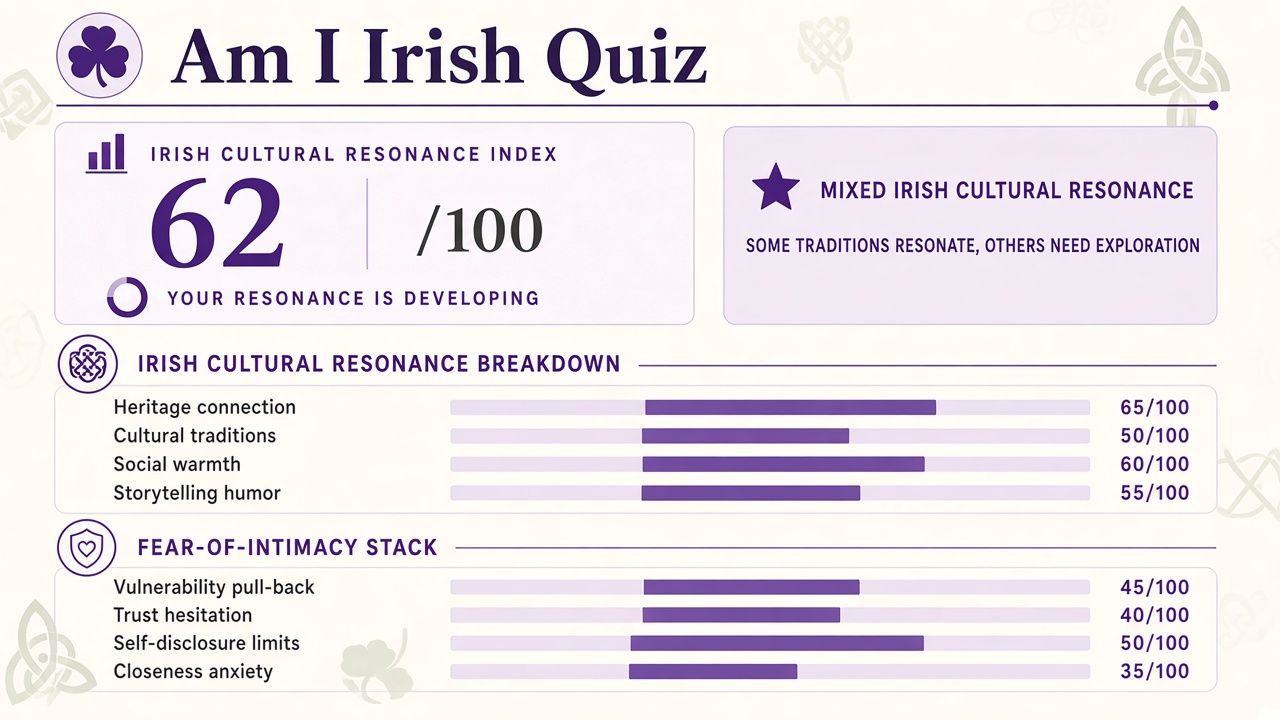
After all 20 items, you get a royalty vibe index from 0 to 100, a band label, four domain bars, and a fear-of-intimacy stack chart.
What this quiz can and cannot tell you
Can tell you
- How often regal presence, etiquette, luxury, and command habits showed up in your self-report
- A royalty vibe index and fear-of-intimacy stack index with domain bars
- Which domain feels strongest when you play with main-character energy
- A playful mirror for cosplay, aesthetic branding, or friend-group banter
Cannot tell you
- Whether you have noble ancestry or verified royal lineage
- Whether others must defer to you in real life
- Your socioeconomic class or income level
- Permission to treat service workers or peers disrespectfully
Regal self-image, cultural capital, and playful limits
Sociologist Pierre Bourdieu described cultural capital as the tastes, manners, and confidence signals that groups use to mark belonging. Historical European courts codified etiquette into manuals that still echo in modern ideas about polish and deference, even when most people taking BuzzFeed-style royalty quizzes are joking about aesthetics.
The Quiz Hub built this am I royalty quiz as an original entertainment screener plus FOIS-style intimacy avoidance layers. Our am I posh quiz screens posh vibe habits. The am I rich quiz maps wealth mindset rather than regal presence.
| The Quiz Hub test | What it adds |
|---|---|
| Am I posh quiz | Posh vibe and upper-crust etiquette signals, not full command presence domains |
| Am I rich quiz | Wealth mindset and spending discipline, not regal entrance energy |
| Am I popular quiz | Social popularity habits, not luxury expectation items |
| Fear of intimacy quiz | General closeness avoidance, not performance pressure when praised |
| This quiz | Royalty vibe index plus fear-of-intimacy stack for presence, etiquette, luxury, and command |
Sample items include whether you delegate naturally in group projects or feel annoyed when products feel cheap. High luxury expectations with high closeness anxiety on the stack may land in Mixed bands when polished self-image hides vulnerability about money or background. Read our editorial policy or browse the fun and novelty tests hub.
Am I Royalty Quiz FAQ
What does the am I royalty quiz measure?
Twenty original agreement items ask about regal presence, etiquette standards, luxury expectations, and command presence in your self-image. Each item also maps to a fear-of-intimacy stack layer. You receive a royalty vibe index from 0 to 100 where higher scores mean stronger royalty vibe patterns on this screener.
Does a higher royalty vibe index prove I have royal blood?
No. The index measures playful self-report habits about presence and expectations, not genealogy, titles, or heraldry records.
What is the fear-of-intimacy stack on this quiz?
The fear-of-intimacy stack is a second results chart inspired by FOIS-style intimacy avoidance themes, adapted to regal performance and guarded vulnerability when praise feels exposing.
How is this different from the am I posh quiz?
The am I posh quiz screens posh vibe and upper-crust etiquette habits. This royalty quiz adds luxury expectations and command presence domains for main-character energy framing.
Can high scores excuse rude behavior toward staff?
No. Entertainment scores never justify disrespect. Pair with our am I rude quiz if you want a blunt communication screener angle.
Who reviewed this content?
Dr. James Whitfield, PhD, reviewed the test framing and result explanations. See our editorial policy for review standards.
Who reviewed this content?
Dr. James Whitfield, reviewed the test framing and result explanations. See our editorial policy for review standards.
Reviewed by