What this bedroom confidence quiz measures
This am I good in bed quiz estimates how often confidence and attentiveness habits show up when you reflect on intimate experiences with a consenting partner. Twenty-two original frequency items group into four domains drawn from sexual satisfaction research by the Kinsey Institute and responsive desire work by Emily Nagoski (2015): partner attentiveness, confidence presence, desire communication, and satisfaction connection. Each item also maps to a fear-of-intimacy stack layer so you can see whether vulnerability pull-back, trust hesitation, self-disclosure limits, or closeness anxiety rides alongside bedroom doubt. Your bedroom confidence index averages these patterns into a 0 to 100 score where higher numbers mean more frequent confidence signals on this screener.
Partner attentiveness
Reading partner cues, adjusting pace, consent check-ins, and warm-up or aftercare habits.
Confidence presence
Body comfort, initiating when mutual, staying present, and recovering from awkward moments.
Desire communication
Naming likes and limits, honest feedback, boundary talk, and asking instead of guessing.
Satisfaction connection
Emotional connection afterward, pride in care shown, and trust that partners feel attended to.
How it works
Three steps from first question to your bedroom confidence report with fear-of-intimacy stack. Click Start Quiz to open the interactive quiz in a full-screen modal.
Answer 22 frequency items
Rate how often each bedroom confidence habit shows up when you reflect on intimate experiences, from Never to Almost always. You click Next after each answer; nothing auto-advances.
Items map to bedroom domains and intimacy stack
Your answers accumulate percentages for partner attentiveness, confidence presence, desire communication, and satisfaction connection, plus four fear-of-intimacy stack layers.
View band, domain bars, and stack chart
Results show Lower, Mixed, or Higher Bedroom Confidence with domain bars, stack layers, and reflection prompts. Lower bands include support resources for overwhelming anxiety.
Take the am I good in bed quiz
Rate 22 statements about partner attentiveness, confidence presence, desire communication, and satisfaction connection. Your answers produce a bedroom confidence index from 0 to 100, four domain scores, a fear-of-intimacy stack chart, and a band label for reflection or partner conversation.
Opens in a focused modal. No account required. Results stay on screen.
What your bedroom confidence result means
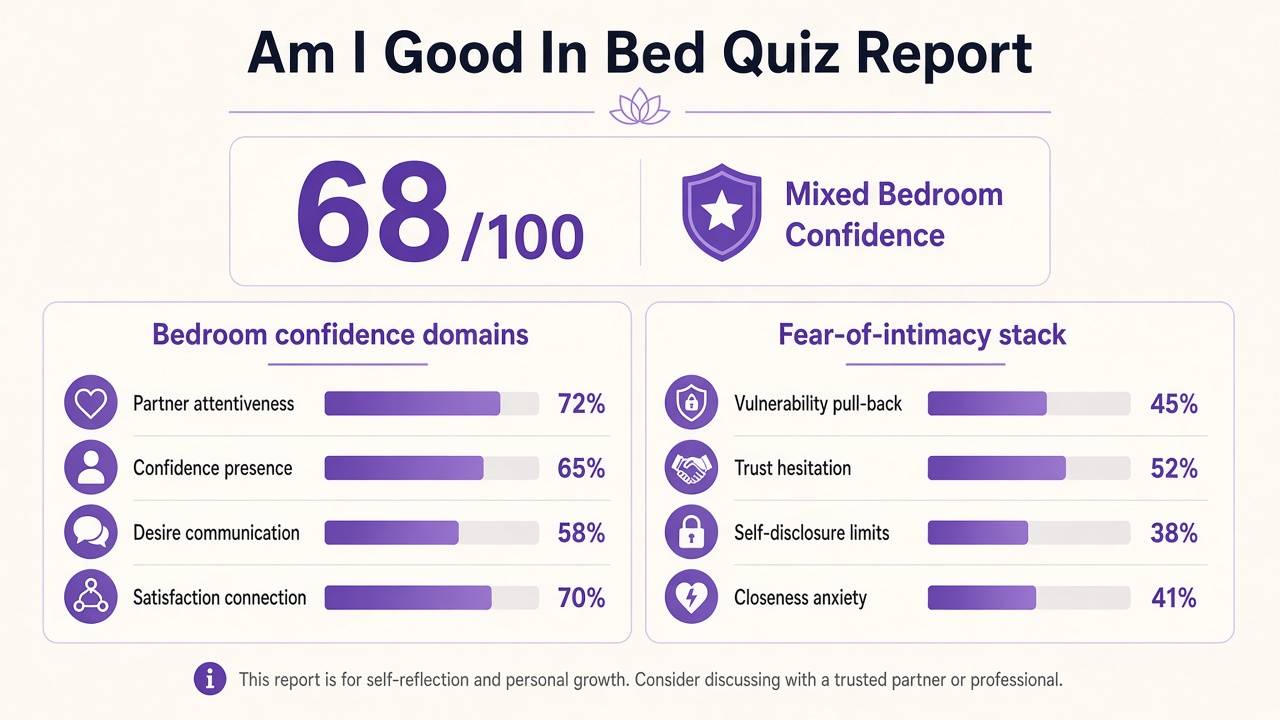
Your bedroom confidence index is the normalized total across all 22 items on a 0 to 100 scale. Higher scores mean more frequent partner attentiveness, presence, desire talk, or connection items on this screener. Domain bars show endorsement rates so you can see whether reading cues, staying present, naming desires, or feeling connected drives your result most. The fear-of-intimacy stack chart shows parallel layers for vulnerability pull-back, trust hesitation, self-disclosure limits, and closeness anxiety when closeness guarding shapes bedroom doubt.
| Band | Index range | Typical reading |
|---|---|---|
| Lower Bedroom Confidence | 0 to 35 | More self-doubt and fewer confidence signals; shame, stress, or limited practice talking about sex may play a role |
| Mixed Bedroom Confidence | 36 to 65 | Blend of strong habits and pockets of doubt; domain and stack charts show where confidence feels strongest |
| Higher Bedroom Confidence | 66 to 100 | Frequent attentiveness, presence, and connection habits on this screener; still not proof partners rank you highest |
What your good in bed report looks like
After all 22 items, you get a bedroom confidence index from 0 to 100, a band label, four domain bars for partner attentiveness, confidence presence, desire communication, and satisfaction connection, plus a fear-of-intimacy stack chart with vulnerability, trust, disclosure, and closeness anxiety layers.
What this quiz can and cannot tell you
Can tell you
- How often bedroom confidence habits showed up in this self-report screener
- A bedroom confidence index and four domain bars for attentiveness, presence, communication, and connection
- A fear-of-intimacy stack showing which closeness-guarding layer feels strongest alongside sexual doubt
- A starting point for partner conversation, sex-positive education, or therapy about intimacy shame
Cannot tell you
- Whether your partner secretly thinks you are bad in bed without their honest feedback
- Whether you have a sexual dysfunction or disorder without clinical evaluation
- Whether you should compare yourself to past partners, porn, or viral quizzes as skill benchmarks
- What specific techniques will guarantee orgasm or satisfaction for every partner
Bedroom confidence, partner cues, and the intimacy stack
People search am I good in bed when performance anxiety, a new partner, or a dry spell makes them doubt their skills. Sex researchers at the Kinsey Institute have long studied how satisfaction ties to communication, attentiveness, and emotional connection rather than a single technique score. Emily Nagoski wrote in Come As You Are (2015) that responsive desire and context matter as much as spontaneous arousal myths suggest. Those research threads inform everyday language about reading partner cues, naming preferences, and recovering from awkward moments without spiraling into shame.
The Quiz Hub built this am I good in bed quiz as an original self-report screener inspired by sexual satisfaction themes plus FOIS-style intimacy avoidance layers from Descutner and Thelen (1991), not a reproduction of any published clinical instrument. Readers often compare it to sibling tools on this site. Our how kinky are you quiz screens novelty curiosity and boundary clarity. The orange peel test measures partner responsiveness on small daily favors. The sexual profile quiz maps six intimate style dimensions with primary and secondary match labels.
| The Quiz Hub test | What it adds |
|---|---|
| How kinky are you quiz | Novelty curiosity and boundary clarity domains, not everyday confidence habits |
| Orange peel test | Partner responsiveness on daily favors, not bedroom attentiveness items |
| Sexual profile quiz | Six intimate style dimensions with type match labels, not confidence frequency screen |
| Fear of intimacy quiz | General intimacy avoidance across vulnerability and trust, not bedroom confidence domains |
| Bird test relationship | Viral partner responsiveness index on relationship bids, not sexual self-confidence |
| This good in bed quiz | Bedroom confidence index plus fear-of-intimacy stack for attentiveness, presence, communication, and connection |
Sample item types include frequency ratings such as whether you check in with a simple question when unsure, or whether you name what you enjoy when your partner asks. High partner attentiveness with high trust hesitation on the stack often lands in Mixed Bedroom Confidence bands when you perform well but doubt positive feedback. Strong desire communication with lower satisfaction connection can split domain scores when talking is easier than feeling bonded afterward. Read how we review adult quizzes in our editorial policy or browse more tools on our relationships and dating hub.
Am I good in bed quiz FAQ
How do I know if I am good in bed?
Honest signs include reading partner cues, staying present, naming desires, and leaving intimate time feeling connected. One awkward night does not define you. This am I good in bed quiz measures how often those habits show up in your self-report, plus a fear-of-intimacy stack chart showing how closeness anxiety may shape bedroom doubt. It is not a clinical verdict or proof of partner satisfaction.
What does this am I good in bed quiz measure?
Twenty-two original frequency items ask how often you notice partner attentiveness, confidence presence, desire communication, and satisfaction connection when you reflect on intimate experiences with a consenting partner. Each item also maps to a fear-of-intimacy stack layer: vulnerability pull-back, trust hesitation, self-disclosure limits, and closeness anxiety. You receive a bedroom confidence index from 0 to 100 and a band from Lower through Higher Bedroom Confidence.
What is the fear-of-intimacy stack on this quiz?
The fear-of-intimacy stack is a second results chart inspired by FOIS-style intimacy avoidance themes from Descutner and Thelen (1991), adapted to sexual self-confidence framing. Each of the 22 items maps to one of four stack layers showing how closeness guarding may connect to bedroom doubt: hiding vulnerability, testing trust, limiting disclosure, or panicking when bonds deepen. The stack index summarizes those layers alongside the bedroom confidence index.
How is this different from the how kinky are you quiz?
The how kinky are you quiz screens novelty curiosity, boundary clarity, and adventurous openness themes. This am I good in bed quiz focuses on everyday confidence habits: reading partner cues, staying present, talking about desires, and feeling connected afterward. Both are self-report screeners for reflection, not proof of skill rank or partner approval.
Can this quiz tell me if my partner thinks I am good in bed?
No. The bedroom confidence index describes self-reported habits on this abbreviated screener. Partners may value different things than you assume, and chemistry shifts with stress, health, and life stages. Only honest conversation with a consenting partner can clarify what feels good for both of you. Online quizzes cannot read your partner's mind or rank lovers.
What should I do if I get a lower bedroom confidence band?
Name one small change to try, such as a check-in question or slower pacing. Read Emily Nagoski on responsive desire if arousal feels unpredictable. Consider an AASECT-certified sex therapist if shame or avoidance persists. If anxiety feels overwhelming, call or text 988 (US) or your local crisis line.
Who reviewed this content?
Dr. James Whitfield, PhD, reviewed the test framing and result explanations. See our editorial policy for review standards.
Reviewed by