
What this boy or girl quiz measures
This am I a boy or girl quiz estimates how often masculine-coded versus feminine-coded habits show up in how you report dressing, spending free time, socializing, and expressing feelings. Twenty original frequency items group into four domains inspired by psychologist Sandra Bem's gender schema theory on how people learn masculine and feminine cultural cues, plus sociologist Raewyn Connell's work on how gender is performed in daily life: masculine style pull, masculine interests pull, masculine social pull, and masculine expression pull. Each item also maps to a fear-of-intimacy stack layer. Your masculine pull index averages these patterns into a 0 to 100 score where higher numbers mean more masculine-coded habits on this screener, with feminine pull as the complement.
Masculine style pull
Baggy fits, gear research, hidden skincare experiments, soft-color seriousness worries, and bold palette enjoyment without irony.
Masculine interests pull
Sports and action content, scrubbed lifestyle feeds, hands-on tutorial trust, downplayed cozy hobbies, and craft-night comfort.
Masculine social pull
Sarcastic banter, emotional-talk avoidance, gym-or-game hangouts, vague crush stories, and heart-to-heart hosting.
Masculine expression pull
Joke deflection on feelings, solo problem-solving before hugs, open diary sharing, crying-in-front-of-partner worry, and fix-it-first vent responses.
How it works
Three steps from first question to your masculine versus feminine pull report with fear-of-intimacy stack. Click Start Quiz to open the interactive quiz in a full-screen modal.
Answer 20 frequency items
Rate how often each masculine or feminine pull pattern shows up in everyday style, hobbies, and feelings, from Never to Almost always. You click Next after each answer; nothing auto-advances.
Items map to pull domains and intimacy stack
Your answers accumulate percentages for masculine style, interests, social, and expression pull, plus four fear-of-intimacy stack layers.
View band and dual charts
Results show More Feminine-Leaning Pull, Mixed Masculine-Feminine Blend, or More Masculine-Leaning Pull with domain bars and a fear-of-intimacy stack chart. Higher masculine pull index means more masculine-coded habits on this screener.
Take the am I a boy or girl quiz
Rate 20 statements about masculine versus feminine pull across style, hobbies, social energy, and expression. Your answers produce a masculine pull index from 0 to 100, a feminine pull index, a fear-of-intimacy stack index, four domain scores, and a band label for reflection or honest identity talks.
Opens in a focused modal. No account required. Results stay on screen.
What your masculine pull result means
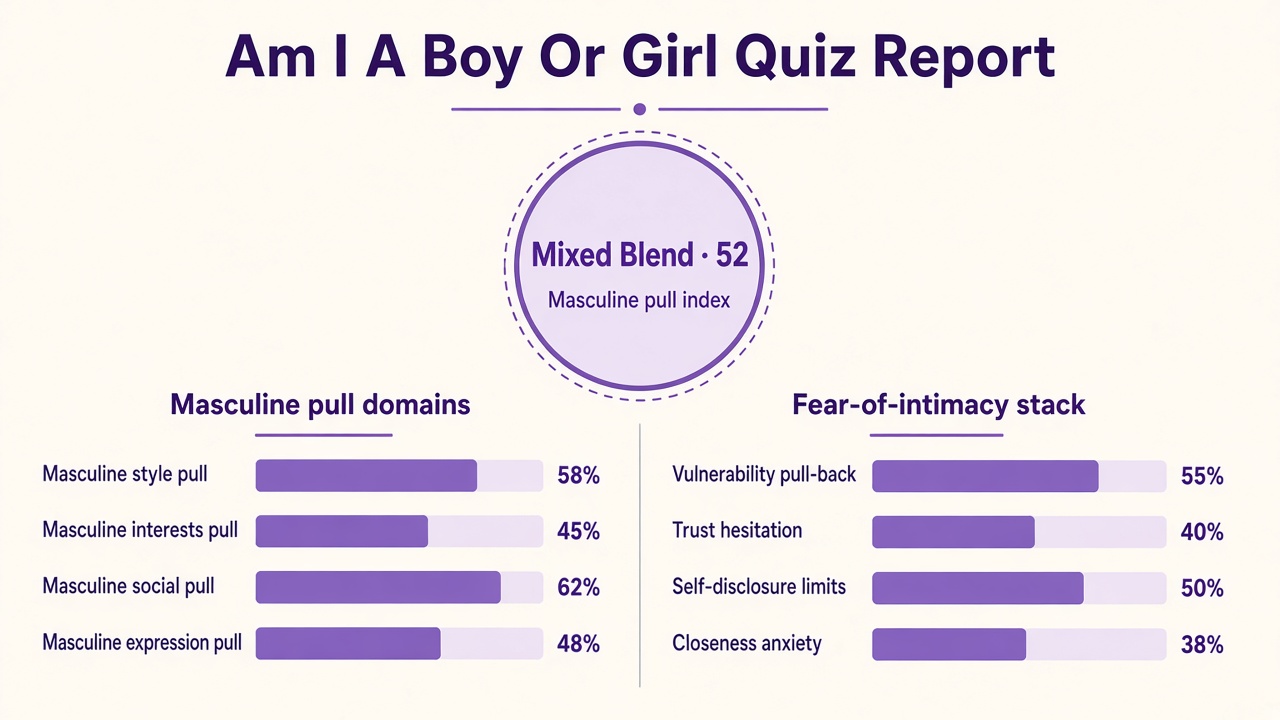
Your masculine pull index is the normalized total across all 20 items on a 0 to 100 scale, with reverse scoring on feminine-coded comfort items so higher scores mean more masculine-coded habits overall. The feminine pull index is the complement at 100 minus masculine pull. The fear-of-intimacy stack index uses the same answers mapped to vulnerability, trust, disclosure, and closeness anxiety layers where higher stack scores mean more avoidance patterns. Domain bars show endorsement rates so you can see whether style, interests, social energy, or expression drives your result most.
| Band | Index range | Typical reading |
|---|---|---|
| More Feminine-Leaning Pull | 0 to 35 | More feminine-coded style, hobby, social, or expression habits; culture and friend groups can still shift scores temporarily |
| Mixed Masculine-Feminine Blend | 36 to 65 | Blend of masculine-coded and feminine-coded signals; domain and stack charts show where closeness guarding shows up |
| More Masculine-Leaning Pull | 66 to 100 | Frequent baggy fits, action hobbies, sarcastic banter, or joke deflection on feelings on this screener |
What your boy or girl quiz report looks like
After all 20 items, you get a masculine pull index from 0 to 100, a band label, four masculine pull domain bars, and a fear-of-intimacy stack chart with vulnerability pull-back, trust hesitation, self-disclosure limits, and closeness anxiety layers. Percentages reflect how you report style, hobbies, and feelings, not a verdict on gender identity.
What this quiz can and cannot tell you
Can tell you
- How often masculine-coded versus feminine-coded style, hobby, social, and expression patterns showed up in your self-report
- A masculine pull index, feminine pull index, and fear-of-intimacy stack index with domain bars
- Which masculine pull domain or intimacy stack layer feels strongest in your current habits
- A starting point for honest identity reflection, feelings talks, or therapy conversation about shame and closeness
Cannot tell you
- Your gender identity, biological sex, or sexual orientation from expression habits alone
- Whether every friend reads you as boy or girl without their side of the story
- Whether culture, family norms, or safety concerns explain your score
- What specific identity labels fit you without honest reflection and trusted support
Boy or girl memes, gender expression, and the fear-of-intimacy stack
Social media turned boy or girl into a playful label for whether your habits read more masculine-coded or feminine-coded in memes, group chats, and outfit polls. Psychologist Sandra Bem argued that people learn gender schemas from culture long before any single quiz can sort them. Sociologist Raewyn Connell showed how masculinity and femininity are performed differently across communities, not fixed traits inside one person. In real life, hiding skincare experiments, deflecting feelings with jokes, or waiting until you look presentable before deep talks can feel safe while closeness stays guarded.
The Quiz Hub built this am I a boy or girl quiz as an original self-report screener inspired by those expression-as-performance themes plus FOIS-style intimacy avoidance layers from Descutner and Thelen (1991), not a reproduction of any single published boy-girl scale. Readers often compare it to sibling tools on this site. Our am I a tomboy quiz screens tomboy versus girly expression with agree-disagree items and a dual spectrum chart. The gender identity test maps internal sense of gender with identity clarity bands. The am I cis quiz uses frequency items about cisgender comfort rather than meme boy-girl pull.
| The Quiz Hub test | What it adds |
|---|---|
| Am I a tomboy quiz | Tomboy versus girly dual spectrum with agree-disagree items, not masculine pull frequency with intimacy stack |
| Gender identity test | Identity clarity and comfort with gender labels, not meme masculine versus feminine pull frequency |
| Am I bigender quiz | Bigender identity clarity index, not style and hobby pull domains |
| Fear of intimacy quiz | General intimacy avoidance across vulnerability and trust, not boy-girl meme framing |
| Am I a cheerleader quiz | Cheerleader energy index with intimacy stack, not masculine versus feminine pull domains |
| This boy or girl quiz | Masculine pull index plus fear-of-intimacy stack for style, hobbies, social energy, and expression habits |
Sample item types include frequency ratings such as whether you pick sports highlights over beauty drama streams, or whether you worry that crying in front of a partner makes you look weak. High masculine social pull with high self-disclosure limits on the stack often lands in Mixed Masculine-Feminine Blend bands. Action hobbies with soft-style experiments can split domain scores. Read how we review quizzes in our editorial policy or browse more tools on our fun and novelty hub.
Am I a boy or girl quiz FAQ
What does the am I a boy or girl quiz measure?
Twenty original frequency items ask how often masculine-coded or feminine-coded style, hobby, social, and expression habits show up in everyday life. Each item also maps to a fear-of-intimacy stack layer: vulnerability pull-back, trust hesitation, self-disclosure limits, and closeness anxiety. You receive a masculine pull index from 0 to 100 where higher scores mean more masculine-coded habits on this screener, plus a parallel stack index and feminine pull index.
Does a higher masculine pull index mean I am a boy?
No. On this screener, a higher index means you endorsed more masculine-coded style, hobby, social, or expression items. Many girls, women, and nonbinary people score high on action hobbies or blunt banter without identifying as boys. This quiz cannot prove gender identity, biology, or who you should date.
What is the fear-of-intimacy stack on this quiz?
The fear-of-intimacy stack is a second results chart inspired by FOIS-style intimacy avoidance themes from Descutner and Thelen (1991), adapted to boy-girl meme framing. Each of the 20 items maps to one of four stack layers showing how closeness guarding may pair with tough or polished presentation habits: hiding vulnerability, testing trust, limiting disclosure, or worrying about being too close. Higher stack scores mean more avoidance patterns on these items.
How is this different from the am I a tomboy quiz?
The am I a tomboy quiz uses agree-disagree items about sporty style, active interests, direct social energy, and practical presentation with a dual tomboy versus girly spectrum chart. This am I a boy or girl quiz uses how-often frequency items about masculine versus feminine pull across style, hobbies, social energy, and expression with a parallel fear-of-intimacy stack chart in one report.
How is this different from the gender identity test?
The gender identity test screens identity clarity and comfort with gender labels using agree-disagree items about internal sense of gender. This am I a boy or girl quiz uses frequency items about masculine-coded versus feminine-coded expression habits for meme entertainment, not clinical identity assessment.
Can this quiz tell me my real gender?
No. The masculine pull index describes self-reported style, hobby, social, and expression patterns on this abbreviated entertainment screener. Culture, friend groups, and mood all shape how habits land. Only you can explore gender identity through honest reflection, trusted conversations, or professional support.
Who reviewed this content?
Dr. James Whitfield, PhD, reviewed the test framing and result explanations. See our editorial policy for review standards.
Reviewed by
