How to Choose a Family Psychologist: Fit, Credentials, and First Questions
Last updated:
Educational only: This article offers selection tips, not medical advice or emergency care. If someone in the home might hurt themselves or others tonight, call or text 988 (U.S.), contact Samaritans at 116 123 (UK), or use local emergency services. See our editorial policy.
To choose a family psychologist, verify state licensure, confirm training in family systems work, interview for fit with your goals, and screen out conjoint therapy when active abuse or coercion is present. A strong clinician explains confidentiality limits, involves children at developmentally appropriate levels, and sets clear goals within the first few sessions. You are not looking for a friend; you are hiring someone who can observe live interaction, name patterns without taking sides, and refer out when individual safety work must come first. The American Psychological Association (2017) ethics code requires competence and informed consent; your questions at intake are part of that process.
Tips at a glance
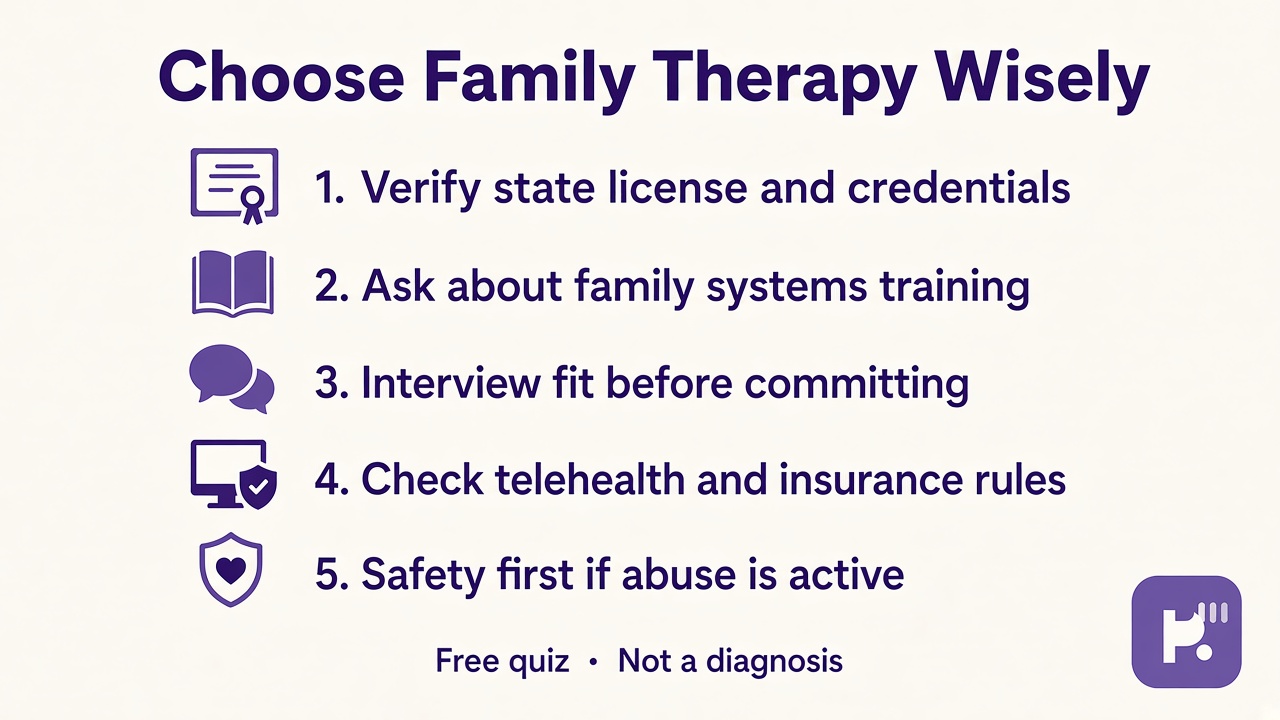
Key takeaways
- License verification beats marketing slogans; check your state psychology board registry.
- Family systems training matters more than a generic "we see all ages" line on a website.
- One bad session does not doom therapy, but months with no agreed goals signal a poor match.
- Active domestic violence or credible threats usually need safety planning before conjoint sessions.
- Child symptoms may need a child psychologist alongside family work, not instead of parents learning new skills.
- Online child screeners prepare questions; they cannot pick your therapist for you.
What a family psychologist actually does
Family psychologists study how relationships shape mood, behavior, and stress. Sessions may include both parents, one parent and a teen, or the full household. They track who speaks for whom, which topics freeze the room, and how conflict spreads to school or sleep. Some use structural or strategic family therapy models; others integrate cognitive-behavioral skills for anxiety or oppositional behavior inside a family frame.
Modalities differ. Experiential approaches such as gestalt family therapy emphasize present-moment contact and experiments in the room. More structured programs may assign homework sheets and measure progress weekly. Neither style is automatically better; fit with your culture, literacy, and patience for emotional intensity matters.
Psychologists with doctoral training (PhD or PsyD in the U.S.) typically complete supervised hours before licensure. Licensed marriage and family therapists (LMFT) or clinical social workers (LCSW) may also lead family work when their scope and training match your needs. Title alone does not guarantee family expertise; ask what percentage of their caseload is multi-person therapy.
Credentials and red flags: quick comparison
| Green lights | Yellow flags (ask more) | Red flags (consider walking away) |
|---|---|---|
| Active state license listed on the board website | Only life-coach certification for complex child trauma | Refuses to share license number or disciplinary history |
| Clear informed consent about confidentiality and mandated reporting | Vague fees until after several sessions | Promises to "fix" a child without involving caregivers |
| Experience with your child's age and your family structure | Telehealth only with no plan for minors' privacy at home | Pressure to reveal secrets in front of an abusive partner |
| Referral network for psychiatry, advocacy, or school collaboration | No crisis plan between sessions | Dual relationships (dating a parent, hiring you for side jobs) |
| Measurable goals reviewed every few sessions | Discourages second opinions | Boundary violations or grooming behavior toward a minor |
Ethical practice is not optional. Our summary of ethical principles for psychologists covers competence, confidentiality, and when clinicians must break privacy to protect someone from serious harm. You can reference those standards in your first call if something feels off.
Questions to ask on the first call
Treat the intake call like a job interview. Clinics expect it. Sample prompts:
- "What license do you hold in this state, and what is your training in family systems therapy?"
- "How do you involve children versus meeting with parents only?"
- "What is your approach when one adult refuses to attend?"
- "How do you handle substance use, self-harm talk, or bullying disclosed in session?"
- "What are your fees, superbill options, and telehealth policies for minors?"
- "When would you refer us to individual therapy or psychiatry instead?"
If scheduling feels overwhelming, borrow language from our guide on how to formulate a request for a psychologist with employers, schools, or partners. A short script reduces shame and speeds triage on busy clinic phones.
When family therapy fits (and when it does not)
Family therapy can help with co-parenting conflict, sibling rivalry, adjustment after divorce, chronic illness stress, and teen withdrawal that affects everyone. It works best when adults agree on basic safety rules and can tolerate hearing feedback without retaliation.
Conjoint sessions are usually a poor first step when physical violence, credible threats, severe untreated substance dependence, or ongoing coercive control is present. Clinicians may start with individual safety planning, advocacy referrals, and separate sessions before anyone shares a room. Forcing "honesty" exercises when someone fears retaliation can increase harm.
Child-specific symptoms still matter. Read when to seek a child psychologist if school refusal, panic, or mood changes last weeks and block learning or friendships. Many families combine a child psychologist for assessment with family sessions to practice new routines at home.
Insurance, telehealth, and logistics
Call your insurer before the first appointment. Ask whether family therapy requires a diagnosis on one member, whether telehealth is covered equally, and whether out-of-network benefits apply. Note the reference number from the representative. Clinics can often bill while benefits verify if you understand your copay risk.
Telehealth adds privacy questions for teens and children. Where will they sit? Can someone overhear? Good clinicians coach families on headphones, car sessions, or school counselor rooms when home is not private. Document consent rules for minors in your state; psychologists follow local law and ethical codes.
Logistics shape success. Evening slots, language access, and commute matter for weekly attendance. Missing sessions because of childcare costs is a systems problem, not a moral failure. Ask whether the practice offers sliding scale slots or trainee clinicians supervised by a licensed psychologist.
How to tell if you chose well
Early sessions should include clear goals: fewer yelling matches, agreed screen-time rules, or a plan for school meetings. You should leave with homework that feels doable, not shamed. The psychologist names patterns without labeling one person as the sole problem unless abuse is documented.
If after several sessions nothing shifts, discuss the treatment plan openly. Modality changes (more parent coaching, fewer full-family meetings) or a referral may help. Staying out of loyalty to a poor fit wastes time and money. One awkward goodbye is better than a year of stalemate.
Limits of online articles
Blogs cannot observe your household dynamics, power imbalances, or cultural strengths. Quizzes cannot verify licensure or predict chemistry in the room. Use articles to prepare questions, then trust your gut when a clinician dismisses your safety concerns or rushes conjoint work after disclosures of violence.
Related quizzes on The Quiz Hub
These tools help you notice child stress patterns before intake. They do not diagnose disorders or replace a licensed evaluation.
- Child anxiety scale: screens worry and body symptoms you can discuss with a family or child psychologist.
- Child development quiz: compares skills and milestones to prompt questions about learning and behavior.
- Browse Mental Health & Clinical for additional YMYL screeners with study-not-diagnosis framing.
Frequently asked questions
What does a family psychologist do?
A family psychologist assesses how relatives influence emotions, behavior, and conflict. They may meet with parents, children, teens, or the whole household to map communication patterns, roles, and stressors. Treatment can include conjoint sessions, parent coaching, and coordination with schools or pediatricians. They do not prescribe medication in most U.S. states; psychiatrists or primary care doctors handle that role when needed.
How is a family psychologist different from a marriage counselor?
Marriage counselors often focus on the couple bond. Family psychologists usually frame problems as system-wide: sibling rivalry, co-parenting after divorce, a child's anxiety affecting everyone, or generational trauma. Overlap exists; many clinicians hold licenses that cover both. Ask whether they treat children in the room and how they handle secrets between parents and teens.
What questions should I ask before booking family therapy?
Ask about license type and state, training in family systems or structural therapy, experience with your child's age, telehealth rules, fees, and crisis plans between sessions. Request how they would handle one partner refusing to attend or active substance use in the home. A good fit interview is normal; you are hiring a professional for a high-stakes job.
Does insurance cover family psychology?
Many plans cover family therapy when a member has a diagnosable condition and the session includes that person. Some insurers require a primary diagnosis on one individual even when everyone attends. Call member services with the CPT codes the clinic provides, ask about copays for PhD or PsyD providers, and note whether telehealth is reimbursed at the same rate as in-person visits.
When should kids see a child psychologist instead of only family therapy?
Family therapy helps when patterns involve multiple people. A child psychologist may be better when symptoms are severe, developmentally specific, or when the child needs a private space to disclose abuse or self-harm. Many families use both: individual work for the child plus periodic family sessions to practice new skills at home.
How many sessions before we know if family therapy is working?
Some families feel relief after four to six sessions when communication homework sticks. Deeper change after trauma or years of conflict can take months. Ask the psychologist for measurable goals at intake (fewer school refusals, calmer dinners, agreed co-parenting rules). If nothing shifts after a agreed review point, discuss a different modality or clinician rather than forcing a poor fit.
Sources
- American Psychological Association. (2017). Ethical Principles of Psychologists and Code of Conduct.
- American Psychological Association. (2023). Family and relationships resources.
- Centers for Disease Control and Prevention. (2024). Children's mental health.
- Substance Abuse and Mental Health Services Administration. (2023). Find support for mental health and substance use.
- 988 Suicide & Crisis Lifeline. (2024). 988 Lifeline.
Reviewed by