How to Become a Psychologist: Degrees, Training, and Licensure Overview
Last updated:
Educational only: This article summarizes typical psychologist training paths in plain language. It is not legal advice, admissions counseling, or a guarantee of registration in any country. Requirements change; verify steps with your national psychology board and accredited programs before you enroll. See our editorial policy for how we review career content.
To become a psychologist, you usually complete university-level psychology training, graduate study in psychology or a recognized specialty, supervised practice under a licensed supervisor, and a registration or licensing exam set by your jurisdiction. The title "psychologist" is legally protected in many countries; calling yourself one without registration can be an offense. Coaches, influencers, and certificate holders are not interchangeable with registered psychologists unless your local law explicitly says otherwise.
Key takeaways
- Plan for years of study plus supervised hours; shortcuts marketed online rarely lead to legal practice.
- Undergraduate psychology, statistics, and research or volunteer experience strengthen graduate applications.
- Clinical, counseling, school, forensic, and research psychologists share training cores but different job markets.
- Ethics, confidentiality, and scope-of-practice rules are central from day one of accredited programs.
- U.S. readers should follow our become a psychologist in the USA guide for EPPP and state board detail.
Tips at a glance
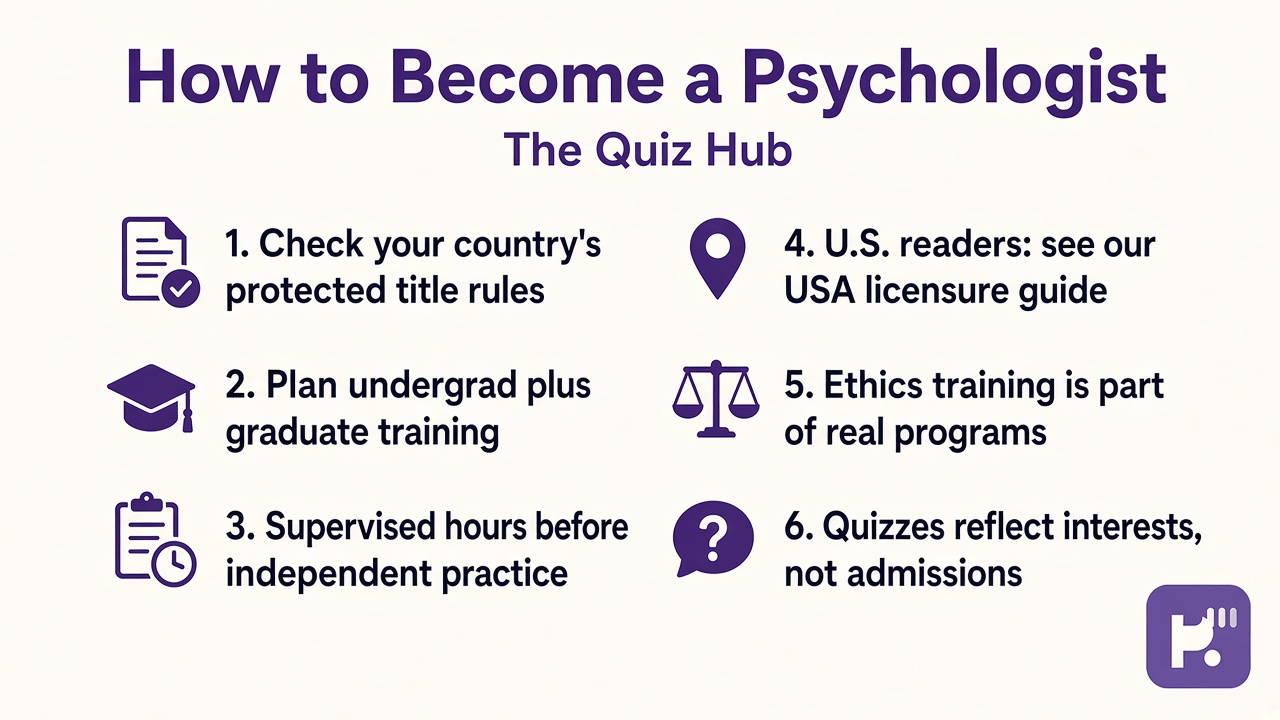
What "psychologist" means in law and practice
Colloquial speech uses "psychologist" for anyone who listens well. Regulators use it for people who met education, supervision, and exam standards and appear on an official register. In the United States, that usually means a doctoral degree and state licensure. In parts of Europe and Asia, a master's plus additional supervised practice may suffice. School psychologists, health psychologists, and industrial-organizational psychologists can all be registered psychologists while doing different work.
If you want clarity on clinical versus general psychologist roles, especially around diagnosis and therapy scope, read our difference between psychologist and clinical psychologist article. It walks through training emphasis without replacing your board's definitions.
Typical training timeline (international overview)
The table below is a planning map, not a legal document. Some countries combine steps differently; others require language exams or citizenship for public-sector roles. Use it to estimate years, then open your national association website for the authoritative checklist.
| Stage | Typical duration | Milestones |
|---|---|---|
| Secondary school foundation | Through age 17-18 | Strong writing and math; volunteer or peer-support roles if available; early reality check on long training |
| Bachelor's degree | 3-4 years | Psychology major or related field with core courses; statistics and research methods; lab or clinic volunteering |
| Graduate degree | 2-7 years | Master's and/or doctorate from an accredited program; practicum placements; thesis or dissertation; specialty coursework |
| Supervised practice | 1-3 years | Documented hours with approved supervisor; client contact, assessment, or research duties per jurisdiction |
| Registration exams | 3-12 months | National or regional knowledge exam; ethics or law exam; oral boards in some countries |
| Registered psychologist | Ongoing | Continuing education; renewal fees; scope limits on testing, therapy, supervision, and telehealth |
United States readers: use the dedicated licensure guide
U.S. training is highly structured: APA-accredited doctoral programs, APPIC internship match, the Examination for Professional Practice in Psychology (EPPP), and state-specific postdoctoral hours. Salary, loan, and mobility questions also differ by state. Rather than duplicate that checklist here, follow our how to become a psychologist in the USA article for stage-by-stage detail, then confirm every requirement on your state psychology board site before you apply to programs.
Undergraduate preparation that admissions committees notice
Competitive applicants show they understand what graduate school demands. Useful undergraduate courses include abnormal psychology, developmental psychology, cognitive psychology, statistics, and experimental methods. Research assistant jobs, crisis hotline volunteering, or clinic intake work demonstrate stamina better than a perfect GPA alone. If your degree is in another field, post-baccalaureate psychology coursework may be required, which adds a year.
Talk with practicing psychologists in settings you might want: hospitals, schools, private practice, forensic units, or corporate consulting. Their day-to-day work differs from textbook summaries. Our Big Five personality test can spark questions about conscientiousness and openness, but traits are not destiny and programs will not see your quiz results.
Graduate routes and honest tradeoffs
Doctoral programs (PhD or PsyD in North America, DClinPsy in the UK, and similar titles elsewhere) remain the main path to full psychologist registration in many systems. PhD routes often emphasize research and teaching; practice-focused doctorates emphasize clinical hours. Funding varies: some PhD students receive stipends; some practice doctorates rely heavily on tuition loans. Ask programs about internship or placement match rates, licensure exam pass rates, and average debt for recent graduates.
Master's-level training can lead to regulated titles such as counselor or psychotherapist in some countries without granting the psychologist label. That can still be meaningful client work if it matches your goals. Do not enroll in an online "doctorate" that skips supervised client hours; regulators reject those credentials.
Ethics, boundaries, and professional identity
Psychologist training is not only about techniques. You learn when to break confidentiality to prevent harm, how to document consent, and how to refer when a case exceeds your competence. National codes, such as the APA Ethics Code (2024), shape accreditation standards worldwide even when your country uses a different association. Reading our ethical principles of a psychologist overview early can help you decide whether you want the responsibility that comes with a protected title.
Dual relationships, social media boundaries, and telehealth rules continue to evolve. Expect continuing education after registration, not a finish line at graduation.
Exams, supervision, and registration paperwork
After graduate coursework, most systems require a structured supervision period where a senior psychologist reviews your notes, co-leads sessions, or signs off on assessments. Hours must be documented in formats your board accepts; informal mentoring usually does not count. Knowledge exams cover core domains such as biological bases of behavior, assessment, intervention, ethics, and research design. Retakes are common; budget time and study groups accordingly.
International graduates who move countries may need credential reviews, language tests, or extra supervised hours. Start that research before you relocate, not after you accept a job offer.
Related careers people confuse with psychologist
Psychiatrists are medical doctors who prescribe medication. Psychiatric nurses and physician assistants also work in medication management. Licensed counselors, clinical social workers, and marriage and family therapists often provide talk therapy with master's-level training. Life coaches are typically unregulated and cannot diagnose or bill insurance as psychologists. Choosing among paths is valid; misusing titles is not.
Related quizzes on The Quiz Hub
These free tools explore interests and work style. None predict admissions, licensure, or salary:
- Future career quiz: prompts about work settings; pair results with informational interviews, not as a decision rule.
- MBTI-style type quiz: estimates preference poles for reflection on teamwork in graduate cohorts.
- What job should I have quiz: broad career themes to compare with shadowing a licensed psychologist for a day.
- Browse the Personality & Psychology category for trait and depth frameworks that complement career conversations.
Frequently asked questions
How many years does it take to become a psychologist?
Most regulated psychologist paths take roughly eight to twelve years after high school: about four years for a bachelor's degree, two to seven years for graduate training (master's plus doctorate in some systems, or a direct doctorate in others), and one to three years of supervised practice before full registration. Part-time study, career changes, and missing prerequisites add time. Always confirm the clock with your national or state registration body.
What degree do you need to be called a psychologist?
Requirements vary by country. Many jurisdictions require a doctoral degree in psychology plus supervised hours and a licensing or registration exam. Some countries register psychologists with a master's plus extended supervised practice. Titles such as "counselor," "psychotherapist," or "coach" follow different rules. Never assume a psychology-themed social media title equals a license.
What is the difference between a psychologist and a clinical psychologist?
"Psychologist" is often the umbrella regulated title. "Clinical psychologist" usually signals graduate training focused on assessing and treating mental health conditions. Research, school, forensic, and industrial-organizational psychologists may hold the same license with different day jobs. Our comparison article explains U.S.-style distinctions and when testing or complex diagnosis matters.
Can online personality quizzes tell me if I should become a psychologist?
No. Trait and career quizzes can prompt reflection on patience, curiosity, and tolerance for long training, but admissions committees review transcripts, references, interviews, and ethics records. Quiz scores do not predict internship match, licensure exams, or burnout risk. Use quizzes as conversation starters with mentors, not as hiring or enrollment decisions.
Do psychologists need ethics training?
Yes. Accredited programs teach confidentiality, informed consent, boundaries, and competence standards aligned with bodies such as the American Psychological Association (APA, 2024) or your national association. Ethics exams are common before registration. Understanding professional ethics early helps you decide whether client work fits your values.
Where do I find U.S.-specific licensure steps?
This article stays international on purpose. For doctoral timelines, the EPPP exam, APPIC internship match, and state board rules, read our dedicated guide at /blog/become-a-psychologist-usa/. U.S. readers should treat that page as the detailed checklist and verify every step on their state psychology board website.
Sources
- American Psychological Association. (2024). Graduate study in psychology.
- American Psychological Association. (2024). APA Ethical Principles of Psychologists and Code of Conduct.
- European Federation of Psychologists' Associations. (2024). Standards and accreditation resources.
- U.S. Bureau of Labor Statistics. (2024). Occupational Outlook Handbook: Psychologists.
- Association of State and Provincial Psychology Boards. (2024). Licensure and exam mobility information.
Reviewed by