How to Apologize to Your Partner: Repair Steps That Actually Land
Last updated:
Educational only: This article explains apology and repair skills for romantic partners. It is not couples therapy or legal advice. If you fear harm, are monitored, or cannot say no safely, call or text 988 (U.S.), contact Samaritans at 116 123 (UK), or use local emergency services. Coercive control may require advocacy beyond communication tips.
To apologize to your partner in a way that rebuilds trust, name the specific harm you caused, own it without deflecting, and follow words with visible behavior change. A rushed "sorry" that defends your intent or blames their sensitivity often deepens hurt. Psychologist John Gottman's work on marital stability shows that how couples repair after conflict predicts satisfaction as much as the topic of the fight. This guide offers step-by-step language, tables that separate real apologies from faux ones, and links to Gottman bids and contempt repair when patterns are stuck.
Tips at a glance
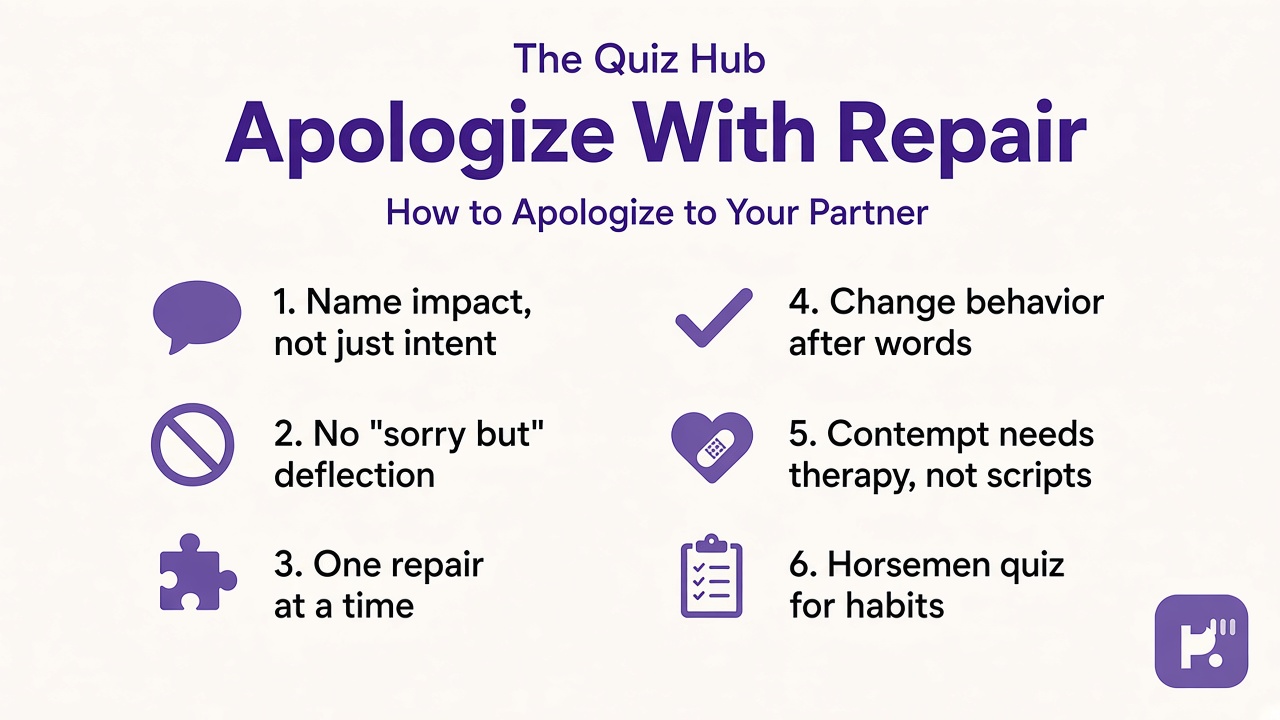
Key takeaways
- Impact matters more than intent in the first minute of repair.
- "Sorry but" and "sorry you feel" usually block trust.
- One clean apology beats a speech that reopens the fight.
- Behavior change across weeks proves sincerity.
- Gottman bids and repair attempts keep talks safe enough to finish.
- Contempt, abuse, or repeated harm need therapy or safety plans, not scripts alone.
Real apology vs faux apology
Partners often confuse politeness with repair. Faux apologies manage your discomfort or speed past accountability. Real apologies center your partner's experience and invite feedback on what would help next. Use the table as a mirror before you speak.
| Element | Faux apology (blocks repair) | Real apology (supports repair) |
|---|---|---|
| Specificity | "Sorry for everything lately." | "I snapped when you asked about bills; that was disrespectful." |
| Responsibility | "Sorry you took it that way." | "I raised my voice; you did not deserve that." |
| Excuses | "Sorry but I had a brutal day." | "Stress is real; I still chose harsh words." |
| Equity trap | "Well you always..." | "We can discuss your hurt next; right now I am owning mine." |
| Change plan | "I will try to be better." | "I will pause and lower my voice; if I fail, remind me to take a break." |
| Follow-through | Repeat harm next week with another sorry | Trackable habits over multiple conflicts |
How to apologize to your partner step by step
These steps assume basic physical and emotional safety. If fights include threats, property destruction, or forced sex, prioritize safety planning before practicing scripts.
1. Regulate enough to be brief
High heart rate narrows empathy. Take ten slow breaths, splash water on your face, or walk around the block if you can do so safely. Aim for two to four sentences before inviting response. Long lectures often re-trigger the original conflict.
2. Name the behavior and impact
Example: "Last night I mocked your job in front of friends. That was humiliating and unfair." Avoid vague "if I hurt you" language when you know what you did.
3. Own responsibility without ranking pain
Example: "You did not deserve that. My stress is not an excuse." Save mutual grievances for a separate repair session if your partner wants one.
4. Offer a concrete change and invite feedback
Example: "I will not joke about your work again. What else would help you feel respected tonight?" Listen without debating their answer.
5. Follow up with behavior
Send a calendar reminder for therapy if you agreed to go. Practice Gottman-style repair phrases during the next disagreement before contempt spikes. Our bids for connection Gottman explained article shows how small turn-toward moments rebuild fondness between big apologies.
Gottman repair and bids after you apologize
Dr. John Gottman and Dr. Julie Schwartz Gottman describe repair attempts as gestures or phrases that de-escalate conflict, such as "I am getting harsh" or a gentle touch if welcome. Partners who accept repairs reduce Four Horsemen patterns (criticism, contempt, defensiveness, stonewalling). After apologizing, make a bid for connection: ask about their day, offer help, or suggest a walk. Turning toward bids trains the brain that conflict does not end closeness.
If bids are repeatedly ignored or mocked, contempt may be present. Eye-rolling, sarcasm, and character attacks predict distress in longitudinal studies. Read our contempt in relationships guide for antidotes and when professional help is urgent.
| Repair phrase | When to use it | What to avoid |
|---|---|---|
| "I need a pause so I do not say more harm." | Flooding during argument | Walking out without return time |
| "You are right about that part." | Partial agreement available | Adding "but" and reopening fight |
| "Can we start over?" | After cooling down | Demanding instant forgiveness |
| "I appreciate you telling me." | Partner shares hurt | Minimizing with "you are too sensitive" |
Apology scripts you can adapt
Customize language to your relationship culture. These scripts skip intent debates and focus on harm.
- After harsh words: "I spoke to you in a way I would not accept from a friend. I am sorry. I will lower my voice and revisit this tomorrow at seven."
- After broken promise: "I said I would handle pickup and I did not. That left you stranded. I will set a phone alarm and text you when I am en route."
- After jealousy or control: "I checked your phone without consent. That violated trust. I will delete the habit and talk with a therapist about my fear."
- After dismissive tone: "I rolled my eyes when you cried. That was contemptuous. I want to hear what hurt you, if you are willing to share."
When apology meets compromise
Some fights need both repair and negotiation. Apologize for how you fought before debating the content. Use a values map so compromise does not erase safety or autonomy. Our compromise in relationship article separates negotiable preferences from non-negotiable boundaries and shows how win-lose streaks breed resentment. Fair trade-offs after apology prevent the same wound from reopening under a new topic.
When professional help makes sense
Couples therapy helps when both partners want the relationship and can tolerate structured conflict. Emotionally focused therapy and Gottman-informed methods practice repair in session. Individual therapy fits when shame, trauma, or substance use blocks accountability. If apologies cycle with harm, assess whether staying is safe. Screeners on our Mental Health & Clinical hub highlight symptoms worth bringing to a clinician; they do not diagnose or choose your next step for you.
Related quizzes on The Quiz Hub
Quizzes prompt reflection before therapy; they do not score whether your partner should forgive you.
- Four horsemen relationship quiz: screens criticism, contempt, defensiveness, and stonewalling habits that block apologies from landing.
- Communication styles in relationships quiz: explores direct, avoidant, and volatile patterns that shape conflict repair.
- Am I the problem in my relationship quiz: prompts honest review of reciprocity and harm (not blame games).
- Browse the Relationships & Dating category and the Mental Health & Clinical hub for more tools with stated limits.
Frequently asked questions
What makes a real apology to your partner?
A real apology names the specific harm, takes responsibility without excuses, acknowledges impact on your partner, and offers a concrete change plan. It avoids "sorry you feel that way" or "sorry but" deflection. Tone matters less than follow-through: repeated harm without new behavior erodes trust faster than a clumsy first attempt. Apologies repair moments; patterns require therapy or boundaries.
How do you apologize without being defensive?
Pause until you can describe your partner's experience in their words. Lead with impact: "When I raised my voice, you shut down, and that is on me." Save context for a later conversation only if your partner invites it. Do not rank whose day was harder or cite past grievances mid-apology. If you feel flooded, ask for a twenty-minute break and return with a shorter, cleaner repair.
Why does my partner not accept my apology?
Trust may be low from repeated broken promises, contempt habits, or harm that needs more than words. Some people need time before softening; others need witnessed behavior change across weeks. Ask what repair would look like to them and whether couples therapy could help. If apologies are demanded but your safety is threatened, focus on advocacy rather than perfect scripts.
What is the difference between apology and compromise?
Apology addresses harm you caused; compromise trades preferences on future decisions. You can apologize for harsh tone during a budget talk and still negotiate numbers afterward. Apologizing to avoid values you hold is people-pleasing, not repair. Fair compromise keeps core boundaries intact; see our compromise relationship guide for values maps and Gottman repair habits during tense talks.
When is sorry not enough in a relationship?
Sorry is insufficient when abuse, contempt, infidelity, or chronic stonewalling continues without professional help. Gottman research links contempt to elevated divorce risk because it trains partners to see each other as enemies. Apologies without changed behavior become manipulation. Individual or couples therapy, and sometimes separation for safety, belong on the table when harm repeats.
Can quizzes help me apologize better?
Screeners such as our four horsemen relationship quiz highlight criticism, contempt, defensiveness, and stonewalling habits that block repair. Communication style quizzes prompt reflection on flooding or avoidance. They do not grade your partnership or replace licensed couples therapy. Use results with our Gottman bids article to practice turning toward your partner after conflict.
Sources
- Gottman, J. M., & Levenson, R. W. (1992). Marital processes predictive of later dissolution: Behavior, physiology, and health. Journal of Personality and Social Psychology, 63(2), 221-233.
- Gottman, J. M., & Silver, N. (1999). The seven principles for making marriage work. Crown.
- Lazare, A. (2004). On apology. Oxford University Press.
- The Gottman Institute. (2024). The Four Horsemen.
- American Association for Marriage and Family Therapy. (2023). Couples therapy overview.