God Complex in Relationships: Signs, Causes, and Boundaries
Last updated:
Educational only: This article uses "god complex" as descriptive slang, not a clinical diagnosis. It is not couples therapy or legal advice. If a partner threatens you, controls your money or phone, or you fear violence, contact the National Domestic Violence Hotline at 1-800-799-7233 or call or text 988 (U.S.) when you are in crisis. Safety planning outranks fixing their self-image.
A god complex in relationships shows up as entitlement: your partner acts like their version of events is the only valid one, your feelings are overreactions, and compromise means you giving in. The term comes from pop culture and leadership critique, not the DSM. It often overlaps with narcissistic patterns such as grandiosity and thin empathy, but overlap is not automatic diagnosis. Naming the pattern helps you set boundaries; it does not replace professional assessment when control turns coercive.
Tips at a glance
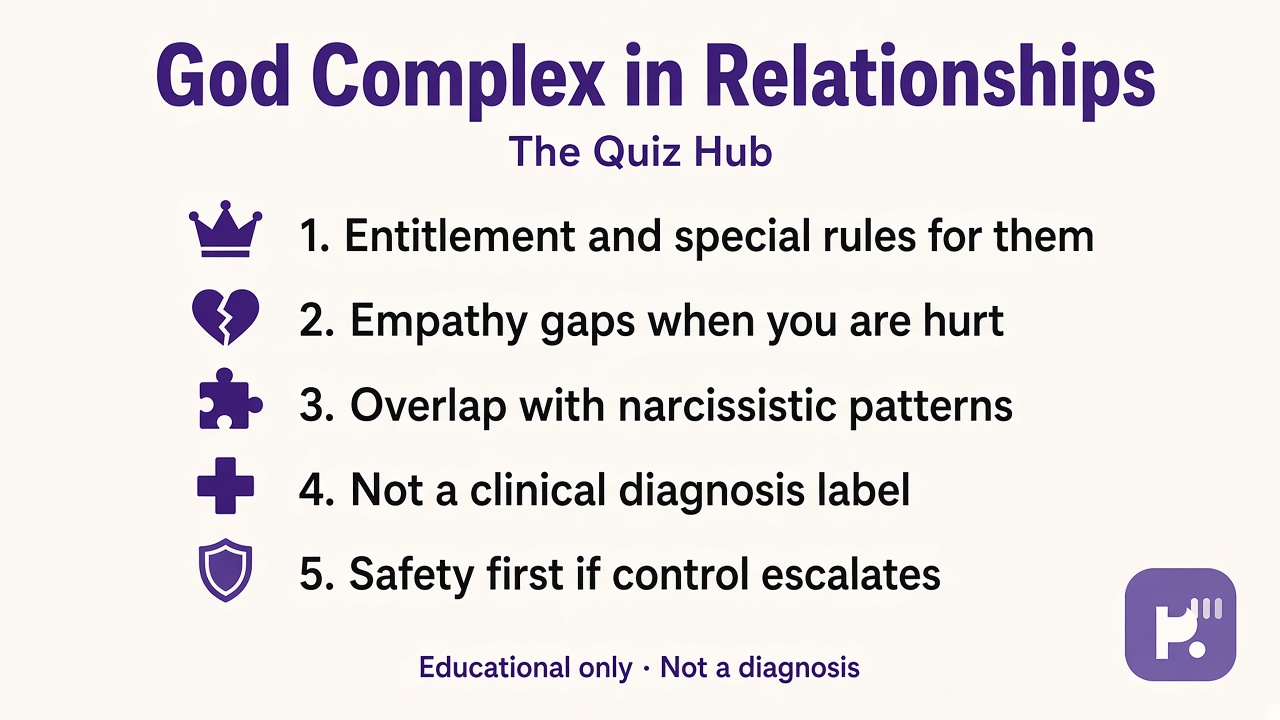
Key takeaways
- God complex is informal language for superiority and rule-bending, not a medical label.
- Patterns include dismissing your pain, hogging credit, and punishing disagreement.
- Narcissistic personality disorder requires a clinician; traits can look similar in daily fights.
- Manipulation and contempt often ride alongside entitlement; see linked guides below.
- Leave or seek advocacy when fear, monitoring, or threats appear, not only when ego bruises.
- Online screeners organize symptoms; they cannot tell you whether to stay or go.
Signs of a god complex in a partner
You are not looking for one arrogant joke. You are tracking whether respect is steady or conditional. Common signs include rewriting history after you prove a fact, treating your career or parenting as lesser, and expecting praise while offering little when you succeed. They may lecture instead of listening, interrupt with corrections, or sulk until you apologize for having a boundary.
In conflict, they often claim moral high ground: you are "too sensitive," "irrational," or "disrespectful" for naming harm. Repair is one-sided: you must grovel; they offer a vague "sorry you feel that way." Friends and family may only see the charming public version, which makes you doubt your memory. That doubt is a reason to read our emotional manipulation signs guide, not a sign you are broken.
God complex habits versus narcissistic patterns
Clinicians diagnose narcissistic personality disorder (NPD) with structured interviews and duration criteria (American Psychiatric Association, 2022). God complex is a lay label for behavior that feels omnipotent in a relationship. Use the table to prepare therapy questions. It is not a scoring sheet for diagnosing anyone at home.
| Theme | God complex (colloquial) | Narcissistic pattern (clinical traits) |
|---|---|---|
| Beliefs about self | "I am the smartest person in every room." | Persistent grandiosity or sense of uniqueness needing recognition |
| Rules | Expects exceptions; lateness is fine for them, not for you | Entitlement to favorable treatment or automatic compliance |
| Empathy | Impatient with your tears; changes subject to their stress | Difficulty recognizing others' feelings unless useful for image |
| Accountability | Never wrong; evidence becomes "your interpretation" | Externalizes blame; fragile self-esteem masked by arrogance |
| Admiration | Demands praise for basic tasks; sulks if not center of attention | Excessive need for admiration; envy of others' success |
| Diagnosis | Not a DSM category; useful for naming arrogance | NPD diagnosis only after licensed evaluation |
For a fuller trait list tied to toxic behavior, read twelve traits of narcissistic toxic behavior. Pair that article with this one when you wonder whether you are dealing with vanity or a sustained pattern that erodes your self-trust.
How god-complex behavior shows up in daily life
At home, they may control the thermostat, calendar, and narrative: vacations happen where they want, photos center them, and your hobbies are "childish." At work they might be well liked while you hear private rants about "idiot" colleagues. With children they can model humiliation if a kid questions them. You might shrink your stories to avoid lectures.
Sex and intimacy can turn performative: your pleasure matters only if it proves their skill. Financial decisions may happen without consultation, then you are blamed for spending on essentials. When you ask for joint budgeting, they accuse you of being controlling. That reversal is a classic control tactic worth discussing with a therapist who understands coercive dynamics.
Overlap with contempt and manipulation
Superiority feeds contempt: eye rolls, mockery, and disgust toward your opinions. John Gottman's research links contempt to relationship distress when it stays unrepaired. God-complex energy often supplies the moral excuse for contempt: you deserved the insult because you were "wrong." Read contempt in relationships: signs and repair for antidotes when both partners still want respect. Antidotes fail when the superior partner punishes every repair attempt.
Manipulation adds guilt trips, gaslighting, and intermittent warmth. Entitlement says they are right; manipulation makes you act as if they are right to keep peace. Document facts in a safe place when memory battles wear you down. Individual therapy helps you rebuild reality testing without forcing a joint label on your partner.
Common causes (without excusing harm)
Childhood environments that rewarded dominance or punished mistakes can teach that vulnerability is dangerous. Some people climb corporate ladders where confidence is currency and feedback is rare. Trauma can harden into armor: if admitting fault once led to punishment, arrogance becomes protection. Substance use and sleep loss lower impulse control. None of these reasons require you to accept harm.
Cultural gender scripts still praise men for command and women for sacrifice, which can inflate one partner's voice in heterosexual couples. Same-sex couples are not immune; power can track income, status, or who moved first into the relationship. Therapy explores these layers when the superior partner is willing. Your job is not to become their unpaid coach.
Boundaries that protect your reality
Start with concrete limits: "If you raise your voice, I pause the talk for twenty minutes." "I will not discuss money when you call me names." "We need a third party for decisions over $500." Write agreements and notice whether they honor them without retaliation. One broken boundary is data; a pattern is a decision point.
Stop debating their character in circular fights. State impact once, request change, name consequence. Example: "When you mock my job in front of friends, I leave the room. If it continues, I will not attend events with you." Consequences must be ones you will enforce. Friends or a therapist can rehearse scripts so you do not collapse under pressure.
When professional help makes sense
Individual therapy helps you sort fear from love, plan exits, and recover self-trust. Couples therapy can work when insults stop, both attend, and the superior partner tolerates feedback from the clinician. Personality-focused therapy (such as schema or dialectical behavior therapy) may help willing partners who meet diagnostic thresholds. Refusal to attend while behavior worsens is its own answer.
If mood symptoms such as hopelessness or panic accompany the relationship stress, a primary care visit or psychiatrist can screen for depression and anxiety. Relationship pain can mimic or worsen clinical mood episodes. Screeners below organize symptoms to discuss at intake; they do not diagnose your partner.
Related quizzes on The Quiz Hub
These tools highlight patterns worth discussing with a licensed clinician. They cannot score abuse risk or tell you whether someone has narcissistic personality disorder.
- Mental Health and Clinical hub: browse grief, mood, and trauma screeners with stated limits for reflection before therapy intake.
- Anxiety and depression screening (PHQ-4): brief mood and anxiety items when relationship stress affects sleep, appetite, or joy.
- Depression test: tracks low mood and loss of interest frequency; pair results with a medical visit if symptoms persist two weeks or more.
Frequently asked questions
What is a god complex in a relationship?
A god complex in everyday language means acting as if your opinions, comfort, or status matter more than a partner's reality. You may hear entitlement, dismissive corrections, and little curiosity when you are upset. The phrase is not a formal DSM diagnosis. It describes arrogance and control habits that can overlap with narcissistic traits or abuse when they escalate.
How is a god complex different from narcissistic personality disorder?
Narcissistic personality disorder is a clinical diagnosis based on persistent grandiosity, need for admiration, and empathy deficits assessed by a licensed clinician. A god complex is colloquial: superiority, refusal to be wrong, and belief that rules apply to others but not to them. Someone can show god-complex behavior without meeting full disorder criteria, and some people with NPD never use the slang term. Only a professional evaluation can diagnose a personality disorder.
What causes god-complex behavior in partners?
Causes are mixed: early praise without accountability, leadership roles that reward dominance, trauma defenses that equate vulnerability with danger, and family cultures where one parent's word was law. Stress and substance use can worsen contempt. None of these excuses harm. Understanding patterns helps you set boundaries; it does not obligate you to stay.
Can a relationship survive a partner with a god complex?
Change is possible when the person owns impact, accepts feedback without revenge, and commits to therapy with measurable behavior shifts over months. Many partners refuse help and double down when challenged. Your safety and self-respect set the bar. Couples therapy is not safe when coercion, threats, or violence are present; individual support and advocacy come first.
Is a god complex emotional abuse?
Belittling, controlling money, isolating you, or punishing disagreement can be emotional abuse or coercive control regardless of labels. A superiority attitude alone is painful; paired with fear, monitoring, or threats it is a safety issue. Contact the National Domestic Violence Hotline at 1-800-799-7233 or thehotline.org when you fear harm. Call or text 988 (U.S.) if you feel suicidal.
Do online quizzes diagnose a god complex?
No. Screeners on our site highlight mood, entitlement habits, or relationship stress for reflection. They cannot see your full context, legal risk, or whether you should leave. Use results to prepare questions for a therapist, not as proof someone is irredeemable or that you must tolerate harm.
Sources
- American Psychiatric Association. (2022). Diagnostic and Statistical Manual of Mental Disorders (5th ed., text rev.). Narcissistic personality disorder criteria.
- Gottman Institute. (2023). The Four Horsemen.
- National Domestic Violence Hotline. (2024). Coercive control resources.
- American Psychological Association. (2023). Personality disorders overview.