Feeling Lost in Life: What to Do This Week When Nothing Fits
Last updated:
Educational only: This article offers a week structure for when life feels directionless. It is not therapy, a diagnosis, or emergency care. If hopelessness includes self-harm thoughts, call or text 988 (U.S.) or contact local emergency services. See our editorial policy for review standards.
When you feel lost in life, start with a one-week stabilization plan before you rewrite your identity on a blank page. Sleep, a repeatable routine, one honest conversation, and gentle movement give your nervous system enough steadiness to think clearly. Direction and values work comes next; our companion guide on how to find direction when you feel lost covers that layer. This page is what to do when nothing fits right now.
Tips at a glance
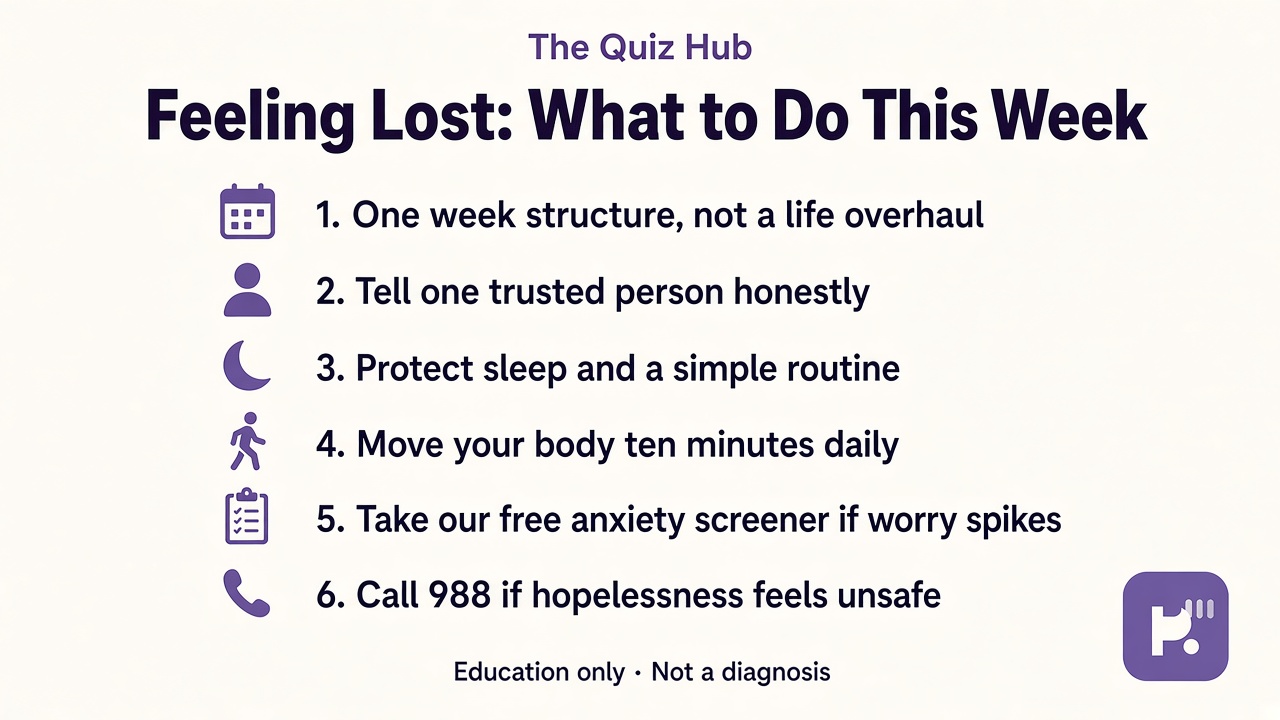
Key takeaways
- Feeling lost is often a signal to stabilize basics, not to make irreversible choices overnight.
- A seven-day plan beats vague advice: one anchor habit per day plus shared accountability.
- Sleep timing, morning light, and reduced late-night scrolling protect mood more than inspiration quotes.
- One trusted person hearing the truth lowers shame loops that mimic depression.
- Therapy intake questions are easier after you track sleep, mood, and energy for a week.
- Call 988 when safety is uncertain; week plans do not replace crisis care.
Why structure helps before big answers
Lost feelings often arrive when roles shift: graduation, breakup, layoff, new parenthood, chronic illness, or the quiet after a long goal ends. Your brain may scan for a single correct path while sleep debt and isolation amplify the noise. Behavioral activation research (Martell et al., 2010) shows small scheduled actions can lift mood enough for clearer thinking, even before you know your "purpose."
That is different from forcing toxic positivity. You are allowed to admit the map is blank. You are also allowed to stop debating the universe at 2 a.m. Structure creates evidence that you can influence the next hour, which rebuilds agency for harder questions later.
If dread centers on meaning or mortality, read what existential dread is and how to cope. Pair philosophy with clinical care when symptoms persist most days or include suicidal thoughts.
Signs you need stabilization first
Use this quick check before quitting a job, ending a relationship, or moving cities on impulse. None of these prove a disorder, but they suggest your body needs care before major life edits.
- Sleep under six hours most nights for two weeks, or sleeping twelve hours and still exhausted.
- Skipping meals, showers, or bills because decision fatigue feels paralyzing.
- Drinking, vaping, or scrolling until numb most evenings.
- Isolating from friends who previously felt safe.
- Repeated thoughts that life is not worth living, even without a plan.
Persistent low mood with loss of interest may need depression therapy alongside direction work. A primary care screen rules out thyroid issues, anemia, or medication side effects when fatigue dominates.
Seven-day plan when you feel lost in life
Copy the table onto paper. Adjust times to your schedule. The goal is repetition, not perfection. If you miss a day, restart the next morning without a shame spiral.
| Day | Focus | One required action | Optional stretch |
|---|---|---|---|
| 1 | Sleep anchor | Pick a wake time within a 30-minute window for seven days; set one alarm. | No caffeine after 2 p.m. if you are sensitive. |
| 2 | Tell someone | Send a text: "I feel lost lately. Can we talk for twenty minutes this week?" | Name one fear out loud without fixing it. |
| 3 | Movement | Ten-minute walk, stretch video, or stairs outside. | Invite the person from Day 2 to join. |
| 4 | Food rhythm | Eat one predictable meal (same breakfast or lunch) with protein. | Prep ingredients the night before. |
| 5 | Digital boundary | Charge phone outside the bedroom; no doom scrolling first or last hour of day. | Delete one app that triggers comparison for seven days. |
| 6 | Competence task | Finish one small chore you have avoided (laundry, email, appointment). | Write three skills you used, not three flaws. |
| 7 | Review and next step | Rate sleep, mood, and energy 1 to 10 on paper. Note what helped. | Book therapy intake or read the direction guide linked below. |
After Day 7, keep the wake time and one social touchpoint even if motivation dips. Add values experiments only when you can shower, eat, and sleep with modest consistency.
Sleep and daily routine without overhauling your life
Sleep regularity often beats total hours when your schedule is chaotic. The American Academy of Sleep Medicine (2023) emphasizes consistent wake times to anchor circadian rhythm. If you work nights, anchor one meal and one pre-sleep ritual instead of copying a 6 a.m. influencer routine.
Morning cues
Open blinds within thirty minutes of waking. Drink water before coffee. If mornings are rushed, stack habits: toothbrush, water, two-minute stretch. These cues tell your brain the day has started even when motivation is low.
Evening cues
Dim overhead lights an hour before bed. Write tomorrow's top one task on a sticky note so your mind stops rehearsing lists. If rumination spikes, use a fifteen-minute "worry appointment" on paper, then close the notebook.
Routine without rigidity
Pick three anchors: wake window, one meal template, ten minutes of movement. Everything else is flexible. Lost phases punish all-or-nothing thinking. A partial day still counts.
Social support when you feel invisible
Isolation convinces you that everyone else has a script. One honest conversation breaks that illusion. Choose someone who listens without immediate fixes: a friend, sibling, mentor, clergy member, or peer group leader. You do not need to share every secret on Day 2. Start with "I feel stuck and tired of pretending."
If family relationships are part of the stress, set time limits on calls and use text check-ins between heavier talks. Support groups for grief, caregiving, or career transition normalize lost seasons better than solo searches at midnight.
When shame blocks outreach, write the message in notes app first, then paste send. Ask for practical help ("Can you body-double while I pay bills?") if emotional talks feel too big.
Therapy intake when you feel lost
Therapy is not only for crises. It helps when lost feelings last months, follow trauma, or pair with panic, substance use, or relationship rupture. Start intake while doing the week plan so you bring data, not only fog.
Before the first session
- Bring your seven-day sleep and mood notes.
- List three situations that make lost feelings spike (Sunday nights, work meetings, social media).
- Ask about sliding scale fees, intern clinics, or employee assistance programs if cost blocks care.
Questions to ask a new clinician
- How do you work with clients who feel directionless but are not in immediate crisis?
- Do you use CBT, ACT, interpersonal therapy, or existential approaches for this pattern?
- How soon can we revisit safety if suicidal thoughts appear?
Telehealth can shorten wait times. Our guide to digital psychologists and online therapy covers licensing checks, privacy, and when in-person care fits better. If medication might help depression overlap, ask whether your therapist coordinates with a prescriber.
When to shift from coping to direction work
Move to values clarification when you can complete basic self-care most days and still feel empty about the future. That is the right time for feeling lost in life: how to find direction, which walks through small experiments, role models, and meaning without a dramatic leap.
Stay on stabilization longer if you are actively using alcohol to sleep, missing work repeatedly, or debating self-harm. Direction exercises can feel cruel when your body is depleted.
Related quizzes and screeners
- Free anxiety screener: notes how often worry, tension, and restlessness showed up in the past two weeks. Bring results to therapy intake; scores are not a diagnosis.
- Depression test: highlights low mood and loss of interest patterns that may need clinical care before big life decisions.
- Browse the Mental Health & Clinical test hub for free quizzes and screeners with stated limits.
When to seek urgent help
Call or text 988 in the U.S. if you have thoughts of suicide with intent, a plan, or means, or if you cannot guarantee your safety tonight. Go to the nearest emergency department when risk feels immediate. UK readers can contact Samaritans at 116 123.
Book outpatient care within days when lost feelings include panic attacks, trauma flashbacks, inability to work or parent, or rising substance use. Early depression therapy often clears enough fog for direction work to feel useful instead of punishing.
Frequently asked questions
What should I do first when I feel lost in life?
Stabilize basics before big decisions. Pick one week plan: consistent wake time, one meal you can repeat, ten minutes of movement, and one honest conversation with someone safe. If hopelessness includes self-harm thoughts, call or text 988 in the U.S. before trying to fix your entire future in one night.
Is feeling lost the same as depression?
They overlap but are not identical. Feeling lost often sounds like "I do not know who I am or what matters." Depression frequently adds persistent low mood, loss of interest, sleep or appetite shifts, and guilt that lasts most days for two weeks or more. A primary care visit or therapist can sort overlap. Our screeners highlight patterns to discuss, not a diagnosis.
How long should I try a routine before changing careers or relationships?
Give a simple structure two to four weeks unless safety is at risk. Track sleep, mood, and energy on paper. If you still feel empty after basics improve, shift to values and direction work with a counselor. Sudden life exits during sleep debt or active substance use often backfire.
Can online therapy help when I feel lost?
Yes for many people. Licensed telehealth can start intake faster when travel or childcare blocks office visits. Match modality to symptoms: CBT or ACT for rumination and avoidance, interpersonal therapy after grief, medication evaluation when depression signs dominate. Read our digital psychologist guide for vetting platforms and privacy limits.
Should I take a personality quiz when I feel lost?
Quizzes can spark reflection if you treat scores as questions, not fate. They cannot measure depression severity, trauma, or whether you should quit a job. Pair any screener with clinical care when symptoms impair work, parenting, or safety. Use our anxiety test to note worry frequency, then bring results to intake.
When does feeling lost need crisis care?
Seek emergency help when you cannot stay safe, have a suicide plan, hear commands to harm yourself, or cannot care for dependents. In the U.S., call or text 988. Go to the nearest emergency department when risk feels immediate. Therapy waitlists and week plans are not substitutes for crisis services.
Sources
- American Psychiatric Association. (2022). Diagnostic and Statistical Manual of Mental Disorders (5th ed., text rev.). (Educational reference for depression duration criteria.)
- Martell, C. R., Dimidjian, S., & Herman-Dunn, R. (2010). Behavioral Activation for Depression. Guilford Press.
- American Academy of Sleep Medicine. (2023). Clinical sleep duration guidance.
- Substance Abuse and Mental Health Services Administration. (2024). 988 Suicide & Crisis Lifeline.
- National Institute of Mental Health. (2024). Depression overview.