What the Ideal Partner Quiz measures
This quiz does not pick a celebrity for you, rank classmates, or diagnose your orientation. It measures how much you agree with statements in four groups: shared values compatibility about kindness, honesty, boundaries, and everyday fit beyond hype; emotional safety trust about feeling heard, calm conflict, listening before fixing, and rejecting control games; communication boundaries about asking instead of assuming, consent language, teamwork, and independence for both people; and respectful reflection limits about fun-only framing, refusing pass-fail scorecards, and separating crush energy from knowing someone. You rate 22 statements from strongly disagree to strongly agree, with reverse-worded stereotype myths so autopilot responding cannot inflate every bar. Your answers also feed a second chart on closeness and trust habits. The total becomes an index from 0 to 100 where higher means more endorsed values-forward reflection on this screener, not proof anyone should date you.
Shared values compatibility
Kindness beyond charm, honesty, boundaries, and everyday teamwork.
Emotional safety trust
Feeling heard, calm repair, and rejecting jealousy control plots.
Communication boundaries
Ask-do-not-assume, consent language, and room for solo time.
Respectful reflection limits
Fun-only framing, no stereotype ranking, no entitlement.
How it works
Answer 22 agreement items
Rate each statement from Strongly disagree to Strongly agree. Tap Next after each answer.
Answers sort into four domains
Each answer feeds one of four ideal partner value groups, and every item also feeds a closeness and trust layer.
See your index and charts
You get a 0 to 100 index, a band, four domain bars, and a second chart for intimacy habits.
Take the Ideal Partner Quiz
Answer 22 short statements to see your ideal partner values index, four domain bars, and a closeness and trust chart.
What your result means
Your index is the average of all 22 answers, scaled from 0 to 100, with reverse-worded items flipped first. Read respectful reflection limits together with shared values before you treat the total as a crush hunting license or proof you are a good partner.
| Band | Index range | Typical reading |
|---|---|---|
| Softer ideal partner endorsement | 0 to 35 | You agreed with fewer shared values, safety, communication, and limit items on this screener. |
| Mixed ideal partner endorsement | 36 to 65 | Some partner domains click; others stay vague or secondhand from media. |
| Stronger ideal partner endorsement | 66 to 100 | Frequent agreement across values, safety, communication, and limits; still fun only. |
Tips at a glance
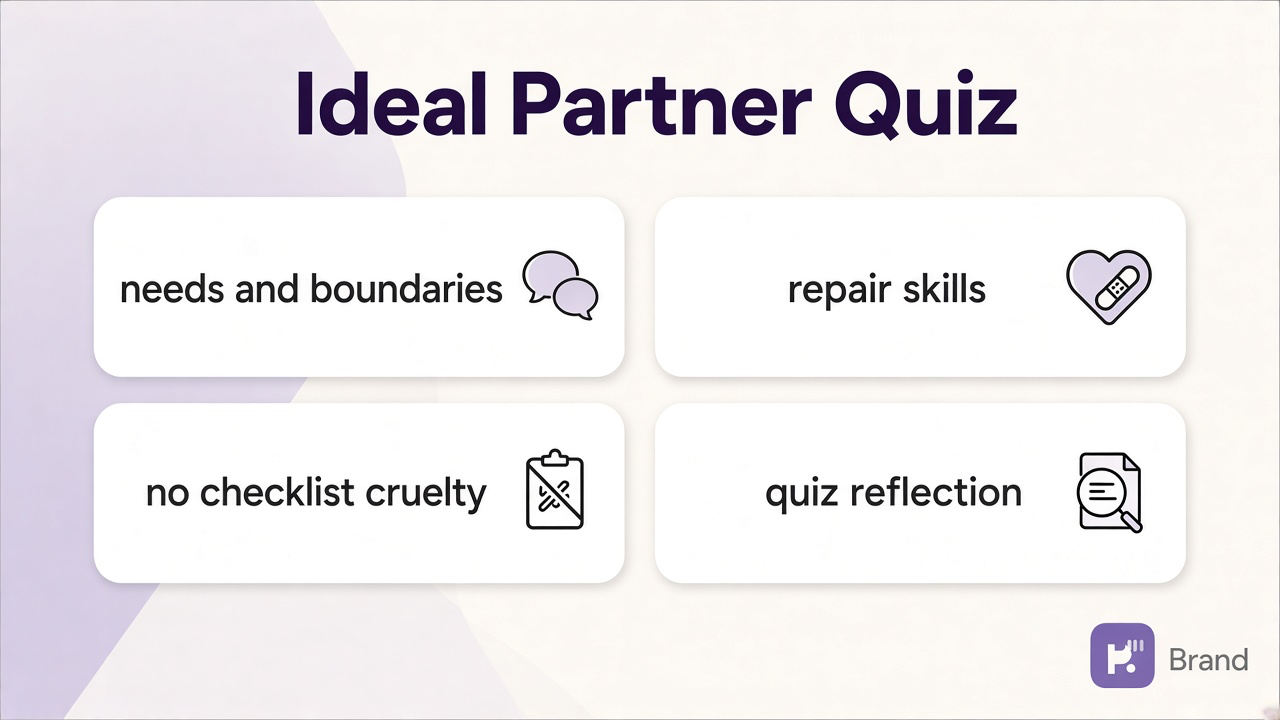
A quick takeaway graphic with topic tips (not your personal quiz scores). Start the quiz for your index, bands, and charts.
What this quiz can and cannot tell you
Can tell you
- Clarify which values matter beyond appearance tropes in your daydreams
- Separate crush fantasy from knowing someone real habits and boundaries
- Give language for ask-do-not-assume talks when you feel ready
- Highlight stereotype myths you might unlearn before pursuing anyone
Cannot tell you
- Prove a specific person is your destined partner or should date you
- Replace consent, conversation, and time learning someone in real life
- Rank or pressure people who do not match your fantasy bars
- Label anyone's gender, orientation, or worth from quiz scores
Ideal partners, values, and stereotype traps
Search traffic around ideal partner quizzes usually wants a shareable label for crush daydreams. That can be playful when it sparks honesty about kindness, humor, and teamwork. It turns harmful when scores become permission to rank classmates, chase only looks, or assume every person should match a meme template. Values language works best when fantasy stays separate from consent in real life.
Dr. James Whitfield reviews relationship reflection tools with a respect-first lens. Shared values compatibility tracks whether honesty, boundaries, and everyday compatibility beat stereotype checklists in your daydreams. Emotional safety trust tracks listening, repair, and patience, not silent mind-reading plots. Communication boundaries tracks asking what someone wants instead of guessing from gender clichés. Respectful reflection limits keeps fun framing visible beside crush energy so admiration does not slide into objectification.
Real reflection mixes bars. You might score high on kindness while still agreeing with a reverse look-only item on a tired day, which is a cue to retake calmly, not shame. You might score high on limits while low on communication, which often describes early crush stage before you imagine daily life. Reverse items catch myths: influencer-only attraction, meme stereotypes, jealousy-as-romance plots, clone-yourself fantasies, and using quiz scores to withhold basic respect should not inflate bars meant to track values.
Pair results with siblings on this hub instead of forcing one fantasy story. Our ideal man quiz uses similar values language with masculine-title framing when that feels clearer. Our ideal woman quiz parallels the lens with separate anti-stereotype stems. Our attachment style quiz explores closeness and trust patterns beyond daydream values. Browse the relationships and dating hub for more reflection screeners. Share scores as fun only and keep real people names out of threads that should stay playful.
| Test | Focus |
|---|---|
| Ideal man quiz | Masculine-title values framing rather than gender-neutral partner stems on this page |
| Ideal woman quiz | Feminine-title values framing with separate anti-stereotype stems rather than neutral partner language here |
| Attachment style quiz | Closeness and trust patterns rather than ideal partner value daydreams on this screener |
Ideal Partner Quiz FAQ
What does the Ideal Partner Quiz measure?
It measures how much you agree with statements about shared values, emotional safety, communication boundaries, and respectful limits in ideal partner reflection. You get an index from 0 to 100 plus four bars. It describes self-reported habits on this screener, not whether someone suits you or your dating destiny.
Is this quiz telling me which person to date?
No. It is fun reflection on what you say you value in daydreams. Real dating needs consent, time, and conversation. No score picks a classmate, celebrity, or coworker for you.
Does a high score mean my crush should like me back?
No. High scores mean you agreed with many values-forward statements here. They do not create obligation for anyone else, replace asking how someone feels, or prove you know them beyond a crush image.
Why include items about stereotypes and limits?
Ideal partner searches often skip respect and consent ethics. Limit bars keep fantasy playful and separate from ranking real people or treating tropes as rules every person must follow.
Who reviewed this quiz?
Dr. James Whitfield reviewed the respectful framing, stereotype-aware reverse items, and fun-only limits. See our editorial policy for review standards.
Reviewed by