What the Humor Coping Scale CHS measures
This quiz does not administer the published Coping Humor Scale (CHS) from Martin and Lefcourt research settings, and it cannot diagnose mood disorders or replace therapy. It measures how much you agree with unofficial coping-humor literacy grouped four ways: stress coping humor habits about relief without denial; affiliative reframing about consensual bonding jokes; harmful humor traps about punching down and toxic positivity; and unofficial CHS limits about humble captions. You rate 22 statements from strongly disagree to strongly agree, with reverse-worded traps so one lucky streak cannot inflate every bar. Your answers also feed a second chart on closeness and trust habits.
Stress coping humor habits
Relief that still names problems.
Affiliative reframing
Bonding jokes with consent.
Harmful humor traps
Stop when humor stings.
Unofficial CHS limits
Quiz not mailed CHS file.
How it works
Answer 22 agreement items
Rate each statement from Strongly disagree to Strongly agree. Tap Next after each answer.
Answers sort into four domains
Each answer feeds one of four coping humor study groups, and every item also feeds a closeness and trust layer.
See your index and charts
You get a 0 to 100 index, a band, four domain bars, and a second chart for intimacy habits.
Take the Humor Coping Scale CHS
Answer 22 short statements to see your coping humor literacy index, four domain bars, and a closeness and trust chart.
What your result means
Your index is the average of all 22 answers, scaled from 0 to 100, with reverse-worded items flipped first. Read harmful humor trap bars with limit bars together before you treat a high total as resilience proof. Therapists and crisis lines still own care when distress is severe.
| Band | Index range | Typical reading |
|---|---|---|
| Building coping humor literacy | 0 to 35 | Fewer agreed habits on stress coping humor, affiliative reframing, harmful humor traps, or unofficial CHS limits. |
| Mixed coping humor literacy | 36 to 65 | Solid coping awareness with softer bars on harmful humor traps or unofficial limit items. |
| Strong coping humor literacy | 66 to 100 | Frequent agreement with habits and limits; still unofficial reflection only. |
Tips at a glance
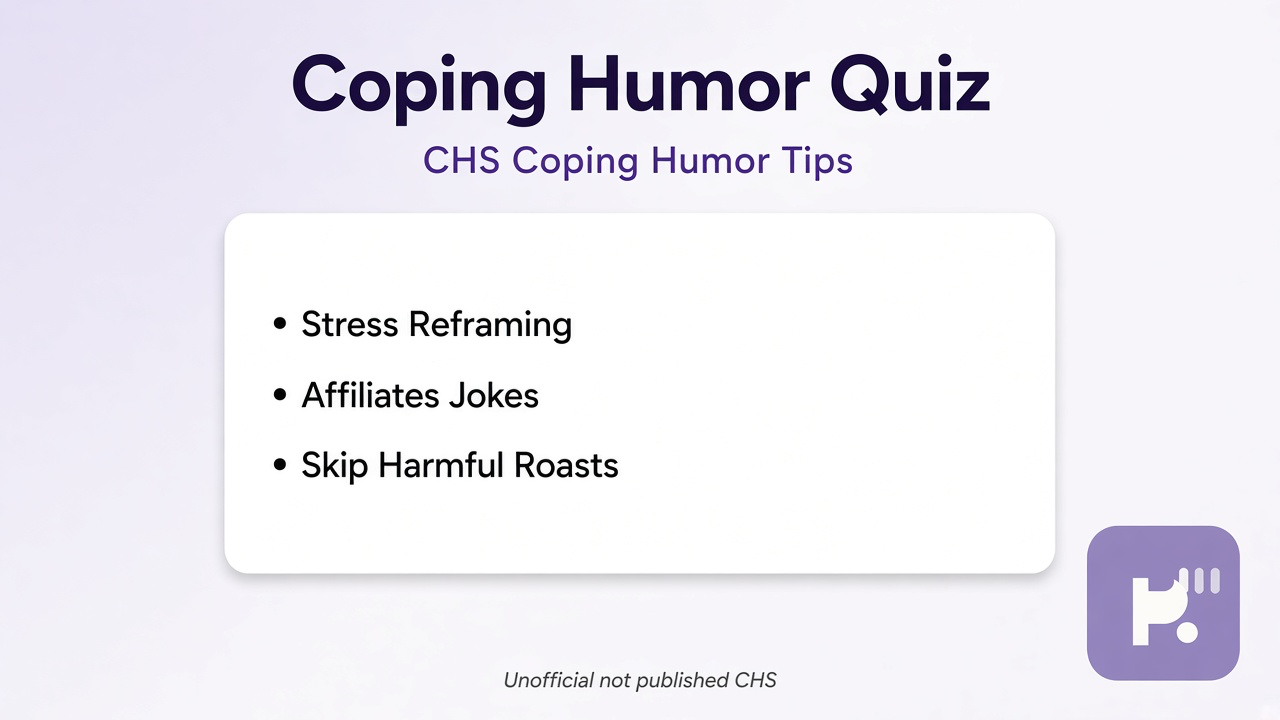
A quick takeaway graphic with topic tips (not your personal quiz scores). Start the quiz for your index, bands, and charts.
What this quiz can and cannot tell you
Can tell you
- Highlight coping humor habits worth revisiting before conflict spirals
- Separate reflection from published CHS substitution cosplay
- Encourage consensual humor without roast ranking polls
- Spark better learning goals without claiming therapy authority
Cannot tell you
- Replace the published CHS or any clinician-administered assessment
- Prove resilience or mental health outcomes from couch scores
- License public roast or humor ranking threads about acquaintances
- Diagnose friends or tell you to skip professional care from agree totals
Coping humor, affiliative reframing, traps, and unofficial CHS limits
People search coping humor scales when stress collides with meme culture and influencer resilience slogans. Martin and Lefcourt published the Coping Humor Scale in research settings; this online screener is inspired by that lens but is not the official mailed CHS. Your answers suggest where habits cluster so you can discuss them with friends or therapists, not so a bar chart replaces care.
Stress coping humor can ease tension when it pairs laughter with honest problem naming. Joke spirals that replace sleep, food, or medical help are reverse signals this page tries to catch. Affiliative reframing rewards consensual bonding humor without dodging apology work forever.
Harmful humor traps show up when roasts punch down, toxic positivity shames grief, or sarcasm blocks repair. Stopping when someone says the bit hurts is a literacy habit worth protecting even when the room laughed first.
Pair results with siblings instead of forcing one humor story. Our from author Rod A Martin page explores humor styles literacy with separate stems. Our Martin S humor styles questionnaire HSQ stays on inventory-style themes. Our humor quiz offers playful trivia with different domains. Browse the personality and psychology hub for more reflection screeners.
| Test | Focus |
|---|---|
| From author Rod A Martin | Humor styles author literacy rather than coping-under-stress CHS framing here |
| Martin S humor styles questionnaire HSQ | Inventory-style humor styles rather than unofficial CHS limit stems on this page |
| Humor quiz | Playful humor trivia rather than coping humor research literacy here |
Humor Coping Scale CHS FAQ
What does the Humor Coping Scale CHS measure?
It measures self-reported coping humor study habits across stress relief, affiliative reframing, harmful humor traps, and unofficial CHS limit items, plus a parallel fear-of-intimacy stack chart.
Is this the official Martin and Lefcourt Coping Humor Scale?
No. Limit items reject published-scale cosplay. This is an unofficial agree screener for reflection, not the validated CHS used in research clinics.
Can high bars prove I do not need therapy?
No. Bars describe humor habits you endorsed here, not mental health outcomes or licenses to skip professional care when distress is severe.
How is this different from the HSQ humor styles quiz?
This page emphasizes coping-under-stress literacy and unofficial CHS limits. The HSQ sibling focuses inventory-style humor style themes with separate stems.
Who reviewed this quiz?
Dr. Priya Sharma reviewed the framing, limit language, and result explanations. See our editorial policy for review standards.
Reviewed by