What How To Listen To Your Conversation Partner measures
This screener does not read minds, replace couples therapy, or declare which partner listens worse from bar height. It measures how much you agree with active listening habits grouped four ways: full attention habits about devices and presence; reflect-before-advise about mirroring before fixing; patience without fixing about sitting with discomfort; and quiz-not-therapy-substitute limits about refusing licensed-care cosplay from agree totals. You rate 22 statements from strongly disagree to strongly agree, with reverse-worded traps flipped first. Your answers also feed a second chart on closeness and trust habits. The total becomes an index from 0 to 100 where higher means more reported respectful listening manners on this screener, not proof you should skip counseling when harm persists.
Full attention habits
Phones down.
Reflect before advise
Mirror then offer.
Patience without fixing
Sit with discomfort.
Quiz not therapy substitute
Mirror not session.
How it works
Answer 22 agreement items
Rate each statement from Strongly disagree to Strongly agree. Tap Next after each answer.
Answers sort into four domains
Each answer feeds one of four active listening groups, and every item also feeds a closeness and trust layer.
See your index and charts
You get a 0 to 100 index, a band, four domain bars, and a second chart for intimacy habits.
Take the How To Listen To Your Conversation Partner
Answer 22 short statements to see your active listening literacy index, four domain bars, and a closeness and trust chart.
What your result means
Your index is the average of all 22 answers, scaled from 0 to 100, with reverse-worded items flipped first. Read patience bars together with limit bars before you treat a high score as therapy substitute. Licensed professionals still own care when contempt, control, or safety risks appear.
| Band | Index range | Typical reading |
|---|---|---|
| Building active listening literacy | 0 to 35 | Fewer agreed habits on attention habits, reflect-before-advise, patience, or limit items, or unofficial limit items. |
| Mixed active listening habits | 36 to 65 | Solid habits with softer slips on reverse traps or unofficial limit items. |
| Strong active listening literacy | 66 to 100 | Frequent agreement with habits and limits; still unofficial only. |
Tips at a glance
A quick takeaway graphic with topic tips (not your personal quiz scores). Start the quiz for your index, bands, and charts.
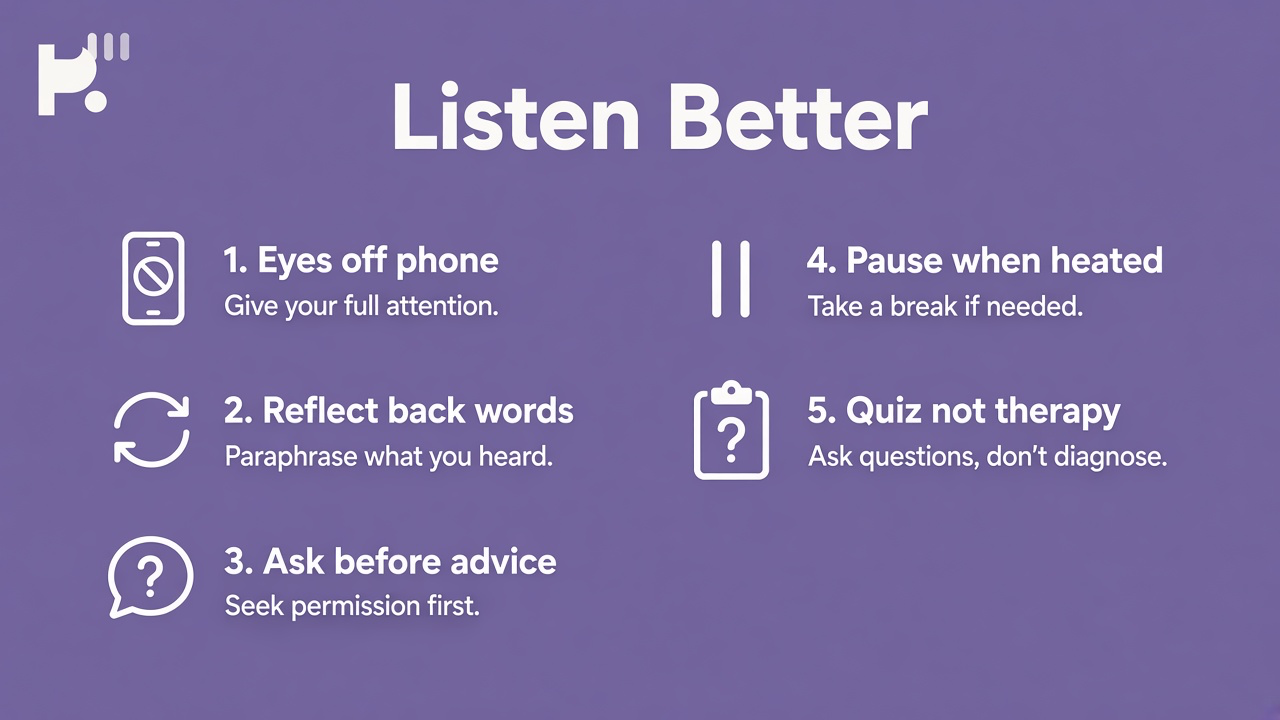
What this quiz can and cannot tell you
Can tell you
- Highlight attention, reflection, and patience habits worth revisiting before hard talks
- Separate educational reflection from partner ranking polls and fix-it cosplay
- Encourage consented skill shares without mind-reading verdict spirals
- Spark kinder conversations without claiming bars replace counselors
Cannot tell you
- Replace couples therapy, mediation, or crisis services
- Prove you may diagnose partners or exes from agree totals
- Read minds or predict what someone meant from bar height
- Rank who is the worse listener in your friend group from one session
Why listening talk needs attention habits, reflection, patience, and therapy separation
Relationship feeds sell fix-it scripts while partners still need mirrors more than monologues. Literacy reflection helps when readers put phones down, paraphrase feelings, and resist ranking threads. It hurts when couch scores become licenses to post partner listening scoreboards.
Dr. Priya Sharma reviews relationship screeners with a split between honest presence habits and honest refusal of therapy substitution. Attention items track devices and tone. Reflection items track advise-after-mirror norms. Patience items track sitting with discomfort. Limit items keep screeners separate from licensed-care cosplay.
Reverse items catch interrupting, mind-reading diagnosis, and skip-counseling myths that should not inflate bars meant to track respectful listening habits.
Pair results with siblings instead of forcing one communication story. Our love language test sibling explores preference language with separate stems. Our relationship quiz page stays on broader partnership habits rather than listening depth here. Browse the relationships and dating hub for more screeners. Caption shares as practice warm-up and skip sentencing partners who never asked for a quiz.
| Test | Focus |
|---|---|
| Love language test | Communication preference language rather than active listening depth here |
| Relationship quiz | Broader partnership habits rather than reflect-before-advise caps on this page |
| Relationships and dating hub | More screeners when listening themes need another lens |
How To Listen To Your Conversation Partner FAQ
What does the How To Listen To Your Conversation Partner measure?
It measures self-reported habits around full attention, reflect-before-advise, patience without fixing, and unofficial limits. You get an index from 0 to 100 plus four domain bars.
Is this a substitute for couples therapy?
No. Licensed therapists own treatment. This page stays unofficial listening habit reflection only.
Does a high score rank me above others?
No. Bars describe habits you endorsed on this screener, not moral worth, medical proof, or permission to dunk strangers online.
How is this different from the love language test?
This page emphasizes listening presence and anti-therapy-substitution limits. The love language sibling focuses on preference language with separate stems.
Who reviewed this quiz?
Dr. Priya Sharma reviewed the framing, limit language, and result explanations. See our editorial policy for review standards.
Reviewed by