What How Susceptible Are You To Stress measures
This screener does not administer Perceived Stress Scale batteries, diagnose anxiety disorders, or declare which peer is too stressed from bar height. It measures how much you agree with unofficial stress literacy grouped four ways: stress reactivity literacy about signals without weakness dunk cosplay; tension recovery pacing about rest without grind bravado; support and help-seeking about outreach when function drops; and quiz-not-clinical-diagnosis limits about inspired framing and refusing bar-height verdict polls. You rate 22 statements from strongly disagree to strongly agree, with reverse-worded traps flipped first. Your answers also feed a second chart on closeness and trust habits. The total becomes an index from 0 to 100 where higher means more reported stress literacy habits on this screener, not proof you may skip clinicians when safety is at risk.
Stress reactivity literacy
Signals not shame.
Tension recovery pacing
Rest without grind bravado.
Support and help-seeking
Ask before isolate.
Quiz not clinical diagnosis
Mirror not DSM mailer.
How it works
Answer 22 agreement items
Rate each statement from Strongly disagree to Strongly agree. Tap Next after each answer.
Answers sort into four domains
Each answer feeds one of four stress literacy groups, and every item also feeds a closeness and trust layer.
See your index and charts
You get a 0 to 100 index, a band, four domain bars, and a second chart for intimacy habits.
Take the How Susceptible Are You To Stress
Answer 22 short statements to see your stress reactivity literacy index, four domain bars, and a closeness and trust chart.
What your result means
Your index is the average of all 22 answers, scaled from 0 to 100, with reverse-worded items flipped first. Read help-seeking bars together with unofficial-limit bars before you treat a high score as clinical proof. Licensed professionals still own diagnosis and treatment when symptoms threaten safety or daily roles.
| Band | Index range | Typical reading |
|---|---|---|
| Building stress reactivity literacy | 0 to 35 | Fewer agreed habits on core domains or unofficial limit items on this stress literacy screener. |
| Mixed stress reactivity literacy | 36 to 65 | Solid habits in some domains with softer slips or limit corners elsewhere. |
| Strong stress reactivity literacy | 66 to 100 | Frequent agreement with habits and limits; still unofficial reflection only. |
Tips at a glance
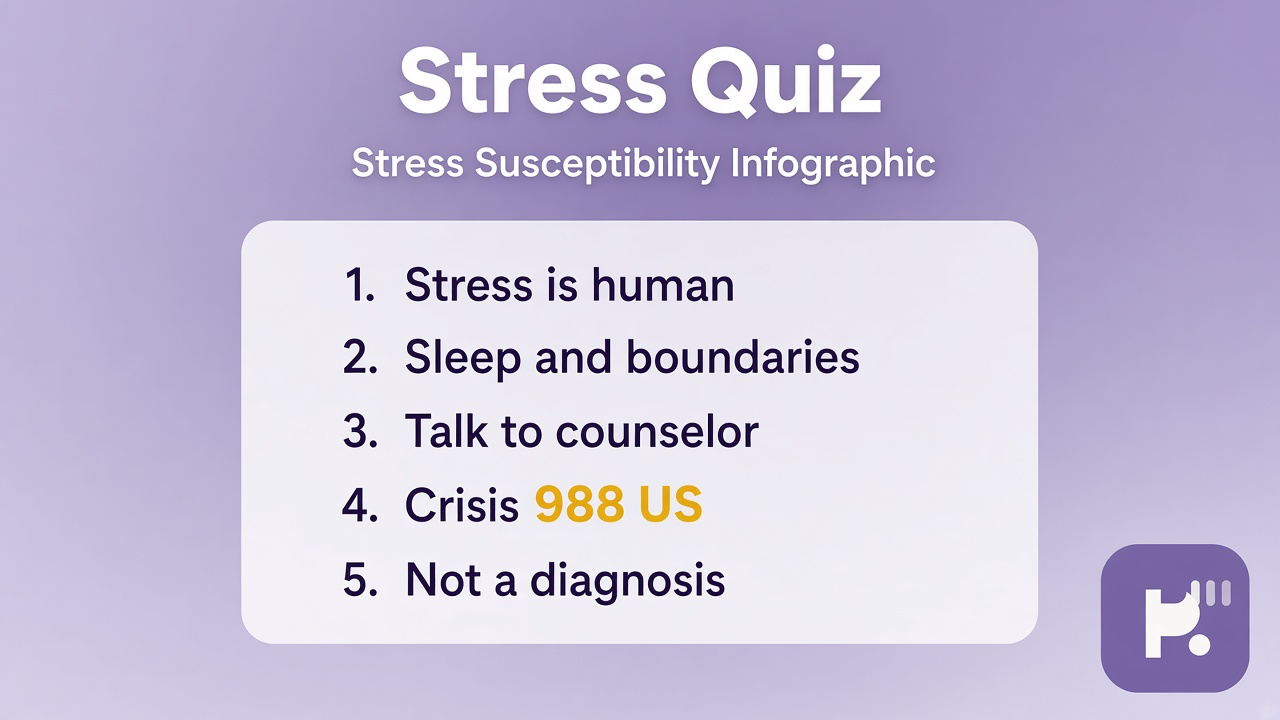
A quick takeaway graphic with topic tips (not your personal quiz scores). Start the quiz for your index, bands, and charts.
What this quiz can and cannot tell you
Can tell you
- Highlight reactivity, recovery, and help-seeking habits worth revisiting during stressful seasons
- Separate educational reflection from weakness dunk threads and public stress ranking polls
- Encourage clinician or crisis outreach without shaming named overwhelm
- Spark kinder routines without claiming bars replace formal stress batteries
Cannot tell you
- Replace therapy, medical treatment, crisis services, or mailed PSS scores
- Diagnose anxiety, PTSD, or burnout disorders from one screener
- Prove you may ignore self-harm thoughts or function collapse from bar height
- Rank coworkers or exes as too stressed from agree totals alone
Why stress susceptibility talk needs reactivity literacy, recovery pacing, help-seeking, and diagnosis separation
Stress traffic mixes honest curiosity with comment boxes that treat immunity doom memes and PSS screenshots as the same as clinical science. Literacy reflection helps when readers protect sleep, boundaries, and help-seeking without weakness dunk threads. It hurts when agree bars become licenses to run public stress ranking polls.
Dr. Priya Sharma reviews mental health screeners with a simple split: reward signal naming and reward refusal of diagnosis substitution at the same time. Reactivity items track body and mood cues without shame cosplay. Recovery items track pacing without grind bravado. Help items track outreach when function drops. Limit items keep the page separate from mailed scale cosplay.
Reverse items catch weakness dunking, skipped care from bar height, and coworker ranking myths. Those traps should not inflate bars meant to track respectful stress habits.
Pair with our drivers of mental health quiz when sleep and connection drivers need another lens. Our perceived stress scale PSS-10 sibling uses separate procedure stems, not this literacy mirror. Browse the mental health and clinical hub for more YMYL screeners.
| Test | Focus |
|---|---|
| Drivers of mental health quiz | Sleep, connection, and driver habits rather than stress reactivity lanes here |
| Perceived stress scale PSS-10 | Formal scale procedure rather than unofficial literacy caps on this page |
| Mental health and clinical hub | More YMYL screeners when stress themes need another lens |
How Susceptible Are You To Stress FAQ
What does How Susceptible Are You To Stress measure?
It measures how much you agree with statements about stress reactivity literacy, tension recovery pacing, support and help-seeking, and quiz-not-diagnosis limits. You get an index from 0 to 100 plus four bars reflecting self-rated habits on this screener.
Is this the Perceived Stress Scale or a clinical diagnosis?
No. Licensed clinicians and published scale procedures own formal assessment. This page stays unofficial literacy reflection only.
Can high bars mean I should skip therapy or crisis care?
No. Reverse items reject skip-care myths. Bars describe habits you endorsed here, not clearance to avoid follow-up when safety is at risk.
Can I use results to rank who is too stressed at work?
No. Limit items reject public verdict polls. Use results as a private habits map, not surveillance over coworkers.
Who reviewed this screener?
Dr. Priya Sharma reviewed the framing, limits language, and result explanations. See our editorial policy for review standards.
Reviewed by