What the How Do I Think Quiz measures
This quiz does not measure IQ, diagnose learning disorders, or sort classmates into smart versus slow piles. It measures how much you agree with unofficial thinking reflection statements grouped four ways: analytic step habits about logic with flexibility; intuitive creative habits about pattern play without mystic cosplay; metacognition and curiosity about noticing what you know and what you guess; and quiz-not-intelligence-verdict limits about refusing to treat bar height like Mensa clearance. You rate 22 statements from strongly disagree to strongly agree, with reverse-worded traps so agreeable mood cannot hide dunk threads. Your answers also feed a second chart on closeness and trust habits. The total becomes an index from 0 to 100 where higher means more reported reflection habits on this screener, not proof of intelligence.
Analytic step habits
Logic with flexibility.
Intuitive creative habits
Pattern play with tests.
Metacognition and curiosity
Notice your mind.
Quiz not intelligence verdict
Mirror not IQ cosplay.
How it works
Answer 22 agreement items
Rate each statement from Strongly disagree to Strongly agree. Tap Next after each answer.
Answers sort into four domains
Each answer feeds one of four thinking reflection groups, and every item also feeds a closeness and trust layer.
See your index and charts
You get a 0 to 100 index, a band, four domain bars, and a second chart for intimacy habits.
Take the How Do I Think Quiz
Answer 22 short statements to see your thinking style reflection index, four domain bars, and a closeness and trust chart.
What your result means
Your index is the average of all 22 answers, scaled from 0 to 100, with reverse-worded items flipped first. Read limit bars together with metacognition habits before you treat a high score as intelligence proof. Clinicians and educators still own formal assessment when learning or attention concerns persist.
| Band | Index range | Typical reading |
|---|---|---|
| Building thinking style reflection | 0 to 35 | Fewer agreed habits on analytic step habits, intuitive creative habits, metacognition and curiosity, and quiz-not-intelligence-verdict limits or unofficial limit items. |
| Mixed thinking style reflection | 36 to 65 | Solid habits in some domains with softer bars on limits or humility items. |
| Strong thinking style reflection | 66 to 100 | Frequent agreement with habits and limits; still unofficial reflection only. |
Tips at a glance
A quick takeaway graphic with topic tips (not your personal quiz scores). Start the quiz for your index, bands, and charts.
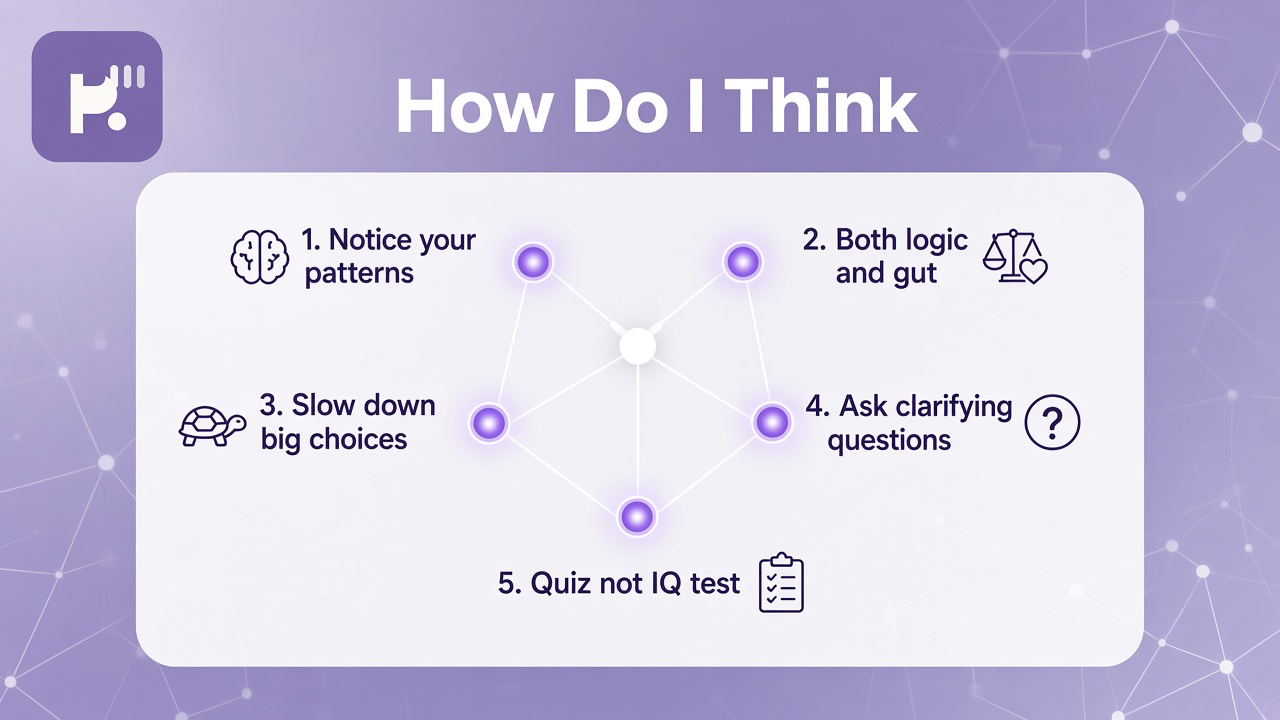
What this quiz can and cannot tell you
Can tell you
- Highlight analytic, intuitive, and metacognition habits worth revisiting during study or work
- Separate playful reflection from IQ dunk threads and class ranking cosplay
- Encourage clarifying questions without shaming confusion
- Spark better learning conversations without claiming bar height equals gifted status
Cannot tell you
- Replace neuropsych testing, school evaluations, or licensed clinical interviews
- Prove IQ, gifted status, or learning disability labels from couch bars
- Rank classmates, coworkers, or strangers as smart or dumb from one screener
- Predict grades, salaries, or life outcomes from reflection totals alone
Why thinking style quizzes need logic, intuition, metacognition, and IQ separation
Search traffic around how do I think often follows study stress and meme IQ wars, not clinic referrals. Those goals help when readers name their habits, ask better questions, and refuse to treat agree bars like intelligence verdicts. They hurt when couch scores become public dunk threads on classmates who never opted in.
Dr. James Whitfield reviews personality screeners with a simple split: reward honest curiosity about how you reason and reward refusal of IQ cosplay at the same time. Analytic items track steps without spreadsheet arrogance. Intuitive items track hunches you still test. Metacognition items track naming confusion. Limit items keep the page separate from intelligence testing myths.
Real people mix bars. You might score high on analytic habits while keeping intuitive play moderate, which often describes detail focus with growing comfort for creative leaps. Reverse items catch vibe-only certainty, memory bravado, and grading strangers from bar height.
Pair results with siblings instead of forcing one brain label story. Our definition of thinking style explores vocabulary with separate stems. Our Benziger thinking styles assessment stays on preference language rather than metacognition limits here. Our on topic thinking style sibling offers another reflection pass. Browse the personality and psychology hub for more screeners. Caption shares as private habits, not IQ scoreboards.
| Test | Focus |
|---|---|
| Definition of thinking style | Thinking style vocabulary rather than metacognition and IQ-limit lanes here |
| Benziger thinking styles assessment | Preference-style language rather than analytic-intuitive reflection stems here |
| On topic thinking style | Alternate reflection pass with distinct stems from this page |
How Do I Think Quiz FAQ
What does the How Do I Think Quiz measure?
It measures how much you agree with statements about analytic step habits, intuitive creative habits, metacognition and curiosity, and quiz-not-intelligence-verdict limits. You get an index from 0 to 100 plus four bars reflecting self-rated habits on this screener.
Is this an IQ test?
No. Limit items reject IQ cosplay. Licensed psychologists own formal intelligence testing and interpretation.
Can high bars prove I am smarter than friends?
No. Reverse items reject ranking myths. Bars describe habits you endorsed here, not permission to dunk people online.
Does this diagnose ADHD or learning disabilities?
No. Seek educators and clinicians when attention or learning concerns disrupt school or work. This page stays unofficial reflection only.
Who reviewed this quiz?
Dr. James Whitfield reviewed the personality framing, non-predictive limits, and result explanations. See our editorial policy for review standards.
Reviewed by