What the Horse Skeleton Quiz measures
This quiz does not license veterinarians, interpret radiographs, or proctor cadaver practicals from one session. It measures how much you agree with equine osteology statements grouped four ways: axial and limb bone recall; joint and ligament landmarks; equine osteology humility about calling professionals; and quiz-not-vet-lab-exam limits about refusing licensing cosplay. You rate 22 statements from strongly disagree to strongly agree, with reverse-worded traps. Your answers also feed a second chart on closeness and trust habits. The total becomes an index from 0 to 100 where higher means more reported skeleton literacy on this screener, not proof you should skip imaging or clinical exams. Stems stay osteology rather than horse-parts external labeling on this hub.
Axial and limb bone recall
Skull, spine, ribs, limb sequences.
Joint and ligament landmarks
Stifle, hock, fetlock vocabulary.
Equine osteology humility
Study without web lameness verdicts.
Quiz not vet lab exam
Warm-up not licensing clearance.
How it works
Answer 22 agreement items
Rate each statement from Strongly disagree to Strongly agree. Tap Next after each answer.
Answers sort into four domains
Each answer feeds one of four horse skeleton study groups, and every item also feeds a closeness and trust layer.
See your index and charts
You get a 0 to 100 index, a band, four domain bars, and a second chart for intimacy habits.
Take the Horse Skeleton Quiz
Answer 22 short statements to see your horse skeleton study literacy index, four domain bars, and a closeness and trust chart.
What your result means
Your index is the average of all 22 answers, scaled from 0 to 100, with reverse-worded items flipped first. Read lab-limit bars together with osteology humility before you treat a high score as licensing authority. Veterinarians and instructors still own clinical interpretation and practical rubrics.
| Band | Index range | Typical reading |
|---|---|---|
| Building horse skeleton literacy | 0 to 35 | Fewer agreed habits on axial limb recall, joint landmarks, humility, or lab-limit items. |
| Mixed horse skeleton literacy | 36 to 65 | Solid skull and limb recall with joint slips, imaging cosplay, or lab substitution myths. |
| Strong horse skeleton literacy | 66 to 100 | Frequent agreement with bone recall, joints, humility, and lab limits; still study warm-up only. |
Tips at a glance
A quick takeaway graphic with topic tips (not your personal quiz scores). Start the quiz for your index, bands, and charts.
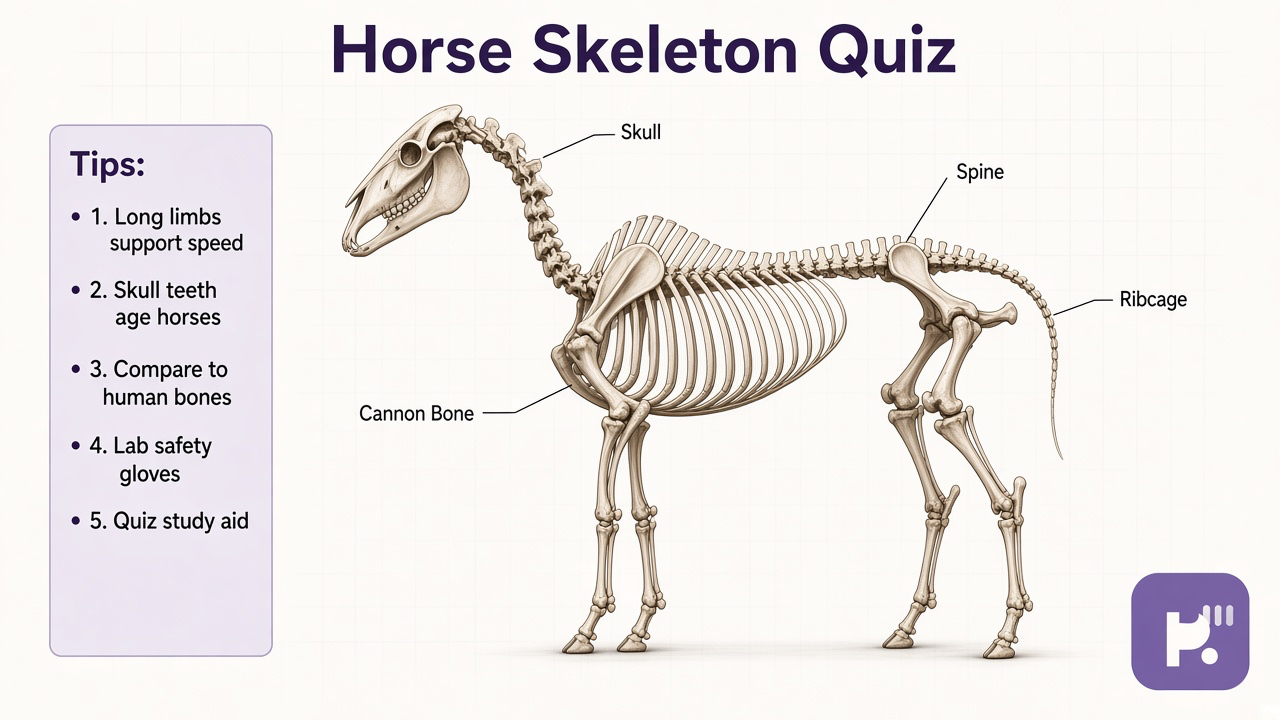
What this quiz can and cannot tell you
Can tell you
- Highlight axial, limb, and joint labeling habits worth revisiting before labs
- Separate playful osteology from licensing substitution myths and comment-section triage
- Encourage diagram humility without shame spirals about one mislabeled scapula
- Spark better anatomy questions without claiming veterinary authority
Cannot tell you
- Replace cadaver practicals, veterinary licensing exams, or radiology training
- Prove lameness diagnosis or imaging interpretation from one couch screener
- Give permission to skip clinicians when horses show sustained lameness
- Predict lab grades from literacy bars alone
Why horse skeleton quizzes need bone recall, joint literacy, osteology humility, and licensing separation
Students search horse skeleton labeling when an equine unit hands them an unmarked bone set and every long bone looks equally femur-shaped. Osteology mixes axial regions, forelimb versus hindlimb sequences, and joint vocabulary, so instructors expect partition order instead of one lazy label. Treating couch bars like lameness triage is the trap this screener flags on purpose.
Dr. James Whitfield reviews anatomy study screeners with a split: reward honest bone agreement and honest limits on licensing substitution myths. Axial and limb recall tracks skull-to-cannon order. Joint landmarks tracks stifle and hock language. Osteology humility keeps study pointed at professionals. Quiz-not-vet-lab limits keep screeners separate from licensing fantasies.
Real anatomy students mix bars. You might score high on skull recall while keeping joint landmarks moderate, which often describes strong axial memory yet occasional stifle blur. Reverse items catch imaging cosplay and lab waiver fantasies.
Pair results with siblings instead of forcing one clinician hero story. Our horse parts quiz focuses on external labels with separate stems rather than osteology depth here. Our horse quiz covers general care literacy rather than bone charts on this page. Our anatomy quiz widens whole-body habits when equine night needs less overlap. Browse the IQ and cognitive hub for more study screeners.
Lab calendars and joint memes rotate faster than instructor bone lists in group chat. Retake after one labeled diagram session and watch whether lab-limit bars stay high under cram hype.
| Test | Focus |
|---|---|
| Horse parts quiz | External anatomy labels rather than osteology depth on this page |
| Horse quiz | General horse care literacy rather than skeleton charts here |
| Anatomy quiz | Whole-body anatomy rather than equine osteology focus on this screener |
Horse Skeleton Quiz FAQ
What does the Horse Skeleton Quiz measure?
It measures how much you agree with statements about axial and limb bones, joint landmarks, osteology humility, and quiz-not-lab limits. You get an index from 0 to 100 plus four bars. It reflects self-rated study habits on this screener, not a licensing score.
Is this the same as the horse parts quiz?
No. The parts sibling focuses on external labeling. This page focuses on bones, joints, and osteology with distinct stems.
Can high scores diagnose lameness?
No. Limit items reject triage cosplay. Licensed clinicians and imaging still own lameness workups.
Who reviewed this quiz?
Dr. James Whitfield reviewed the educational framing and unofficial limits. See our editorial policy for review standards.
Reviewed by