
What the Homeschool Style Quiz measures
This quiz does not decide school placement, certify teaching licenses, or reward parent dunk threads from one session. It measures how much you agree with unofficial homeschool style statements grouped four ways: rhythm and routine habits about flexible schedules instead of burnout timetables; curriculum curiosity about resource trials and pacing adjustments instead of brand wars; social and support kindness about play and caregiver respite without shaming different learners; and quiz-not-school-verdict limits about family reflection versus ranking cosplay. You rate 22 statements from strongly disagree to strongly agree, with reverse-worded traps so one haul week cannot hide shame items. Your answers also feed a second chart on closeness and trust habits. The total becomes an index from 0 to 100 where higher means more reported reflective habits on this screener, not proof your family chose the only valid path.
Rhythm and routine habits
Flexible weeks, real breaks.
Curriculum curiosity
Try resources, adjust pace.
Social and support kindness
Play and caregiver respite.
Quiz not school verdict
Mirror; no family dunk threads.
How it works
Answer 22 agreement items
Rate each statement from Strongly disagree to Strongly agree. Tap Next after each answer.
Answers sort into four domains
Each answer feeds one of four homeschool style reflection groups, and every item also feeds a closeness and trust layer.
See your index and charts
You get a 0 to 100 index, a band, four domain bars, and a second chart for intimacy habits.
Take the Homeschool Style Quiz
Answer 22 short statements to see your homeschool style reflection index, four domain bars, and a closeness and trust chart.
What your result means
Your index is the average of all 22 answers, scaled from 0 to 100, with reverse-worded items flipped first. Read rhythm bars together with unofficial-limit bars before you treat a high score as authority to shame other parents. Educators and clinicians still matter when learning struggles persist.
| Band | Index range | Typical reading |
|---|---|---|
| Building homeschool style literacy | 0 to 35 | Fewer agreed habits on rhythms, curriculum curiosity, or social kindness or unofficial limit items. |
| Mixed homeschool style literacy | 36 to 65 | Solid curiosity with softer bars on manners, sources, or unofficial limit corners. |
| Strong homeschool style literacy | 66 to 100 | Frequent agreement with study or play habits and limits; still unofficial reflection only. |
Tips at a glance
A quick takeaway graphic with topic tips (not your personal quiz scores). Start the quiz for your index, bands, and charts.
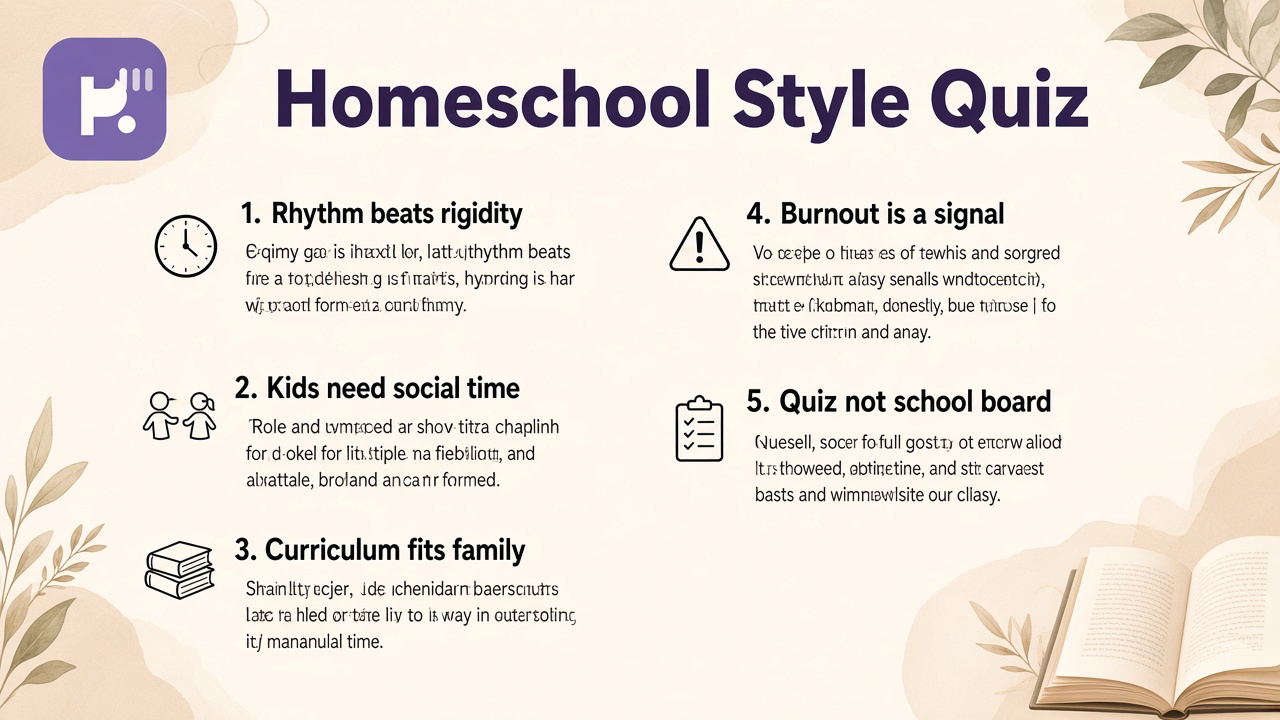
What this quiz can and cannot tell you
Can tell you
- Highlight rhythm and curriculum habits worth trying during your next term
- Separate family reflection from school-choice dunk threads
- Encourage social play and caregiver breaks without ranking kids
- Spark better co-op conversations without claiming placement proof
Cannot tell you
- Replace licensed educators, evaluators, school districts, or clinicians when needs persist
- Prove you may shame other families, force burnout schedules, or rank kids from bar height
- Substitute for mandated assessments or professional learning evaluations
- Declare school-choice superiority from literacy bars alone
Why homeschool style screeners need rhythms, curiosity, and anti-verdict limits
Search traffic around homeschool style quizzes often follows curriculum haul season while feeds reward school-choice dunk threads as if both were placement credentials. Those goals help when caregivers build flexible rhythms, try resources, and plan social play kindly. They hurt when literacy bars become proof someone may rank neighbors kids online.
Dr. Sarah Chen reviews parenting reflection screeners with a respect-first split: reward honest rhythm experiments and honest refusal of verdict cosplay at the same time. Curriculum curiosity tracks pacing adjustments without brand wars. Social kindness tracks play and respite without mocking brick-school families. Unofficial limits track private reflection, not court winners.
Real families mix bars. You might score high on curiosity while keeping rhythm habits moderate, which often describes new homeschool years with sick seasons. Reverse items catch overconfidence: viral timetables, public roasts, or one-workbook flexes should not inflate bars meant to track supportive habits.
Pair results with siblings instead of forcing one forever curriculum story. Our parenting style quiz explores broader caregiver reflection when discipline stems fit better than rhythm lanes here. Our your preferred learning style sibling angles toward kid preference language rather than homeschool verdict limits on this page. Our personality and psychology hub lists more reflection screeners. Caption shares as private notes, cite resources, and skip ranking families who never opted in.
| Test | Focus |
|---|---|
| Parenting style quiz | Broader caregiver reflection rather than homeschool rhythm stems here |
| Your preferred learning style | Kid preference language rather than school-verdict limits on this screener |
| Personality and psychology hub | More reflection screeners when homeschool stems need a sibling pass |
Homeschool Style Quiz FAQ
What does the Homeschool Style Quiz measure?
It measures how much you agree with statements about rhythm habits, curriculum curiosity, social kindness, and quiz-not-school-verdict limits. You get an index from 0 to 100 plus four bars reflecting self-rated habits on this screener.
Does this quiz decide if we should homeschool or enroll in school?
No. It reflects habits and attitudes, not placement algorithms. Talk with educators and your family for real school choices.
Can a high score justify shaming other parents school choices online?
No. Reverse items reject dunk threads and kid-ranking polls. Bars describe habits you endorsed here, not verdict credibility.
How is this different from the parenting style quiz?
This page emphasizes homeschool rhythms, curriculum curiosity, and school-verdict limits. The parenting sibling uses broader caregiver stems.
Who reviewed this quiz?
Dr. Sarah Chen reviewed the reflection framing, kindness language, and result explanations. See our editorial policy for review standards.
Reviewed by
