What the Hierarchy Of Life Values measures
This quiz does not certify moral superiority, assign personality disorders, or prove one priority list fits every adult. It measures how much you agree with unofficial values hierarchy reflection statements grouped four ways: priority clarity habits about naming what matters now; tradeoff humility between values about competing goods without panic; alignment between values and choices about calendar honesty; and quiz-not-moral-score limits about playful captions and refusing to treat bar height as shame license. You rate 22 statements from strongly disagree to strongly agree, with reverse-worded traps so perfection myths cannot inflate every bar. Your answers also feed a second chart on closeness and trust habits, because values comparison sometimes pushes withdrawal when ranking feels unsafe. The total becomes an index from 0 to 100 where higher means more reported values reflection habits on this screener, not proof your list is universally correct.
Priority clarity
Name what matters now.
Tradeoff humility
Competing goods calmly.
Values alignment
Calendar matches claims.
Quiz not moral score
Reflection; ranking elsewhere.
How it works
Answer 22 agreement items
Rate each statement from Strongly disagree to Strongly agree. Tap Next after each answer.
Answers sort into four domains
Each answer feeds one of four life values reflection groups, and every item also feeds a closeness and trust layer.
See your index and charts
You get a 0 to 100 index, a band, four domain bars, and a second chart for intimacy habits.
Take the Hierarchy Of Life Values
Answer 22 short statements to see your life values hierarchy reflection index, four domain bars, and a closeness and trust chart.
What your result means
Your index is the average of all 22 answers, scaled from 0 to 100, with reverse-worded items flipped first. Read unofficial moral-limit bars together with tradeoff humility before you treat a high score as moral authority. Cozy reflection supports kinder choices; clinicians still own clinical tools.
| Band | Index range | Typical reading |
|---|---|---|
| Building values reflection habits | 0 to 35 | Fewer agreed habits on priority clarity, tradeoff humility, alignment, or moral-scoreboard limit items. |
| Mixed values reflection habits | 36 to 65 | Solid awareness with tradeoff slips, alignment gaps, or moral-scoreboard corners. |
| Strong values reflection habits | 66 to 100 | Frequent agreement with clarity, tradeoffs, alignment, and unofficial limits; still reflection only. |
Tips at a glance
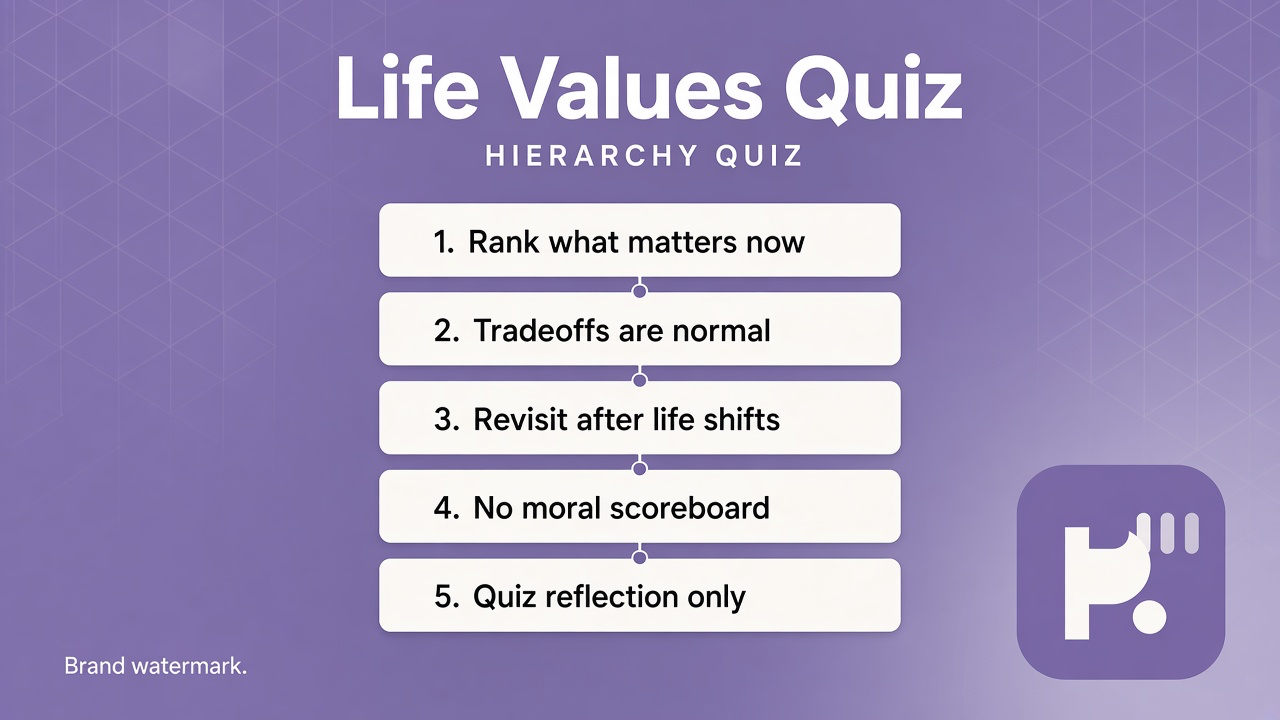
A quick takeaway graphic with topic tips (not your personal quiz scores). Start the quiz for your index, bands, and charts.
What this quiz can and cannot tell you
Can tell you
- Highlight priority clarity and tradeoff habits worth revisiting during transitions
- Separate playful reflection from moral scoreboard myths and diagnosis cosplay
- Encourage calendar alignment checks without shame spirals about imperfection
- Spark better conversations about values without claiming universal rank proof
Cannot tell you
- Diagnose moral development stage or personality disorders from agree bars
- Prove your priorities are objectively superior to friends or strangers
- Give permission to shame, harass, or exile lower scorers from bar height
- Replace therapists, coaches, or mediators when values conflicts involve safety
Why life values reflection needs clarity, tradeoff humility, alignment, and moral-score separation
Search traffic around hierarchy of life values quizzes usually wants a mirror after big decisions, relationship talks, or career pivots, not a moral scoreboard or proof that one priority list is the only adult path. Those goals help when readers name tradeoffs, adjust calendars gently, and keep reflection consensual. They hurt when couch bars become dunk threads, or when perfection cosplay convinces someone they must never feel torn between two good values.
Dr. Priya Sharma reviews personality screeners with a simple split: reward honest values language and honest refusal of moral scoreboard and diagnosis myths at the same time. Priority clarity habits tracks naming what matters without buzzword fog. Tradeoff humility tracks competing goods without panic. Alignment tracks small daily votes instead of aesthetic cosplay. Quiz-not-moral-score limits keep screeners separate from shame threads and harassment bait.
Real adults mix bars. You might score high clarity with moderate alignment, which often describes strong stated values with busy calendar drift. You might score high reflection with softer limit items, which can mean you avoid public posts yet still treat quiz totals like moral certification online. Reverse items catch overconfidence: perfection myths, dunk rights, or honesty-as-overshare should not inflate bars meant to track layered reflection habits.
Pair results with siblings instead of forcing one forever-main story. Our assessment of attitudes toward life values sibling stays on separate inventory stems rather than hierarchy reflection manners here. Our axiological orientation of personality explores value orientation language when study vocabulary fits better than ranking reflection on this page. Our basic beliefs scale angles core belief habits rather than priority tradeoff lanes here. Browse the personality and psychology hub for more unofficial screeners. Caption shares as reflection play and skip ranking strangers who never asked.
Season changes and job shifts rotate faster than identity essays. An alignment bar might dip during crunch season while clarity stays high until you retake calmly. When you share results, say unofficial life values reflection habits. Retake after one honest quarter and watch whether moral-limit bars stay high even if ambition rises.
| Test | Focus |
|---|---|
| Assessment of attitudes toward life values | Separate inventory stems rather than hierarchy reflection manners on this screener |
| Axiological orientation of personality | Value orientation study rather than tradeoff humility lanes here |
| Basic beliefs scale WAS | Core belief habits rather than life priority ranking reflection on this page |
Hierarchy Of Life Values FAQ
What does the Hierarchy Of Life Values measure?
It measures how much you agree with statements about priority clarity, tradeoff humility, values alignment, and quiz-not-moral-score limits. You get an index from 0 to 100 plus four bars. It reflects self-rated reflection habits on this screener, not universal moral truth.
Is this the same as the assessment of attitudes toward life values test?
No. This page centers hierarchy reflection and tradeoff manners. The assessment sibling uses separate inventory stems rather than ranking reflection lanes here.
Can high scores prove my priorities are morally superior?
No. Limit items reject moral scoreboard myths. High bars describe habits you endorsed here, not permission to shame others.
Does this diagnose personality or moral disorders?
No. This is informal reflection, not a clinical instrument. Licensed clinicians use separate validated tools.
Who reviewed this quiz?
Dr. Priya Sharma reviewed the personality framing, tradeoff tone, and result explanations. See our editorial policy for review standards.
Reviewed by