What the Workplace Love Language Quiz measures
This quiz does not certify HR credentials, deliver Gottman method training, or test whether you fit a trademarked five-language model from a book cover alone. It measures how much you agree with unofficial workplace appreciation statements grouped four ways: verbal recognition habits; reliable support and load balance without martyrdom; respect and boundary literacy about consent at work; and quiz-not-licensed-love-language limits about refusing to treat couch bars as clinical or hiring authority. You rate 22 statements from strongly disagree to strongly agree, with reverse-worded traps. Your answers also feed a second chart on closeness and trust habits, because team comparison sometimes mirrors attachment stress. Item banks stay separate from love-language-quiz romantic care stems on this hub.
Verbal recognition at work
Specific thanks without gossip bait.
Reliable support and load balance
Help with time boxes; no hero myths.
Respect and boundary literacy
Care with consent after hours.
Quiz not licensed love language
Unofficial mirror; HR elsewhere.
How it works
Answer 22 agreement items
Rate each statement from Strongly disagree to Strongly agree. Tap Next after each answer.
Answers sort into four domains
Each answer feeds one of four workplace appreciation groups, and every item also feeds a closeness and trust layer.
See your index and charts
You get a 0 to 100 index, a band, four domain bars, and a second chart for intimacy habits.
Take the Workplace Love Language Quiz
Answer 22 short statements to see your workplace appreciation literacy index, four domain bars, and a closeness and trust chart.
What your result means
Your index is the average of all 22 answers, scaled from 0 to 100, with reverse-worded items flipped first. Read unofficial limit bars together with boundary habits before you treat a high score as teamwork authority or share coworker labels.
| Band | Index range | Typical reading |
|---|---|---|
| Building workplace appreciation literacy | 0 to 35 | Fewer agreed habits on recognition, load balance, boundaries, or unofficial-limit items. |
| Mixed workplace appreciation literacy | 36 to 65 | Solid care language with martyrdom slips, ranking corners, or licensed-product substitution myths. |
| Strong workplace appreciation literacy | 66 to 100 | Frequent agreement with recognition, load balance, boundaries, and limits; still unofficial reflection only. |
Tips at a glance
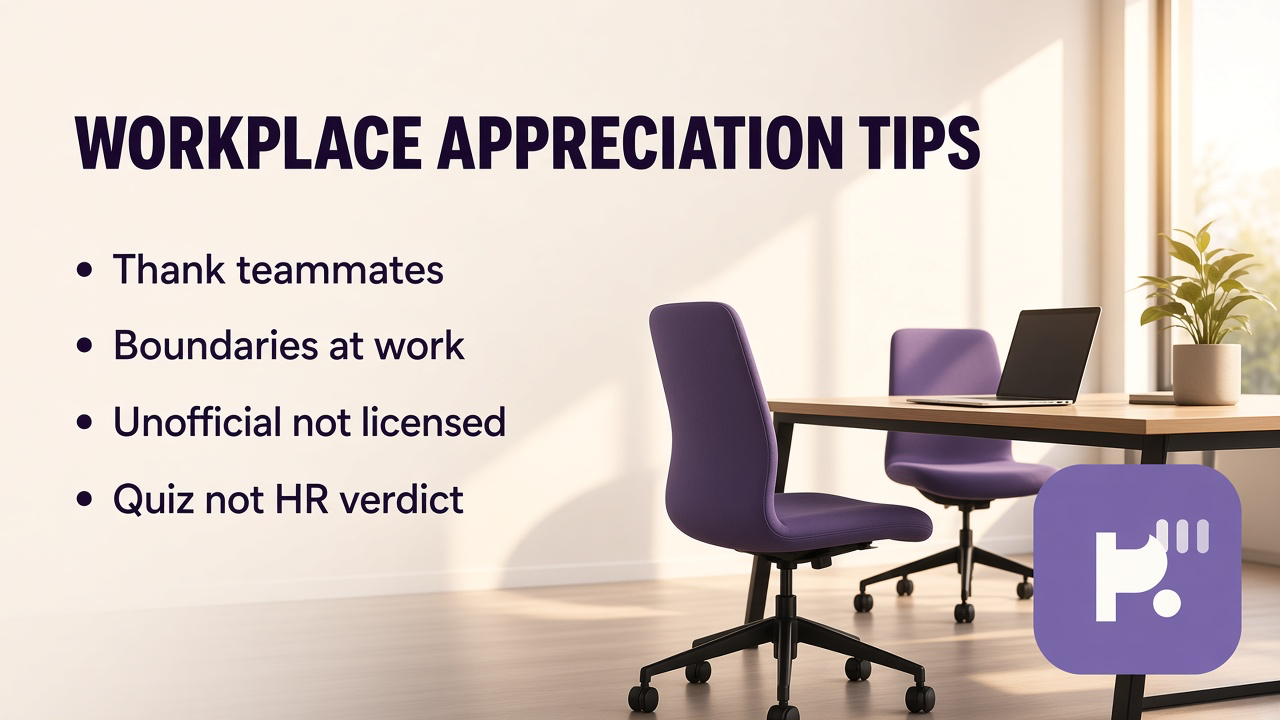
A quick takeaway graphic with topic tips (not your personal quiz scores). Start the quiz for your index, bands, and charts.
What this quiz can and cannot tell you
Can tell you
- Highlight appreciation and boundary habits worth revisiting before team conflict threads
- Separate playful reflection from Gottman or trademark substitution myths
- Encourage specific thanks and load-balance talks without shame spirals
- Spark better one-on-ones about care preferences without claiming clinical authority
Cannot tell you
- Replace HR investigations, unions, mediation, or licensed therapy
- Prove promotion worth or moral superiority from one agree screener
- Give permission to rank, label, or gossip about coworkers from bar height
- Deliver Gottman-certified interventions or trademarked love-language scores
Why workplace love language quizzes need recognition habits, load balance, boundaries, and licensed-product separation
Search traffic around workplace love language quizzes usually wants quick team-building language after tense quarters, onboarding icebreakers, or friend chats that need appreciation vocabulary, not HR stickers or public coworker verdicts. Those goals help when readers name specific thanks, balance load, and keep agree bars away from Gottman or trademark cosplay. They hurt when couch scores become proof you may rank teammates online or treat unofficial screeners like promotion files. Workplace care reflection works best when it pairs everyday appreciation language with unofficial limits while staying distinct from love-language-quiz romantic siblings.
Dr. Priya Sharma reviews relationship screeners with a simple split: reward honest care-habit agreement and honest limits on credential substitution myths at the same time. Verbal recognition tracks specific thanks without gossip bait. Reliable support tracks help with time boxes instead of martyrdom. Respect and boundary literacy tracks consent after hours and at events. Quiz-not-licensed-love-language limits keep screeners separate from trademark ads and HR dunk bait.
Real teammates mix bars. You might score high on verbal thanks while keeping boundary literacy moderate, which often describes enthusiastic cheerleaders who still ping after hours. Reverse items catch overconfidence: ranking rights myths, martyrdom excuses, or Gottman hire fantasies should not inflate bars meant to track layered workplace manners.
Pair results with siblings instead of forcing one forever-main care story. Our love language quiz sibling explores romantic care lanes rather than workplace stems here. Our do you know yourself and your workplace quiz covers broader self-awareness at work with separate banks. Browse the relationships and dating hub for more unofficial relationship screeners. Caption shares as reflection play, skip ranking coworkers, and escalate serious harm through proper channels.
Reorgs and hybrid schedules move faster than team norm conversations. When you share results, say unofficial workplace appreciation habits. Retake after one calmer work month and watch whether licensed-product limit bars stay high even if enthusiasm rises.
| Test | Focus |
|---|---|
| Love language quiz | Romantic care habits rather than workplace appreciation stems on this page |
| Do you know yourself and your workplace quiz | Broader workplace self-awareness rather than appreciation language here |
| Relationships and dating hub | More unofficial relationship screeners rather than this workplace lane alone |
Workplace Love Language Quiz FAQ
What does the Workplace Love Language Quiz measure?
It measures how much you agree with statements about verbal recognition, reliable support, boundary literacy, and unofficial limits at work. You get an index from 0 to 100 plus four bars. It reflects self-rated habits on this screener, not a Gottman or trademarked assessment score.
Is this a Gottman or trademarked love language product?
No. We are not affiliated with The Gottman Institute, Gary Chapman, or publishers of trademarked love-language instruments. This page offers informal workplace reflection inspired by everyday care language.
Why is the URL hat-s-your-workplace-love-language-quiz?
The slug matches our test topic registry spelling. The on-page title uses plain Workplace Love Language Quiz language while keeping that exact path for queue consistency.
Can I use results to rank or label coworkers?
No. Limit items reject ranking myths. High bars describe habits you endorsed here, not permission to gossip or diagnose teammates.
Who reviewed this quiz?
Dr. Priya Sharma reviewed the relationship framing, workplace boundary tone, and result explanations. See our editorial policy for review standards.
Reviewed by